

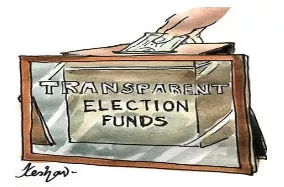
The devil is in the fine print
Electoral reforms announced in the Budget are not what they are claimed to be — they will neither cleanse our politics nor bring transparenc. Given his interest in cricket, this must be called Finance Minister Arun Jaitley’s ‘doosra’. His announcement on electoral reforms in his Budget speech combined an element of surprise, some degree of deception and a sleight (कौशल/चालाकी) of hand — all that go into a doosra in cricket. It is a mark of his deftness (कुशलता/ निपुणता) that his delivery foxed many a seasoned player. Initial reactions to Mr. Jaitley’s announcement ranged from gushing to lukewarm approval. Breathless TV anchors announced it as a historic act of cleansing our polity, just as Mr. Jaitley would have us believe. More sober commentators saw it as a significant though inadequate step forward in the right direction. Even the sceptics felt that the Finance Minister had at least put the issue of political funding on the table. Everyone thought the ball was headed in the right direction. It took a while for democratic reform and right to information activists to find out that this was the wrong one. The fine print of the Finance Bill showed that Mr. Jaitley’s proposals for bringing ‘transparency and accountability’ would achieve exactly the opposite. Ranging from redundant to sinister (बेईमान/ कपटी), these proposals would rob the system of whatever little transparency and accountability that it has today. Worse, they draw national attention away from a series of electoral funding reforms that the Election Commission and democratic reform activists have been asking for a long time. All the four elements This might sound like the usual oppositional and alarmist reaction. So, let us carefully unpack each of the four elements of the scheme announced by the Finance Minister to “cleanse the system of funding of political parties”. First, he claimed to follow the Election Commission in proposing a ceiling of Rs. 2,000 on the amount of cash donation that a political party can receive from one person in a year. Second, he announced that political parties would be “entitled to receive” donations by cheque or digital mode from their donors. Third, he proposed a new scheme of Electoral Bonds. Fourth, he said that every political party would have to file its Income Tax return within the prescribed time limit in order to enjoy exemption from payment of income tax. He insisted that this scheme will bring about “greater transparency and accountability in political funding, while preventing future generation of black money”. Now, the second and the fourth components of this scheme are redundant, as these are no different from what the existing law provides for. It does not require a new law to say that political parties are “entitled” to receive donations by cheque or digitally. They were always entitled to this and were already doing so. We needed a new law to mandate that the parties would be “required” to receive donations by cheque or digitally. The Finance Minister did not propose any such thing. Similarly, the existing law requires political parties to file their income tax returns to enjoy tax exemption. The Finance Bill now proposes a new proviso in Section 13A clause (d) of the Income Tax Act 1961 that explicitly says that the return should be filed within the stipulated time limit. So far, all major parties have routinely flouted (उपेक्षा करना/ अवज्ञा करना) this requirement. Big national parties file their return months after the due date and many parties don’t file the return at all. No one gets penalised for this non-compliance. The government really did not need this amendment if it had the will to enforce the existing law. Limiting cash donations The proposal about limiting cash donations to Rs. 2,000 has been widely misunderstood and therefore welcomed as a first step in the right direction. Everyone was foxed into believing that the limit for anonymous (बेनाम) donations, contributions that are exempt from reporting, has been reduced from the existing Rs. 20,000 to Rs. 2,000. That is what the Election Commission (EC) had asked for in its revised compendium (सारांश/संक्षेप) of Proposed Electoral Reforms in December 2016. The Finance Minister’s speech claimed to follow the EC’s advice. The Finance Bill reveals something different. The existing limit of Rs. 20,000 on anonymous donation as per Section 23 of the Representation of the People Act (RPA) has been left untouched. The Minister has merely proposed a new, additional, clause that limits cash donation from one source to Rs. 2,000 in one year. Notice that there was and is no requirement to disclose a contribution by cheque or digital transfer up to Rs. 20,000. There was and is no limit to how much a party can receive from anonymous donations. More importantly, there was and is no limit to how much overall a party can receive in cash from all sources put together. Following the Law Commission’s recommendations, the EC had proposed that no party should be allowed to receive more than Rs. 20 crore or 20% of its overall donations from anonymous sources. The Minister did not pay heed to this. This proposal is unlikely to make any difference to the business as usual for political parties. The fact is that most political funds remain in the pockets of party leaders. A small amount enters the coffers (कोष) of the party and becomes party funds. A tiny fraction of party funds is placed in the bank accounts of the party to meet some expenses that cannot remain invisible. The figures widely discussed in the media relate to that tiny fraction of party funds, which is a small proportion of political funds. Most of this is not voluntary (स्वयंसेवी/ऐच्छिक) contribution or donation. Much of what political parties show as donations is black money generated by party leaders which is turned into white money by way of book. entries as donations to the party. So far, the accountant who had to covert (गुप्त/अप्रकट) , say, Rs. 100 crore had to make sure than the entire amount was broken down into entries of Rs. 20,000 or below. Now they will absorb the same amount by breaking it down into entries of Rs. 2,000 or below. All that the proposed law would ensure is more book entries and perhaps a higher fee for the accountant. Otherwise, it would be business as usual. Trouble with electoral bonds Still, one can say that this change would do no harm. But that is not the case with the new proposal of Electoral Bonds. Although the detailed rules are yet to be framed, the basic outline of the scheme is clear. Anyone who wants to donate to a political party would be able to purchase bonds from authorised banks. This purchase will have to be in ‘white money’ against cheque and digital payments only. Once purchased, these bonds will be like bearer bonds and will not contain the name of the eventual beneficiary. These bonds shall be redeemable (प्रतिदेय) only in the designated account of a registered political party within a prescribed period. So, the donor’s bank would know about who bought how much of Electoral Bonds, but not the name of the party which received it. The party’s bank would know the amount deposited through Bonds, but not the identity of the donor. The Income Tax authorities and the EC would not know anything: reporting of donor, beneficiary, or even the amount of contribution has been exempted by amending the Income Tax Act Section 13A (b) and the RPA, Section 29C. The net effect, and indeed the purpose, of the Bonds will be that no one except the fund giver and the fund receiver would know about this exchange done in white money with full tax exemption. Let us think of a classic quid pro quo (प्रतिदान/बदले में). A government favours a business house in a mining or spectrum or oil deal to the tune of Rs. 5,000 crore. Both of them have a fifty-fifty deal. Under the existing arrangement, the business house would have to either declare in its balance sheet a ‘donation’ of Rs. 2,500 crore to the ruling party, or find that much cash to secretly hand over to the party bosses. If the payment is in white, the party will have to declare the amount and the name of the company to the Income Tax authorities and to the EC. Now, the company could simply purchase Election Bonds worth Rs. 2,500 crore and hand it over to the party. The company’s balance sheet will show “purchase of Election Bonds” with no name of the beneficiary, while it enjoys 100% tax deduction on that amount. The party will simply deposit the money in its account, with no obligation to report anything to the IT authorities or to the EC. It may well report an innocuous (अहानिकर) amount of, say, Rs. 3.8 crore as its annual reportable income! So much for transparency! Once introduced, these bonds will mask whatever little transparency exists in the current system. Instead of the usual practice of converting black money into white, these bonds will push white money into a grey, if not black, trail. Indeed, the black money in politics might go down, as the white money has been provided a perfect cover of secrecy. Why would anyone give any money to a political party through cheque or digital payment and face all the hassle (परेशानी) of disclosure?Arun Jaitley’s doosra is a great leap backwards in the history of election funding reforms.Sleight (noun)
The use of dexterity or cunning, especially so as to deceive/ the manipulation of cunning or skill, particularly as a means of deception. कौशल/चालाकी
Synonyms: Artifice, Cunning, Deception, Hoax, Stratagem
Example: The card cheat used a sleight of hand trick to ensure he won the biggest pot of the night.
Deftness (noun)
Skillful performance or ability without difficulty. कुशलता/ निपुणता
Synonyms: Adeptness, Adroitness, Litheness, Skill, Skillfulness, Sleight, Dexterousness
Example: He proved his deftness by showing a trick that no one could identify.
Sinister (adjective)
Giving the impression that something harmful or evil is happening or will happen. बेईमान/ कपटी/ भयानक/ अशुभ
Synonyms: Ominous, Baleful, Frightening, Eerie
Example: The outspoken minister was quick to speak out against any book he considered to be sinister.
Flout (verb)
To intentionally disobey (a law, rule, convention) उपेक्षा करना/ अवज्ञा करना
Synonyms: Defy, Disregard, Repudiate, Disobey
Example: People find themselves in trouble because they think they’re clever enough to flout the law without getting caught.
Anonymous (adjective)
Not known or lacking marked individuality. बेनाम
Synonyms: Unnamed, Of Unknown Name, Nameless, Incognito, Unidentified, Unknown, Unspecified, Unacknowledged
Example: The donor requested to remain anonymous so that others wouldn’t bother him for money.
Compendium (noun)
A collection of concise but detailed information about a particular subject, सारांश/संक्षेप
Synonyms: Abstract, Brief, Conspectus, Digest, Epitome, Essence
Example: The book is nothing more than a compendium of the author’s rants against the government.
Coffers (noun)
A strongbox or small chest for holding valuables. कोष
Synonyms: Strongbox, Money Box, Cash Box, Money Chest, Treasure Chest, Casket
Example: Just one lawsuit can empty a firm's coffers and cripple its reputation.
Voluntary (adjective)
Done, given, or acting of one's own free will. स्वैच्छिक/स्वेच्छा से
Synonyms: Free, Autonomous, Discretional, Willful
Example: We need a couple of people to help us clean up the gymnasium after the party. Are there any volunteers?
Covert (adjective)
Not openly acknowledged or displayed गुप्त/अप्रकट
Synonyms: Hidden, Concealed, Secret, Disguised, Clandestine
Example: The criminals usually do their covert deeds at night when they are less likely to be discovered.
Redeemable (adjective)
Recoverable upon payment or fulfilling a condition/ able to be recovered or saved from faults or bad aspects. प्रतिदेय
Synonyms: Corrigible, Curable, Emendable, Recoverable, Restorable
Example: I can’t wait to redeem my loan, so I can free myself of debt.
Quid pro quo (noun)
A favor or advantage granted in return for something. प्रतिदान/बदले में
Synonyms: Equal Exchange, Equal Substitution, Equivalent, Return, Reciprocity
Example: The pardon was a quid pro quo for their help in releasing hostages.
Innocuous (adjective)
Not harmful or offensive. हानि रहित/ अहानिकर
Synonyms: Harmless, Safe, Innoxious, Non-Injurious, Non-Dangerous
Example: The politician worked hard to make innocuous speeches that would not offend anyone.
Hassle (noun)
Bother or annoy continually or chronically. परेशानी
Synonyms: Inconvenience, Bother, Nuisance, Bickering, Commotion
Example: I'm sick of being hassled by telemarketers.








Stay updated with The Hindu Editorial Vocab24 app, your definitive source for breaking news and comprehensive coverage from India and around the globe. Whether it's political developments, business updates, sports highlights, the latest technology trends, or current events, The Hindu brings live, accurate, and reliable news directly to your device.
Don’t fall for sensationalized or fake news shared online. Read and share accurate updates with friends and family through The Hindu Editorial Vocab24 app. Download it today!
News Coverage in The Hindu Editorial Vocab24 App
Breaking News: Receive instant notifications on breaking news stories as they unfold. Stay informed about major events and developments in India and around the world with live blogs, news in shorts videos, and concise articles.
Politics: Get the latest updates on Indian politics, including elections, policy changes, government decisions, and political events that shape the nation.
Business and Economy: Stay ahead in the economic landscape with detailed business news and market analysis. Learn about stock market trends, financial reports, corporate news, and economic developments to make informed investment decisions.
Current Events: Follow stories on social issues, policy changes, global events, and daily current affairs, tailored for UPSC and other competitive exam preparations.
Technology: Keep up with the latest gadgets, innovations, and tech trends. Read expert reviews and analyses in short, concise updates on cutting-edge technology from India and beyond.
Sports: Never miss a moment of your favorite sports. Get live scores, match reports, and expert analysis on cricket, football, tennis, and more.
International News: Stay informed about global events and geopolitical developments, including the Russia-Ukraine war, Israel-Palestine conflict, and other key international stories.
Local News: Stay connected to your community with the latest updates on city events, issues, and local news. Coverage includes hyperlocal updates from cities like Bangalore, Chennai, Delhi, Hyderabad, Mumbai, Kolkata, and more.
Trending Topics: Discover what's trending today with the most talked-about stories and hot topics across India and the world.
Experience journalism that values integrity, accuracy, and reliability. Download The Hindu Editorial Vocab24 app today and stay connected with the world.
Subscribe to our newsletter!







