

The danger of counterfactuals
To ascribe Partition to the machinations of the Congress is to distort a very complex historyIn democracies, citizens have a right to know why, where and how the government spends public money. Each year we, therefore, await the Prime Minister’s response to the President’s address in the Budget session of Parliament. This year, Prime Minister Narendra Modi’s speech was less about the financial implications of the intended policies of his government, and more about blaming the Congress for the disasters that track Indians since 1947. In the process, he neatly sidestepped the basic obligation he owes us: accountability.
Equally troubling is his rather rash allegation that the Congress was responsible for the partition of the country, and for the division of Jammu and Kashmir. We know that representations of history tend to wander far away from actual events, and even construct them. But Mr. Modi’s explanation of the Partition has little to do with one of the most catastrophic divisions of territory and people in the subcontinent. It has more to do with a personal obsession.
Counterfactuals
The claim that if Sardar Patel had been the head of the government, Kashmir would have remained united belongs to what is called counterfactual history. In a somewhat random comment, the famous French mathematician Blaise Pascal (1623-1662) wondered whether the history of the world would have been different if Cleopatra’s nose had been shorter. Interestingly, the observation inspired René Goscinny and Albert Uderzo, authors of the delightful comic book series Astérix. Throughout the story of a group of gutsy Gauls fighting the Romans, Getafix the venerable druid, extols Cleopatra and her perfect nose and yearns(to have a deep desire for something or someone) to rub noses with her. We envy Cleopatra her nose, but we simply do not know whether a shorter version would have given us a different history. We can only speculate. But speculation is hardly history, an endeavour that is deeply contested.
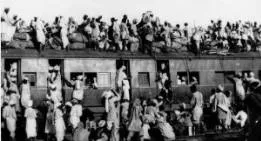
The Partition, which led to one of the biggest mass migrations in world history, and to the death of an estimated one million people or more on both sides of the border, is one of the most debated issues among historians. The puzzle can hardly be under-estimated. Till the middle of the 1940s, Partition was just one of the political alternatives before the country. Historians tell us that Jinnah preferred a federation because the Muslim population was spread across India, and Nehru wanted a centralised and unified state. How did these differences spill over into the calamity of the Great Partition? The complex answers historians give to the question, ‘why Partition’, are based on meticulous research of documentary, literary and biographical sources.
Most scholars agree that the causes can be traced to the turn of the 19th century. The colonial project, intent on intellectually colonising Indians, proceeded to shape a loose, plural and de-centred tradition known as Hinduism, cast it in the mould of Semitic religions, and create a ‘unified’ faith. A homogeneous version of Hinduism, and later Islam, politicised religious identities and harnessed them to competitive nation-making projects. Colonial policies gave an added fillip(something which acts as a stimulus or boost to an activity) to this politicisation through group representation. By the early 20th century, the politicisation of religious identities led to communal violence.
Another group of historians focusses on the role of elites in the making of independent nation states. Elites proceeded to tap religious identities, forge a constituency, and mobilise struggles for independence and for a separate state. In recent times, attention has shifted from the causes of the Partition to its consequences: murder, rapes, mutilation, displacement, and generalised suffering. People were mercilessly removed from their homes and hearths in a land that had suddenly become another country. And yet another strain of writing on Partition focalises the making of new nation states through the creation of boundaries, passports, recovery of abducted women, and consolidation of territory.
We can hardly discern one reason for the Partition. To ascribe(attribute a cause or characteristic) the tragic event to the machinations(a scheme that is usually created for bad reasons) of the Congress party distorts the multiple, complex and often contradictory developments that led to the separation of Pakistan from India. More significantly, the Prime Minister ignores the role of his own constitutive community, and its ideology of Hindutva, in the making of the Partition.
Cause for unease
History has taught us a bitter lesson. If a political movement is successful in tapping deep structures of sentiment in a society, these sentiments must already be there, lurking under the skin of a shallow modernity expected to usher in a secular age. After all, religion cannot be harnessed to the cause of communal mobilisation until it has some grip on people’s minds and psyches. Yet, this neat formulation — customised prejudice translates into murderous assaults on the ‘other’ community — gives us cause for unease. People may or may not be inclined towards religiosity, and yet might hesitate to dine or socialise with members of another community. But this does not mean that they ritually inflict harm on the bodies of other people. We can believe that others have their own reasons for thinking and doing what they think and do, and we have different reasons for thinking and doing what we wish to do. For many reasons, people construct symbolic and spatial barriers between themselves and others.
Note, however, that the bracketing-off of identities is a social phenomenon. Despite these social barriers, forms of cooperation can and do arise in the workplace, in social and political organisations, in and through movements, and through associational life. When these identities are transformed into political weapons in pursuit of symbolic or material gains, a sociological phenomenon translates into a political movement that lays exclusive claims upon the body politic. The politicisation of identities leads to open and ruthless competition for all sorts of power, invariably at the cost of human lives.
What is important is that the transition from, often, hidden animosities(a strong feeling of disliking someone or something) to violence involves a trigger. The trigger is provided by organisations that belong to the religious right and/or entrepreneurs and merchants of hate who excel in excavating unarticulated sentiments of resentment(anger or bitterness related to something that happened in the past) against other communities, and in playing up incidents that otherwise can be easily passed off as minor. The trigger stokes and evokes hellfires of hatred, devastating violence, and eternal damnation(the state of being in hell as punishment after death). When politicised religious identities compete for the same spatial and material resources, communities are motivated to inscribe in-erasable injuries on others, and on the polity.
Each new morn
The Partition teaches us that the eruption of insane political violence under the banner of ‘this’ or ‘that’ religion, the suspension of civil ties between erstwhile neighbours, and the merciless brutality inflicted(to cause someone to experience or be affected by (something unpleasant or harmful)) upon the bodies of children, men and women leaves ineradicable scars on collective memories, and destroys civilisations. We should have learnt that religious identities, once evoked, cannot be controlled. The history of religious strife(bitter and sometimes violent disagreement) in the subcontinent establishes that the trajectories of identity politics are unexpected, and that they take unforeseen and shocking routes. These routes inevitably lead to devastation. “Each new morn,” says Macduff of war in Shakespeare’s Macbeth, “New widows howl, new orphans cry, new sorrows Strike heaven in the face, that it resounds.” Yet, till today, communal organisations continue to trigger the brutalisation of social and political identities, creation of divides, exacerbation(to increase the severity or worsen) of hitherto muted schisms, and the creation of new ones. We have, it appears, not paid heed to these warnings. If we had, India would not re-enact the horrors of the Partition.



Top court quashes FIRs against Gen Z protesters
Sep 04, 2026






Stay updated with The Hindu Editorial Vocab24 app, your definitive source for breaking news and comprehensive coverage from India and around the globe. Whether it's political developments, business updates, sports highlights, the latest technology trends, or current events, The Hindu brings live, accurate, and reliable news directly to your device.
Don’t fall for sensationalized or fake news shared online. Read and share accurate updates with friends and family through The Hindu Editorial Vocab24 app. Download it today!
News Coverage in The Hindu Editorial Vocab24 App
Breaking News: Receive instant notifications on breaking news stories as they unfold. Stay informed about major events and developments in India and around the world with live blogs, news in shorts videos, and concise articles.
Politics: Get the latest updates on Indian politics, including elections, policy changes, government decisions, and political events that shape the nation.
Business and Economy: Stay ahead in the economic landscape with detailed business news and market analysis. Learn about stock market trends, financial reports, corporate news, and economic developments to make informed investment decisions.
Current Events: Follow stories on social issues, policy changes, global events, and daily current affairs, tailored for UPSC and other competitive exam preparations.
Technology: Keep up with the latest gadgets, innovations, and tech trends. Read expert reviews and analyses in short, concise updates on cutting-edge technology from India and beyond.
Sports: Never miss a moment of your favorite sports. Get live scores, match reports, and expert analysis on cricket, football, tennis, and more.
International News: Stay informed about global events and geopolitical developments, including the Russia-Ukraine war, Israel-Palestine conflict, and other key international stories.
Local News: Stay connected to your community with the latest updates on city events, issues, and local news. Coverage includes hyperlocal updates from cities like Bangalore, Chennai, Delhi, Hyderabad, Mumbai, Kolkata, and more.
Trending Topics: Discover what's trending today with the most talked-about stories and hot topics across India and the world.
Experience journalism that values integrity, accuracy, and reliability. Download The Hindu Editorial Vocab24 app today and stay connected with the world.
Subscribe to our newsletter!







