

The big deal behind the ruckus over aukus
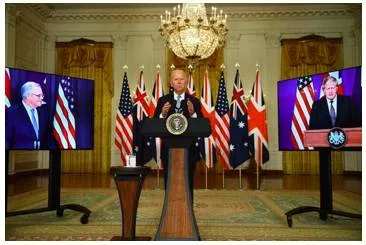
China’s economic and military capacities as well as its belligerence have led to a shift in regional security paradigms.The announcement of the new Australia-U.K.-U.S. (AUKUS) trilateral security pact has naturally generated animated debate in strategic circles, coming as it does just days before the first in-person Quad Leaders Summit to be hosted by United States President Joe Biden on September 24 in Washington. Last week, HMS Queen Elizabeth, the flagship of the United Kingdom’s Carrier Strike Group, arrived in Japan after exercising with India, Malaysia and Singapore and traversing the disputed waters of the South China Sea. Exercise Malabar 2021, held in the Western Pacific from August 26-29, 2021, brought together, for the second year running, the U.S. Navy, Japanese Maritime Self-Defense Force (JMSDF), the Royal Australian Navy and the Indian Navy.
Indo-Pacific is the core issue
Earlier in April, France, which like the United Kingdom has historically been an Indo-Pacific power with territories and bases across the region, participated in a multi-nation naval exercise in the Bay of Bengal with the four Quad nations (the U.S., Japan, Australia and India). All this points to a vigorous strengthening of bilateral, trilateral and multi-lateral security dialogues and structures, seemingly different in scope and activity, but which converge on the core issue of maintaining peace and stability in the Indo-Pacific.
There is no gainsaying the fact that rapid accretion in China’s economic and military capacities, but more particularly its belligerence, has led to a tectonic shift in regional security paradigms.
The Quad is not a security arrangement though there is a widespread feeling that without stronger security underpinnings it would play a limited role in dealing with the real challenge of China’s militarisation. The Malabar exercise is not a naval alliance, even though the habit of cooperation is geared to facilitate communication and interoperability in times of need. Several countries have been obliged to review their defence preparedness in response to China’s rising military power and its adverse impact on regional stability.
In August, Japan’s Defence Ministry proposed a budget of U.S.$50 billion for the fiscal year 2022, which represents a 2.6% nominal increase in its annual defence spending. The traditional ceiling of limiting defence spending to under 1% of GDP is no longer sacrosanct. Its Defence White Paper, for the first time, highlighted the urgent need to take stock of developments around Taiwan, a clear acknowledgement that Japan’s own security is linked to stability in the Taiwan Strait where muscle-flexing by China is the new norm. It is not without reason that Australia’s defence budget has seen enhanced outlays for the ninth straight year. For the financial year 2020-2021, it touched AUD 44.61 billion (USD$34.84 billion) representing a 4.1% hike over the previous year.
The AUKUS pact will facilitate the transfer of nuclear submarine propulsion and manufacturing technologies to Australia, the first instance of a non-nuclear nation acquiring such capability. Even if the first of the eight nuclear-powered submarines may be available only around 2040, or perhaps a few years earlier, the very fact of Australia operating such advanced platforms adds a new dimension to the evolving maritime security architecture in the Indo-Pacific. It conclusively puts to rest a long-standing domestic debate on whether it was time for Australia to assess China through the strategic lens, overcoming the purely mercantile considerations that tended to dominate its China policy.
A chance for the U.K.
The AUKUS pact is also an emphatic assertion of the relevance of the U.S.-Australia Security Treaty (ANZUS). New Zealand, the outlier, walked away in 1984 from the treaty that ironically still bears its initials. Its “nuclear free” stance ran counter to the U.S. Navy’s non-disclosure policy in regard to nuclear weapons aboard visiting vessels. Close ties notwithstanding, Australia’s future fleet of nuclear submarines will not be permitted access to New Zealand’s ports or waters, as averred by Prime Minister Jacinda Ardern.
AUKUS provides a fresh opportunity to the United Kingdom to reinsert itself more directly into the Indo-Pacific. It is already a member of the Five Eyes (FVEY), an intelligence-sharing alliance built on Anglo-Saxon solidarity (Australia, Canada, New Zealand, the U.K., and the U.S.).
AUKUS is not a substitute for the Quad. At the same time, it does not erode the Quad’s significance as a platform for consultations and coordination on broader themes of maritime security, free and open trade, health care, critical technologies, supply chains and capacity-building. The AUKUS submarine deal, on the other hand, is an undiluted example of strategic defence collaboration, and a game-changer at that.
In 2016, Japan’s Mitsubishi-Kawasaki consortium that manufactures the Soryu-class diesel-electric submarine lost out to France’s Naval Group (formerly known as the DCNS) which bagged the contract to build 12 diesel-electric submarines in Australia to replace its six Collins-class vessels. The Shortfin Barracuda Block 1A submarine offered by France was a diesel-electric variant of its own Barracuda-class nuclear attack submarine. It is heightened threat perceptions that have now prompted Australia to switch from conventional to the far more potent nuclear attack submarines.
Beijing’s stance is odd
China, expectedly, has strongly criticised AUKUS and the submarine deal as promoting instability and stoking an arms race. This is sheer hypocrisy. China has the world’s fastest-growing fleet of sub-surface combatants, including the Type 093 Shang-class nuclear-powered attack submarine (SSN) and the Type 094 nuclear-powered Jin-class ballistic missile submarine (SSBN), not to speak of its burgeoning fleet of conventional diesel-electric submarines with AIP (air-independent propulsion) capability. Its nuclear submarines are on the prowl in the Indo-Pacific. Yet, China denies Australia and others the sovereign right to decide on their defence requirements!
As for India, it operates one indigenously-built SSBN (INS Arihant) after returning the SSN (INS Chakra) on lease from Russia. It operates a number of conventional submarines, though far fewer than what it truly needs, including the Scorpene-class diesel-electric attack submarine which is manufactured at Mazagon Dock Shipbuilders Ltd. (MDL) in collaboration with France’s Naval Group under Project 75.
Australia’s role gets a boost
Australia’s proposed nuclear submarines, whether the U.K.’s Astute-class attack submarine or the U.S.’s Virginia-class vessel, will potentially be fully equipped with advanced U.S. weapons such as the Mark-48 torpedoes, the Harpoon anti-ship missiles and the Tomahawk cruise missiles. These will give Australia quite a punch in terms of a stand-off capability. Situated as it is, far away from any other country, the diesel-electric attack submarines that it currently operates, or even those that it might have got from France, have limited capacity in terms of range and duration of mission as compared to nuclear-powered submarines. The growing focus on anti-submarine warfare across a more expansive region is clearly altering calculations.
Australia’s nuclear submarines would help create a new balance of power in the Indo-Pacific, especially in tandem with the U.S. and the U.K. Australia will now have a more meaningful naval deterrence of its own to protect its sovereign interests. Australia is set to play a more robust role in ensuring peace and stability in the Indo-Pacific.
France’s momentary pique at the cancellation of the contract by Australia should soon subside. As a major Indo-Pacific power, France is an important part of the regional security calculus. The setback ‘down under’ may spur France to focus afresh on partners such as India, which must strike a balance between continuing imports and implementing the all-important Atmanirbhar Bharat in defence manufacturing.




Top court quashes FIRs against Gen Z protesters
Sep 04, 2026







Stay updated with The Hindu Editorial Vocab24 app, your definitive source for breaking news and comprehensive coverage from India and around the globe. Whether it's political developments, business updates, sports highlights, the latest technology trends, or current events, The Hindu brings live, accurate, and reliable news directly to your device.
Don’t fall for sensationalized or fake news shared online. Read and share accurate updates with friends and family through The Hindu Editorial Vocab24 app. Download it today!
News Coverage in The Hindu Editorial Vocab24 App
Breaking News: Receive instant notifications on breaking news stories as they unfold. Stay informed about major events and developments in India and around the world with live blogs, news in shorts videos, and concise articles.
Politics: Get the latest updates on Indian politics, including elections, policy changes, government decisions, and political events that shape the nation.
Business and Economy: Stay ahead in the economic landscape with detailed business news and market analysis. Learn about stock market trends, financial reports, corporate news, and economic developments to make informed investment decisions.
Current Events: Follow stories on social issues, policy changes, global events, and daily current affairs, tailored for UPSC and other competitive exam preparations.
Technology: Keep up with the latest gadgets, innovations, and tech trends. Read expert reviews and analyses in short, concise updates on cutting-edge technology from India and beyond.
Sports: Never miss a moment of your favorite sports. Get live scores, match reports, and expert analysis on cricket, football, tennis, and more.
International News: Stay informed about global events and geopolitical developments, including the Russia-Ukraine war, Israel-Palestine conflict, and other key international stories.
Local News: Stay connected to your community with the latest updates on city events, issues, and local news. Coverage includes hyperlocal updates from cities like Bangalore, Chennai, Delhi, Hyderabad, Mumbai, Kolkata, and more.
Trending Topics: Discover what's trending today with the most talked-about stories and hot topics across India and the world.
Experience journalism that values integrity, accuracy, and reliability. Download The Hindu Editorial Vocab24 app today and stay connected with the world.
Subscribe to our newsletter!







