

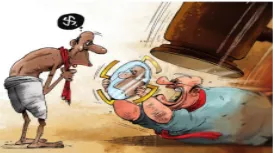
The belly of democracy
Supreme Court seeks to banish (दूर करना/छुटकारा पाना) religion and caste from the electoral sphere entirely, improbably.
Hard cases, it is said, make bad law. Confronted with such a hard case to determine the deceptively simple interpretation of the pronoun `his' while laying down the contours of a corrupt electoral practice, the Supreme Court appears to have reached the right result for the wrong reasons. Its judgment, on appeal by a candidate in elections to voters to vote or refrain from voting for a particular candidate on the grounds of `his' religion, race, community, caste or language, prohibits any appeal to the aforementioned facets(पहलु) of any of the candidates or critically, the voters too. This has tremendous implications (आशय/तात्पर्य/निहितार्थ) on the practice of electoral politics.
At the same time, it produces competing judicial visions of democracy in India. The four majority judges show little appreciation of the pervasive (व्यापक/प्रसारित) consequences of their judgment and why the distinction between the candidate and the voter is an illusory one. Equally, the three dissenting judges appear overly concerned with consequentialist reasoning and reach an outcome that has been shown to be unworkable in practice.
The question in this case, as a matter of law, was whether appeals to religion, race, community, caste or language of the candidates alone, or the voters as well, would constitute a corrupt electoral practice. As a matter of politics, this translated into competing visions of electoral process and about India itself ¬ the possibility of a nation with religion and caste banished from the public sphere entirely, or one which honestly acknowledges their historical significance while seeking to filter out their tendency to divide.
Cast in this manner, the dissenting judgment of Justice Chandrachud is distinctly more appealing. It acknowledges the reality of caste, community and language based parties, and the central role that religion plays in the public discourse in India.
Three judges in the majority (Chief Justice Thakur and Justices Lokur and Rao) on the contrary, set out an idealistic vision of a pure electoral process shorn of caste, religion and presumably other things that matter to Indians. Elections for them must be limited to purely secular concerns, possibly variants of the roti, kapda, makaan formulation. These distinct visions of India underlie the distinct interpretations of the statute (कानून/विधान) by the majority and minority ¬ the former, expanding `his' to include both the voter and the candidates, the latter, limiting it to candidates alone.
Set out in this way, the elucidation (स्पष्टीकरण/विवरण/व्याख्या) of a grand constitutional vision, particularly by CJI Thakur, and a realistic one by Justice Chandrachud, are both problematic. The former leads to an over-expansive conclusion that is entirely out of touch with the reality of politics; the latter, being overly deferential (आदरसूचक/सम्मानपूर्ण) to reality, attempts to carve out a distinction in the statute which simply cannot work. There is little practical difference between a candidate saying “Vote for me, I am a Gorkha” and “You are all Gorkhas and only I can save your pride”. Making such a distinction to plausibly allow the latter but not the former, as Justice Chandrachud and several judges of the Supreme Court before him have done, amounts to making much of a muchness.
The court is consequently caught between the rock of unenforceability or the hard place of floodgates of complaints by losing candidates whose success would turn on how a candidate expressed a particular sentiment. The majority, in reaching the conclusion that this distinction should be dispensed with, arrived at a logically consistent result. But it was right not because their vision for India required so but, more humbly, because this is a distinction without a difference.
As a result of rooting the judgment in secularism and the purity of the electoral process, the majority judges did not have elbow room to deal with the gargantuan (विशाल/बहुत बड़ा) consequences of dispensing with the distinction. As it stands, any appeal to ascriptive (Ascription occurs when social class or stratum placement is primarily hereditary) factors in the course of election is barred. If enforced, this demolishes elections planks of several parties established to protect ascriptive factors in one stroke ¬ the Shiv Sena, Akali Dal, Bahujan Samaj Party, to name a few. Popular movements based on language and community ¬ such as the Gorkha Janmukti Morcha in West Bengal, the Chakmas in Arunachal Pradesh ¬ who are engaged in a battle for survival on the basis of their identity, now cannot mobilise politically.
This is where the court missed one critical distinction ¬ there is a legitimate distinction between a `grievance' on the basis of religion, language, etc and an `appeal' to vote on such basis. If Gujjars in Haryana feel hard done by a Jat-led dispensation (व्यवस्था) then surely candidates at an election can empathize (समानुभूति होना) with this grievance and raise it in an election campaign.
This is distinct from a direct appeal made by a Gujjar candidate to Gujjar voters holding up her identity as the sole reason for seeking votes. Ascribing (के लिए उत्तरदायी ठहराना/कारण बताना) a high threshold on the word `appeal' and distinguishing it from a grievance would have allowed the judges to reach a result that was both aligned with principle and not wildly out of sync with the reality of Indian politics.
The elephant in the room in this discussion is the statute itself. The entire controversy is a product of a certain grain of thinking underlying the Representation of the People Act that shields Indians from their core impulses, directing them towards a state-sanctioned and loftier (ऊंचा /उन्नत) version of themselves. The majority judges have merely furthered such thinking. It is now time for Parliament to hold up our republican traditions and let Indians be themselves ¬ beautiful, ugly and everything that may lie in between.

Foster competition
Aug 18, 2017
Where we top hope optimism
Aug 17, 2017
Good riddance
Aug 15, 2017
Heed the message
Aug 12, 2017
Mandal's children
Aug 11, 2017
Burgeoning tax base
Aug 09, 2017





Stay updated with The Hindu Editorial Vocab24 app, your definitive source for breaking news and comprehensive coverage from India and around the globe. Whether it's political developments, business updates, sports highlights, the latest technology trends, or current events, The Hindu brings live, accurate, and reliable news directly to your device.
Don’t fall for sensationalized or fake news shared online. Read and share accurate updates with friends and family through The Hindu Editorial Vocab24 app. Download it today!
News Coverage in The Hindu Editorial Vocab24 App
Breaking News: Receive instant notifications on breaking news stories as they unfold. Stay informed about major events and developments in India and around the world with live blogs, news in shorts videos, and concise articles.
Politics: Get the latest updates on Indian politics, including elections, policy changes, government decisions, and political events that shape the nation.
Business and Economy: Stay ahead in the economic landscape with detailed business news and market analysis. Learn about stock market trends, financial reports, corporate news, and economic developments to make informed investment decisions.
Current Events: Follow stories on social issues, policy changes, global events, and daily current affairs, tailored for UPSC and other competitive exam preparations.
Technology: Keep up with the latest gadgets, innovations, and tech trends. Read expert reviews and analyses in short, concise updates on cutting-edge technology from India and beyond.
Sports: Never miss a moment of your favorite sports. Get live scores, match reports, and expert analysis on cricket, football, tennis, and more.
International News: Stay informed about global events and geopolitical developments, including the Russia-Ukraine war, Israel-Palestine conflict, and other key international stories.
Local News: Stay connected to your community with the latest updates on city events, issues, and local news. Coverage includes hyperlocal updates from cities like Bangalore, Chennai, Delhi, Hyderabad, Mumbai, Kolkata, and more.
Trending Topics: Discover what's trending today with the most talked-about stories and hot topics across India and the world.
Experience journalism that values integrity, accuracy, and reliability. Download The Hindu Editorial Vocab24 app today and stay connected with the world.
Subscribe to our newsletter!







