

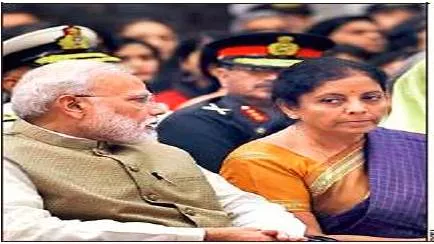
The 2019 budget puzzle
Narendra Modi and the investing class have different economic worldviews.Post-Budget, markets and members of the investing and chattering classes — let’s call them MICs — are, to varying degrees, unhappy and/ or puzzled. As dozens of commentaries since July 5 late afternoon show, these responses are basically centred around a few new taxes/listing rules and the apparent absence of quick-acting booster shots for an economy that’s currently not exactly sizzling.
MICs agree that a government led by someone as focused, determined and currently politically unchallenged as Narendra Modi is serious about the economy. Therefore, their unhappiness and puzzlement are even more acute.
So, what gives? The answer is probably that Modi’s and MICs’ worldviews differ in some fundamental aspects. It’s these differences that even in Modi’s first term had MICs, or some sections of them, puzzled, and led some of them to privately predict a less-than-commanding electoral performance by BJP. These differences are now producing early disenchantment among MICs.
Obviously, both Modi and MICs want a strong economy. MICs look at the economy as primarily a system that gets its zest from investment enthusiasm of top economic and financial actors. Modi has no quarrel with the view that private investment is the key to sustained high growth.
But Modi looks at the economy as primarily a system that hosts millions of ordinary social and economic actors who, given more enabling conditions, can be collectively a transformative force. MICs have no quarrel with this either. After all, top economic and financial actors would love nothing more than millions of Indians taking more buying, saving and investing decisions. Even if the quantum is small, the cumulative impact can be very large.
Where the difference matters is that these different primary views result in very different kind of policy prescriptions or policy ordering.
Let the Chats Show
MICs would have wanted this Budget to concentrate primarily on generating enthusiasm among top investing classes, whether in finance or in the real economy. It’s not that the Budget has nothing on this, far from it.
Take this list of Budget measures: the liquidity window for non-banking financial companies (NBFCs), the moderate bank recapitalisation allocation, some announced or intended reforms in the corporate bond market, sovereign borrowing abroad to ease some pressure on interest rates at home, the extension of corporate tax cut to more companies, holding the fiscal line (even granting some number-fudging) . These were all aimed at easing conditions that investing classes face.
But what wasn’t there is what the media calls ‘big-bang’. Over post-reform years, this has essentially come to mean measures that can quickly charge up markets’ and investing classes’ sentiments, earn praise from chattering classes, and are relatively quick acting in terms of their impact on investment, consumption and growth.
Big-bang for MICs in this Budget would have been a huge public sector share sale programme (the Budget announced a small increase on last year’s figure), a one-time banks’ non-performing assets (NPA) write-off, through bonds, for example, a much more generous helping hand for NBFCs, lowering corporate tax — stuff like that. Stuff aimed at immediately impacting macroeconomic outcomes.
But Modi is a process person, and greatly values improving economic systems, that much was clear in his first term. His panoply of welfare measures, from Aadhaar extension, direct benefit transfer (DBT) and Jan Dhan, to toilet, housing, cooking gas, electricity and health insurance provision, were all process improvements aimed at creating better conditions for ordinary Indians. And he started his second term by making clean water supply his signature target. (There’s a micro puzzle here: budgetary allocation for water resources has gone up only marginally.) Even measures like goods and services tax (GST) and the bankruptcy code, which concern areas important to MICs, were process improvements. As was the attempt to increase ease of doing business.
Also, in MICs’ worldview, higher tax on top earners and proposing dilution of promoters’ equity were exactly the kind of measures the Budget should have avoided. But here, too, there’s a basic difference between Modi and MICs. The former has by now made it abundantly clear that he has no problem making life difficult for the rich if he thinks the cause and/or context is justified. MICs still seem to have difficulty digesting this.
So, Modi’s first Budget of his second term pretty much follows this approach. Budget measures aimed at improving the investment environment didn’t exactly fire up MICs — because they were largely process improvements. And the Budget’s long discursive section on welfare was a restatement of Modi’s primary view of the economy.
A Booster Shot
MICs, though, can and do argue that given a slowing economy, flatlining consumption and stalled private investment, the Budget absolutely needed to give a quick-acting booster or two. The government obviously disagrees. Its own reading seems to be that improvements are a matter of time and the economy is in no kind of crisis at all to justify policy steroids.
Is the government right? The next three or four quarters will tell us. If the economy doesn’t appreciably improve, will Modi change his approach? That’s the $5 trillion question.










Stay updated with The Hindu Editorial Vocab24 app, your definitive source for breaking news and comprehensive coverage from India and around the globe. Whether it's political developments, business updates, sports highlights, the latest technology trends, or current events, The Hindu brings live, accurate, and reliable news directly to your device.
Don’t fall for sensationalized or fake news shared online. Read and share accurate updates with friends and family through The Hindu Editorial Vocab24 app. Download it today!
News Coverage in The Hindu Editorial Vocab24 App
Breaking News: Receive instant notifications on breaking news stories as they unfold. Stay informed about major events and developments in India and around the world with live blogs, news in shorts videos, and concise articles.
Politics: Get the latest updates on Indian politics, including elections, policy changes, government decisions, and political events that shape the nation.
Business and Economy: Stay ahead in the economic landscape with detailed business news and market analysis. Learn about stock market trends, financial reports, corporate news, and economic developments to make informed investment decisions.
Current Events: Follow stories on social issues, policy changes, global events, and daily current affairs, tailored for UPSC and other competitive exam preparations.
Technology: Keep up with the latest gadgets, innovations, and tech trends. Read expert reviews and analyses in short, concise updates on cutting-edge technology from India and beyond.
Sports: Never miss a moment of your favorite sports. Get live scores, match reports, and expert analysis on cricket, football, tennis, and more.
International News: Stay informed about global events and geopolitical developments, including the Russia-Ukraine war, Israel-Palestine conflict, and other key international stories.
Local News: Stay connected to your community with the latest updates on city events, issues, and local news. Coverage includes hyperlocal updates from cities like Bangalore, Chennai, Delhi, Hyderabad, Mumbai, Kolkata, and more.
Trending Topics: Discover what's trending today with the most talked-about stories and hot topics across India and the world.
Experience journalism that values integrity, accuracy, and reliability. Download The Hindu Editorial Vocab24 app today and stay connected with the world.
Subscribe to our newsletter!







