

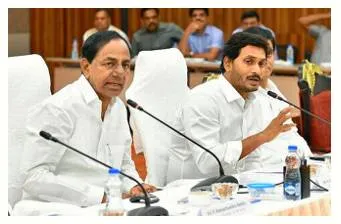
Telugu leaders on a sticky wicket
Jagan Mohan Reddy and Chandrasekhara Rao are lending legitimacy to the BJP’s centralising agenda.Seven years after the bifurcation of erstwhile Andhra Pradesh, many of the promises made in the Andhra Pradesh Reorganisation Act of 2014 affecting the two Telugu States remain unfulfilled. Unkept promises and flow of funds apart, the two States are struggling to cope with post-bifurcation challenges like river water-sharing.
A new trend
Andhra Pradesh’s demands, some of which were articulated by Chief Minister Y. S. Jagan Mohan Reddy in a recent meeting with Union Home Minister Amit Shah, and some others earlier, include Special Category Status; ₹55,656 crore for the Polavaram irrigation project, designated as a national project; shifting of the Polavaram Project Authority from Hyderabad to Rajahmundry; relocating the High Court of Andhra Pradesh from Amaravati to Kurnool; restructuring of debts of ₹50,000 crore in which the Andhra Pradesh power utilities are mired; and release of pending dues — ₹3,299 crore related to subsidy for Public Distribution System rice from the Union Food Ministry and ₹4,652 crore from the Union Rural Development Ministry.
Telangana Chief Minister K. Chandrasekhara Rao’s list is similar. During a meeting with Prime Minister Narendra Modi last month, Mr. Rao sought an Indian Institute of Management at Hyderabad. His other demands have been a Hyderabad-Nagpur Industrial Corridor, ₹1,000 crore for a textile park at Warangal, 100% funding for road network in Left-Wing Extremism affected areas, the setting up of a Tribal University in Warangal, and additional funds for improving road connectivity in backward areas as promised in the State Reorganisation Act.
Despite their customary visits to Delhi and meeting the Prime Minister and Union Ministers, both the Chief Ministers have scrupulously avoided making these long-pending problems a big Centre-State federal issue of national importance. They prefer to maintain a strategic silence.
This is a new trend in Telangana-Andhra politics. It is a perceptible shift from the days of former Chief Minister N.T. Rama Rao, who was in constant battle with the Centre over issues affecting erstwhile Andhra Pradesh, beginning with Telugu culture, language and pride. A fiery fighter against centralisation, the misuse of Article 356, and the institution of governors, Rao strongly worked for multi-party federalism. This is what inspired him to form an anti-Congress rainbow coalition, the National Front. His famous statements — the “Centre is a conceptual myth” and the Congress had “mortgaged” the self-respect and interests of Telugus in Delhi — were a big hit with the Telugu people. Former Chief Minister N. Chandrababu Naidu too sparred with the Centre over Special Category Status and this ultimately led to his Telugu Desam Party (TDP) snapping ties with the Bharatiya Janata Party (BJP).
Ironically, it was Mr. Reddy’s YSR Congress Party’s strident posture on Special Category Status that pushed Mr. Naidu to take a tough stand. Mr. Reddy used to taunt Mr. Naidu and tell people that if he had all 25 MPs fiom Andhra Pradesh in the Lok Sabha, he could have forced the Centre to grant Special Category Status to Andhra Pradesh. The YSR Congress Party now has 22 MPs in the Lok Sabha, but not much is heard about Special Category Status anymore. After provoking Mr. Naidu to walk out of the National Democratic Alliance, Mr. Reddy started cultivating the BJP. Their relationship continues to blossom, pushing State issues to the background.
Notably, both the YSR Congress Party and the Telangana Rashtra Samithi (TRS) supported the revocation of Article 370 and the bifurcation of Jammu and Kashmir into two Union Territories. Though the TRS opposed the Citizenship (Amendment) Bill (CAB) in Parliament, Mr. Rao did not categorically say that the National Register of Citizens (NRC) will not be implemented in Telangana. Mr. Reddy first supported the CAB, but several days later, after Asaduddin Owaisi appealed to him to withdraw his party’s support, said the NRC would not be implemented in Andhra Pradesh.
Fighting for federalism
So, what happened to the fighting spirit of the Chief Ministers and political leaders from Andhra and Telangana? Why are they now going soft on the Union government and being perceived as compromising with it? Why has the battle for federalism been left to leaders like West Bengal Chief Minister Mamata Banerjee?
The reasons are layered. Both Mr. Rao and Mr. Reddy appear to be wary of the dominance of the BJP and the power of Mr. Modi and are aware of the political implications of taking on the Centre. In Mr. Reddy’s case, it may be political compulsion, given the slew of charges of acquiring disproportionate assets that he faces in a special CBI court. He also considers the TDP as a bigger political adversary than the BJP in Andhra Pradesh. Mr. Rao too has preferred to settle for a non-confrontational approach towards the BJP, having realised the futility of floating a non-BJP non-Congress front.
But while strategising for their political survival, the two leaders are either unable to fathom or conveniently ignore the BJP’s centralising tendencies and its attempts to implement its idea of ‘One Nation One Ration Card’, ‘One Nation One Election’, ‘One Nation One Language’. This project fits into the BJP’s long-cherished ideological agenda of homogenising India in total disregard to the nation’s historic diversity and plurality and seeks to bulldoze the federalism cherished by erstwhile Andhra Pradesh’s former leaders.
The beauty of Indian federalism is that it not only created enough space for the States to flourish and fight for their rights, but also safeguarded multiculturalism. This happened over time — first, when the Centre and States were ruled by different parties and later, when national and regional parties came together to form coalition governments. Differences were respected and sorted out in true federal spirit. Some States were accorded special privileges for historical, cultural and ethnic reasons. One party now wants to wipe this out in the name of national unity and its one nation theory.
The signs are already there. For all its talk of promoting ‘cooperative federalism’, the BJP keeps undermining the concept, as seen in the abrogation of Article 370 and its attempt to change the political landscape of Kashmir; the multiple ways in which it creates trouble in West Bengal and Maharashtra; and the defections it has engineered in Madhya Pradesh and Karnataka.
Politically savvy and strong regional leaders like Mr. Rao and Mr. Reddy should rise to the occasion and foil such crude attempts to hit at federalism and democracy. Their attitude of running with the hare and hunting with the hounds could even boomerang. By remaining silent and indirectly toeing the BJP’s line, they are lending legitimacy to its one nation agenda, besides unwittingly enabling this agenda to grow and become stronger. Whatever their compulsions, they should not forget that Indian federalism is intrinsically woven into the Constitution, and they have every right to challenge moves to weaken it, eroding the autonomy of the States. If they chose to be reluctant, they will be doing a great disservice to the nation.

Atiqa records two top-four finishes in WSK Final Cup
Sep 05, 2026









Stay updated with The Hindu Editorial Vocab24 app, your definitive source for breaking news and comprehensive coverage from India and around the globe. Whether it's political developments, business updates, sports highlights, the latest technology trends, or current events, The Hindu brings live, accurate, and reliable news directly to your device.
Don’t fall for sensationalized or fake news shared online. Read and share accurate updates with friends and family through The Hindu Editorial Vocab24 app. Download it today!
News Coverage in The Hindu Editorial Vocab24 App
Breaking News: Receive instant notifications on breaking news stories as they unfold. Stay informed about major events and developments in India and around the world with live blogs, news in shorts videos, and concise articles.
Politics: Get the latest updates on Indian politics, including elections, policy changes, government decisions, and political events that shape the nation.
Business and Economy: Stay ahead in the economic landscape with detailed business news and market analysis. Learn about stock market trends, financial reports, corporate news, and economic developments to make informed investment decisions.
Current Events: Follow stories on social issues, policy changes, global events, and daily current affairs, tailored for UPSC and other competitive exam preparations.
Technology: Keep up with the latest gadgets, innovations, and tech trends. Read expert reviews and analyses in short, concise updates on cutting-edge technology from India and beyond.
Sports: Never miss a moment of your favorite sports. Get live scores, match reports, and expert analysis on cricket, football, tennis, and more.
International News: Stay informed about global events and geopolitical developments, including the Russia-Ukraine war, Israel-Palestine conflict, and other key international stories.
Local News: Stay connected to your community with the latest updates on city events, issues, and local news. Coverage includes hyperlocal updates from cities like Bangalore, Chennai, Delhi, Hyderabad, Mumbai, Kolkata, and more.
Trending Topics: Discover what's trending today with the most talked-about stories and hot topics across India and the world.
Experience journalism that values integrity, accuracy, and reliability. Download The Hindu Editorial Vocab24 app today and stay connected with the world.
Subscribe to our newsletter!







