

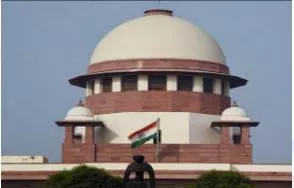
Supreme court dwindled
The Supreme Court of India is facing its worst crisis of credibility since the Emergency. With an occasional exception, the quality of the court’s reasoning, the inconstancy of its judgment, the abdication (failure to fulfill a responsibility or duty.) of its constitutional role in some cases, and its overreach in others, are already denting its authority. But the institutional crisis that the Supreme Court has now created for itself will puncture more holes in the authority that it so valiantly (showing courage and determination) tried to exert. It will also create the conditions under which it will be easier to legitimize diluting judicial independence.The current crisis was occasioned by an order passed by Justice J Chelameswar to constitute a five-judge bench in a petition filed by CJAR that demanded that a SIT be constituted to look into an alleged corruption scandal pertaining to a case involving a medical college. There are two issues: Can the chief justice be part of the hearing, since the scandal allegedly implicates a judgment the CJI wrote, even though he has not been named in the FIR? Second, could a constitution bench be constituted bypassing the chief justice in violation of the current procedure through which such benches are constituted? This is not the place to recount the ugly sequence of events that transpired (to become known). But consider the different ways in which the judiciary has now rendered itself vulnerable.
First, there is the vulnerability that arises from the CBI itself. There are issues of corruption in the courts. The judiciary has failed to find a mechanism to deal with allegations of corruption within its ranks. Every justice in the court needs to be above suspicion. But a lot of care needs to be exercised so that the anti-corruption measures taken do not undermine the independence of the judiciary. This is not a very popular thing to say, but we should also consider the possibility that the threat of being investigated by the CBI, or speculative naming (or suggestion in a CBI report), can itself also be an instrument of seeking recusals (to remove oneself from decision or judgment) or undermining the independence of judges, as is sometimes done with other government officials. This subtle institutional challenge to the judiciary is not outside of the realm of possibility. More than the conduct of Justices Misra and Chelameswar, the judiciary will have to think of how it will deal with instances where the Chief Justice of India or other justices becomes hostage to possible CBI innuendo (implications of something).
The challenge of fighting corruption in the judiciary will be this: How do you do this in a way that does not make the judiciary vulnerable to implicit blackmail and leads to undermining its independence? But a clamour for reforms that undermine independence in the name of accountability will be a natural consequence of the current chain of events. It is precisely because such a danger looms that the judiciary’s conduct needs to be above board (legitimate, honest, and open.). And here, the judiciary has made itself doubly vulnerable. A court carves out (To establish a niche or role for oneself.) its authority by the compelling character of its reasoning on behalf of constitutional values. We have had a succession of chief justices who have failed to exercise intellectual leadership and the present chief justice is no exception. It is not difficult to understand the chief justice’s consternation (a feeling of anxiety or dismay, typically at something unexpected.). He has not been named in an FIR, and the prospect of a CJI’s integrity being questioned on the basis of an unaccountable CBI is not a prospect we should relish. He was also institutionally humiliated by one of his brother justices, who disregarded existing court procedure and appointed a constitutional bench. But notwithstanding this, this is clearly a chief justice who seemed not to understand the concept of conflict of interest. He let his consternation on a procedural matter get the better of his judgment in a cringingly (so as to make one feel embarrassed or disgusted.) unbecoming way. He also gave the impression of not giving counsel a proper hearing. In the way he has constituted benches, he has also shown deep distrust in the capabilities of his senior colleagues. By setting himself up as a judge in his own cause and setting up a bench whose composition looks arbitrary, he has undermined the authority of the judiciary.
But Justice Chelameswar’s order setting up a five-judge bench also made the judiciary vulnerable. Surely, there were better ways of securing the recusal of the chief justice and setting up a bench in a way that did not depart from existing court procedure or humiliate the chief justice. The danger is that the pursuit of justice and the need to project virtue often results in a grandstanding in its own right. Rather than build a robust judicial consensus, judges project their own individual heroism.
Between a chief justice who does not recognise conflict of interest, and justices who think the only recourse is public grandstanding, the judiciary will not be able to survive. Many learned counsel have defended Justice Chelameswar’s move by invoking Article 142 that gives judges the power to do whatever it takes to secure justice. But the use of Article 142 has also become a sign of immense judicial indiscipline, where judges can easily ride roughshod over other procedural proprieties (conformity to conventionally accepted standards of behaviour or morals.).
Taken together, both the chief justice’s and the judge’s conduct highlights one obvious fact: There is no Supreme Court left any more. In expanding its powers, the Supreme Court first replaced the rule of law with the rule of the court (they are not the same thing); now the rule of court has been replaced with the anarchic will of individual judges. The Supreme Court has effectively ended an institution. There is no real command structure left. On procedural matters, whether it is protocols for appointing judges, or handling conflicts of interest, the court is all over the place.
Communication between judges seems to have broken down to the point where the senior leadership of the court is incapable of getting together and coming up with common sense procedural solutions to cases like this. The distrust amongst judges, as evident in the ways benches are being constituted, seems extraordinarily high. And the sense of injured virtue amongst individual judges seems to be trumping any consideration of the reputation of the judiciary as a whole.
There are lots of legal nuances to the case at hand. But the court’s loss of external credibility combined with internal anarchy does not bode well for Indian democracy. Instead of becoming a constitutional lodestar in our turbulent times, the court has itself become a reflection of the worst rot afflicting Indian institutions.












Stay updated with The Hindu Editorial Vocab24 app, your definitive source for breaking news and comprehensive coverage from India and around the globe. Whether it's political developments, business updates, sports highlights, the latest technology trends, or current events, The Hindu brings live, accurate, and reliable news directly to your device.
Don’t fall for sensationalized or fake news shared online. Read and share accurate updates with friends and family through The Hindu Editorial Vocab24 app. Download it today!
News Coverage in The Hindu Editorial Vocab24 App
Breaking News: Receive instant notifications on breaking news stories as they unfold. Stay informed about major events and developments in India and around the world with live blogs, news in shorts videos, and concise articles.
Politics: Get the latest updates on Indian politics, including elections, policy changes, government decisions, and political events that shape the nation.
Business and Economy: Stay ahead in the economic landscape with detailed business news and market analysis. Learn about stock market trends, financial reports, corporate news, and economic developments to make informed investment decisions.
Current Events: Follow stories on social issues, policy changes, global events, and daily current affairs, tailored for UPSC and other competitive exam preparations.
Technology: Keep up with the latest gadgets, innovations, and tech trends. Read expert reviews and analyses in short, concise updates on cutting-edge technology from India and beyond.
Sports: Never miss a moment of your favorite sports. Get live scores, match reports, and expert analysis on cricket, football, tennis, and more.
International News: Stay informed about global events and geopolitical developments, including the Russia-Ukraine war, Israel-Palestine conflict, and other key international stories.
Local News: Stay connected to your community with the latest updates on city events, issues, and local news. Coverage includes hyperlocal updates from cities like Bangalore, Chennai, Delhi, Hyderabad, Mumbai, Kolkata, and more.
Trending Topics: Discover what's trending today with the most talked-about stories and hot topics across India and the world.
Experience journalism that values integrity, accuracy, and reliability. Download The Hindu Editorial Vocab24 app today and stay connected with the world.
Subscribe to our newsletter!







