

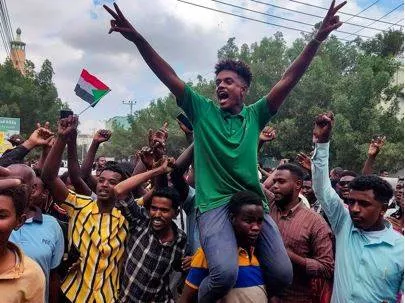
Sudan’s paramilitary rsf falters amid tactical blunders and supply shortfalls
The Sudanese Army has made major gains in recent months, seeming to reverse the tide of a nearly two-year war that has killed tens of thousands of people and uprooted more than 12 million; the RSF’s recruitment efforts have stalled, making them increasingly vulnerable in prolonged combat.Sudan’s paramilitary Rapid Support Forces (RSF) are losing ground to the Army due to strategic blunders, internal rifts, and dwindling supplies, analysts say.
The Army has made major gains, seeming to reverse the tide of a nearly two-year war that has killed tens of thousands of people and uprooted more than 12 million.
Last month, the Army surged through central Sudan, reclaiming the Al-Jazira State capital of Wad Madani before setting its sights on Khartoum.
Within two weeks, it shattered RSF sieges on key Khartoum military bases, including the General Command headquarters, and overran the Al-Jaili oil refinery, the country’s biggest, just north of the capital.
Cameron Hudson, a senior fellow at the Centre for Strategic and International Studies’s Africa programme, said while “the RSF outperformed at the start of the war because it was more prepared”, its weaknesses were now showing.
After nearly two years of fighting, the RSF’s supplies have dwindled and its recruitment efforts have faltered.
Many of its members lack formal military training, making them increasingly vulnerable in prolonged combat, Mr. Hudson said.
The Army, which “was caught off guard” at the start of the war, has “had time to rebuild, recruit and rearm”, he added.
Overextended, exposed
According to a former General in the Sudanese military, the Army has broadened its fighter base, mobilising volunteers, allied militias, and other branches of the security apparatus.
One “critical” addition to the Army’s operations has been reinstating the Special Operations Forces, part of state intelligence, the former General said on condition of anonymity.
The special forces, who are trained in urban warfare according to the former General, have helped reverse what Rift Valley Institute fellow Eric Reeves called the Army’s “cowardly willingness to engage only in ‘stand-off tactics’, namely artillery and aircraft strikes”, particularly in the capital.
The RSF meanwhile has overstretched its resources and exposed vulnerabilities in its military strategy, analysts say.
More than 1,200 kilometres separate RSF strongholds in Darfur — the vast western region nearly entirely under their control — from Khartoum, the fiercely contested metropolis.
Darfur’s strong tribal networks have supplied troops to the RSF, while crucial support from abroad has funnelled through the region’s borders with Chad and Libya, experts and the United Nations have said.
But attempting to expand their control into central and eastern Sudan, the paramilitaries have “stretched themselves too thin”, said Mr. Reeves, a veteran Darfur expert.
The long road — increasingly contested by the Army in areas such as North Kordofan — has made resupply missions “both difficult and dangerous”, said Hamid Khalafallah, a Britain-based Sudanese researcher.
“It has become very costly for the RSF to get supplies from Darfur to the centre and east,” he said.
The United Arab Emirates has been accused of funding the RSF, and there is currently no evidence that the paramilitaries have lost their vital lifeline.
Beyond logistics, analysts say internal rifts have added to the RSF’s troubles.
“Their ability to command their forces in a coherent and organised way across the country has been severely tested,” said Magnus Taylor, deputy director of the Horn of Africa project at International Crisis Group.
In Wad Madani, the high-profile defection of an RSF commander in late 2024 has weakened the group’s hold.
The commander, Abu Aqla Kaykal — widely accused of atrocities against civilians — has since led troops on behalf of the Army, according to a source in his Sudan Shield Forces militia.
Changing tactics
Analysts say the RSF’s setbacks do not necessarily signal their defeat or an imminent end to the fighting.
They say the paramilitary force has changed its strategy, targeting civilian infrastructure in central Sudan while consolidating its hold on Darfur.
“It seems the RSF’s current strategy is to create chaos,” Mr. Hudson said.
“It is not targeting military sites, but civilians... to punish the people and the state,” he added.
RSF commander Mohamed Hamdan Daglo has remained defiant, vowing again on Friday to “expel” the Army from Khartoum.
In recent weeks, the RSF has struck power plants, the only functioning hospital in the North Darfur State capital of El-Fasher and a market in Omdurman, Khartoum’s twin city.
But the prize most critical to the RSF’s continued war effort is 1,000 kilometres west of Khartoum: El-Fasher, the only major city in Darfur out of its control.
Since May, the RSF has laid siege to the city as its fighters have been repeatedly repelled by the military and its allied militias.
Should the paramilitaries succeed in taking El-Fasher, “then the de facto bifurcation of the country will become much more formalised”, said Mr. Hudson.
And the RSF would put “itself in a more advantageous negotiating position, as it controls one third of the country”, he added.


U k budget increases child welfare allowance taxes
Nov 29, 2025







Stay updated with The Hindu Editorial Vocab24 app, your definitive source for breaking news and comprehensive coverage from India and around the globe. Whether it's political developments, business updates, sports highlights, the latest technology trends, or current events, The Hindu brings live, accurate, and reliable news directly to your device.
Don’t fall for sensationalized or fake news shared online. Read and share accurate updates with friends and family through The Hindu Editorial Vocab24 app. Download it today!
News Coverage in The Hindu Editorial Vocab24 App
Breaking News: Receive instant notifications on breaking news stories as they unfold. Stay informed about major events and developments in India and around the world with live blogs, news in shorts videos, and concise articles.
Politics: Get the latest updates on Indian politics, including elections, policy changes, government decisions, and political events that shape the nation.
Business and Economy: Stay ahead in the economic landscape with detailed business news and market analysis. Learn about stock market trends, financial reports, corporate news, and economic developments to make informed investment decisions.
Current Events: Follow stories on social issues, policy changes, global events, and daily current affairs, tailored for UPSC and other competitive exam preparations.
Technology: Keep up with the latest gadgets, innovations, and tech trends. Read expert reviews and analyses in short, concise updates on cutting-edge technology from India and beyond.
Sports: Never miss a moment of your favorite sports. Get live scores, match reports, and expert analysis on cricket, football, tennis, and more.
International News: Stay informed about global events and geopolitical developments, including the Russia-Ukraine war, Israel-Palestine conflict, and other key international stories.
Local News: Stay connected to your community with the latest updates on city events, issues, and local news. Coverage includes hyperlocal updates from cities like Bangalore, Chennai, Delhi, Hyderabad, Mumbai, Kolkata, and more.
Trending Topics: Discover what's trending today with the most talked-about stories and hot topics across India and the world.
Experience journalism that values integrity, accuracy, and reliability. Download The Hindu Editorial Vocab24 app today and stay connected with the world.
Subscribe to our newsletter!







