

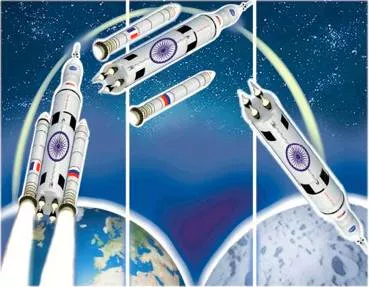
Such a long journey
Jingoism may propel politicians to power, it won’t help Chandrayaan-2 lift-off.A leak in the cryogenic engine last Monday grounded Chandrayaan-2, India’s second Moon mission. But have no doubt: Indian Space Research Organisation (Isro) will take a deep breath, pick itself up, dust itself off and fly to the Moon. And India will be only the fourth country to land a craft on the lunar surface. Prime Minister Narendra Modi will proclaim the greatness of our space odyssey. And social media will host the celebration of pride, patriotism and patting oneself on the back.
When the revelry is over, it would be prudent to look back at those wee hours of July 15 after the countdown clock at Sriharikota froze 56 minutes before the scheduled lift-off of GSLV-Mk-III. It is a reminder that India, which has had 46 successful flights of PSLV, hasn’t yet mastered the cryogenic engine technology to make the heavier GSLVMk-III rocket reliable enough for the proposed manned mission in 2022. It is also an occasion to ponder over Isro’s poignant past, precarious present and promising future.
As a spacefaring nation we are justifiably proud of our achievements, but a new sense of nationalism is threatening to make us look better than what we are. Jingoism may propel politicians to power, but it doesn’t lift rockets. We have no qualms in calling GSLV-Mk-III a ‘Bahubali’ for its ability to carry 8 tonnes to a low-earth orbit, when SpaceX’s Falcon-9 can carry 23 tonnes to the same orbit. Isro should insulate itself from this zealotry and focus on rocket science.
Senior Isro scientists confirmed to TOI that they took a calculated risk after a ground test on June 22 showed a technical glitch. When a leak was detected an hour before the launch – this time on a helium bottle that supplies pressure – they decided to abort the launch. Overlooking the ground test result to go ahead with the launch preparations, Isro appeared to have been in a hurry.
There was euphoria when Modi set 2022, the 75th anniversary of independent India, as the ‘deadline’ for India’s first manned mission to space (Gaganyaan). It also raised some eyebrows in the Isro centres across the country. There was no protest as the Isro chairman said we could do it even earlier, by the end of 2021. Teething troubles with the indigenous cryogenic engine should make some murmurs heard, albeit within the confines of the space agency.
Isro has so far flown the CE-20 cryogenic engine only twice, Chandrayaan-2 is to be its third full-fledged flight. Calling off the Monday launch, scientists said they exercised “abundant caution” with the Rs 978 crore project. Losing such a rocket and spacecraft would be costly. Gaganyaan, which proposes to take three human beings to space, will be priceless.
The failure analysis committee studying the aborted launch may suggest some tweaks in the cryogenic upper stage for future launches including the Sun mission (2020) and the Venus mission (2023), but the manned mission may need more than tinkering to ensure that our men and women who go to space return safely. It is indeed doable, only Isro will need to employ a nocompromise rigour to fly GSLV-Mk-III multiple times on other missions before Gaganyaan. Forget the deadline, keep the dream alive.
A peep into our past shows that’s how we arrived at the present. India’s space mission started in the 1960s under the guidance of Homi J Bhabha and Vikram Sarabhai in a sleepy fishing village called Thumba in Trivandrum. Photographs of APJ Abdul Kalam cycling with a nose cone and a rocket being carried on a bullock cart are as nostalgic as they are illustrative of India’s baby steps in space science.
And it has been a long, arduous journey of trial and error. After firing small American and French rockets to up to 60km into the sky before they fell in the Arabian Sea, India graduated to SLV (Satellite Launch Vehicle) and ASLV (Augmented Satellite Launch Vehicle). The initial days were so disappointing that Vikram Sarabhai Space Centre scientists in self-deprecating jokes called SLV the ‘sea-loving vehicle’ and ASLV the ‘always sea-loving vehicle’.
After three attempts since 1987, ASLV finally put a satellite in orbit in 1994. That year marked the turning point in India’s spacefaring history, with PSLV registering its first successful launch (after a failure the previous year). Ever since, PSLV has been a consistent success and sought after by many countries including the US for commercial satellite launches. At the core of PSLV’s success is the Vikas liquid engine, developed by a team of 50-odd Isro scientists in collaboration with their French counterparts in Vernon, France, during 1975-1980.
We haven’t been as successful with the cryogenic technology that powers the upper stage of GSLV rockets. India’s early attempts to acquire cryogenic technology from the USSR in 1991 were scuttled by US sanctions on Isro and Glavkosmos, the Russian space agency. The infamous Isro spy case of 1994 dealt a further blow to India’s cryogenic dreams, and delayed the project by at least a decade.
As Isro tries to master the technology and build heavier rockets, collaborations such as the one with the French in the mid-1970s to develop the first liquid propulsion engine may be considered. Russia is a pale shadow of its parent USSR, but in rocket and defence science, it still shares an old umbilical cord with India. It’s worth going back in time to get ahead in space.









Stay updated with The Hindu Editorial Vocab24 app, your definitive source for breaking news and comprehensive coverage from India and around the globe. Whether it's political developments, business updates, sports highlights, the latest technology trends, or current events, The Hindu brings live, accurate, and reliable news directly to your device.
Don’t fall for sensationalized or fake news shared online. Read and share accurate updates with friends and family through The Hindu Editorial Vocab24 app. Download it today!
News Coverage in The Hindu Editorial Vocab24 App
Breaking News: Receive instant notifications on breaking news stories as they unfold. Stay informed about major events and developments in India and around the world with live blogs, news in shorts videos, and concise articles.
Politics: Get the latest updates on Indian politics, including elections, policy changes, government decisions, and political events that shape the nation.
Business and Economy: Stay ahead in the economic landscape with detailed business news and market analysis. Learn about stock market trends, financial reports, corporate news, and economic developments to make informed investment decisions.
Current Events: Follow stories on social issues, policy changes, global events, and daily current affairs, tailored for UPSC and other competitive exam preparations.
Technology: Keep up with the latest gadgets, innovations, and tech trends. Read expert reviews and analyses in short, concise updates on cutting-edge technology from India and beyond.
Sports: Never miss a moment of your favorite sports. Get live scores, match reports, and expert analysis on cricket, football, tennis, and more.
International News: Stay informed about global events and geopolitical developments, including the Russia-Ukraine war, Israel-Palestine conflict, and other key international stories.
Local News: Stay connected to your community with the latest updates on city events, issues, and local news. Coverage includes hyperlocal updates from cities like Bangalore, Chennai, Delhi, Hyderabad, Mumbai, Kolkata, and more.
Trending Topics: Discover what's trending today with the most talked-about stories and hot topics across India and the world.
Experience journalism that values integrity, accuracy, and reliability. Download The Hindu Editorial Vocab24 app today and stay connected with the world.
Subscribe to our newsletter!







