

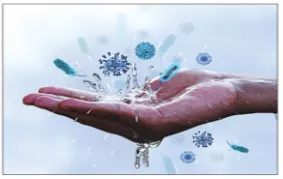
Staving off the superbugs
Clean, safe and well managed water is fundamental to public health. Where water is unclean or sanitation poor, life-threatening diseases such as cholera and typhoid can take root. And where water is unregulated or enforcement lax, contamination from chemicals, pathogens or excreta is a persistent risk. Poor hygiene, meanwhile, exacerbates each of these problems, amplifying one of humanity's gravest (सबसे गंभीर) health security threats: antimicrobial resistance (AMR). AMR occurs when the effectiveness of antimicrobial drugs ¬ including antibiotics ¬ is diminished due to mutations (Alteration or change) in infectious bacteria. This happens when antibiotics are ill-regulated and overused, or when they are used inappropriately or for non-human health. Bacterial mutations and the superbugs they create make treating basic infections such as skin sores or diarrhoea next to impossible. They also make surgery risky. Around 7,00,000 people across the globe already die of AMR each year. If present trends persist, by mid-century AMR will kill more people than cancer. So where does water, sanitation and hygiene come in? To start with, poor sanitation and unsafe water causes a range of bacterial infections that heighten antibiotic usage.Though access across the Southeast Asia region to improved water sources is now at 90%, poor operation and maintenance of water and sanitation systems continues to be a fact of life for many .Millions of people region-wide remain susceptible (संवेदनशील/ग्रहणशील) to water-borne diseases, with high rates of infection compounded by self-medication and inappropriate antibiotic use. Next, poor water, sanitation and hygiene (WASH) in healthcare facilities is a cause of hospital-acquired infections that accelerate bacterial mutations. Just 38% of healthcare facilities in lowland middle-income countries have rudimentary (आधारभूत/प्राथमिक) WASH amenities (सुविधाएँ), resulting in the incubation of a range of deadly pathogens. It is no coincidence that some of the most vicious (dangerous.) antibiotic-resistant bacteria, including NDM1 and MRSA, emerged from healthcare settings. And finally, ill-regulated waste water is scattering antibiotic residues and antibiotic-resistant bacteria throughout the environment, including in drinking water and the food chain. Across the region contaminated (दूषित) wastewater from homes, hospitals, pharmaceutical industries, nursing homes and livestock farms is finding its way into natural water sources, as well as soil and crops. This is hastening (जल्दी करना या होना) the spread of antibiotic resistant pathogens, and increasing human antibiotic consumption. As countries finalise National Action Plans to counter AMR, a return to core WASH principles is needed. By including WASH in multi-sectoral planning, and staying true to a `One Health' approach, governments can neutralise one of AMR's key accelerators and help reverse AMR's growing menace. And they can do so in a way that is cost-effective and has a range of other public health benefits. There are three interventions that will have immediate impact. First, governments can hasten efforts to achieve safe water and sanitation for all. Communities lacking clean water and effective sanitation should be identified in both rural and urban areas, and steps taken to ameliorate (सुधारना) their situation. This could mean treating water at its point of use or systematising the operation and maintenance of local water supply systems. It could also mean investing in water supply systems to serve unreached populations. At the same time, access to safely-managed toilets should be increased by investing in and building them, and by promoting behavioral change aimed at ending open defecation. Second, WASH amenities and training can be enhanced at all healthcare facilities. This can be done by ensuring each facility has a safe and adequate water supply, and that toilets and medical waste management facilities are in or near it. Hand-washing stations should be readily accessible at key points of care, and healthcare workers should be trained in WASH procedures as part of wider infection prevention and control initiatives. To this end, WHO's Clean Care is Safer Care programme is an essential resource, and can be integrated with national policies. And third, regulation and treatment of wastewater can be vastly improved. To do so, investing in water management and treatment infrastructure is crucial, while creating public-private partnerships able to extend service coverage may also be effective. Key contaminators such as hospitals and pharmaceutical plants can meanwhile be encouraged ¬ or required ¬ to develop onsite treatment plants able to neutralise antibiotics and resistant bacteria. Wastewater used in aquaculture and agriculture should also be better regulated to keep water and food systems free of potentially harmful residues and bacteria. Though each of these interventions will have substantial impact, they must be supported by surveillance (निगरानी/निरीक्षण) systems that can monitor the problem effectively and allow policymakers in all sectors to respond as and where needed. There is much that we still do not know about the quantity of antibiotics and resistant bacteria in the environment, and the various ways it got there, meaning gathering actionable information is crucial. Reversing AMR and safeguarding the efficacy (क्षमता/प्रभावोत्पादकता) of our most precious drugs ¬ antibiotics ¬ is a complex undertaking. It requires addressing how antibiotics are produced and regulated; how they are prescribed and consumed; and how different sectors can work together to counter a range of AMR-related threats.It is an undertaking for which WASH principles are well-suited, and for which WASH resources should be marshalled (सुव्यवस्थित करना). In home and hospital, town and city, high quality water, sanitation and hygiene is a vital and cost-effective means to beat back AMR's rapid emergence.Rudimentary (adjective)
Involving or limited to basic principles./ of a primitive kind. आधारभूत/प्राथमिक
Synonyms: Basic, Elementary, Introductory, Primary, Initial, Embryonic
Example: You need to have at least a rudimentary understanding of technology before you can upload a video on that website.
Hasten (verb)
To move in a quick fashion/ be quick to do something. जल्दी करना या होना
Synonyms: Hurry, Expedite, Quicken, Gallop, Scuttle
Example: The increase in property developments is sure to hasten the extinction of many animal species.
Ameliorate (verb)
Make (something bad or unsatisfactory) better. सुधारना
Synonyms: Improve, Amend, Better, Enhance, Refine, Upgrade
Example: One can ameliorate your singing by taking a few vocal lessons.
Efficacy (noun)
The ability to produce a desired or intended result. क्षमता/प्रभावोत्पादकता
Synonyms: Ability, Capability, Capacity, Effectiveness, Potency
Example: Fortunately, the medicine had the efficacy to reduce the amount of pain John was feeling.
Marshal (verb)
Bring together and arrange in order (facts, ideas, objects, etc.). सुव्यवस्थित करना
Synonyms: Arrange, Group, Line Up, Order, Organize
Example: She carefully marshaled her thoughts before answering the question.
Susceptible (adjective)
Likely or liable to be influenced or harmed by a particular thing/ open, subject, or un-resistant to some stimulus, influence, or agency. संवेदनशील/ग्रहणशील
Synonyms: Exposed, Sensitive, Defenseless Against, Prone, Vulnerable
Example: Because James smoked for over twenty years, he is extremely susceptible to respiratory illnesses.
Gravest (adjective)
Giving cause for alarm. सबसे गंभीर
Synonyms: Serious, Profound, Significant, Weighty, Vital, Crucial, Critical
Example: Terrorism is gravest concern to international community.
Amenity (noun)
A desirable or useful feature or facility/ a thing or condition that makes an event or life more enjoyable. सुविधाएँ
Synonyms: Facility, Service, Convenience, Utility
Example: As a parent, I always look for a job that offers the amenity of on-site childcare.
Contaminate (verb)
Make (something) impure by exposure to or addition of a poisonous or polluting substance. दूषित करना
Synonyms: Pollute, Adulterate, Make Impure, Defile
Example: The nurse put on gloves so as not to contaminate herself or the patient.
Surveillance (noun)
Close and continuous observation/ close watch kept over someone or something. निगरानी/निरीक्षण
Synonyms: Vigilance, Supervision, Observance, Monitoring
Example: Conducting undercover surveillance was one of her job duties as a detective on the police force.

Foster competition
Aug 18, 2017
Where we top hope optimism
Aug 17, 2017
Good riddance
Aug 15, 2017
Heed the message
Aug 12, 2017
Mandal's children
Aug 11, 2017
Burgeoning tax base
Aug 09, 2017





Stay updated with The Hindu Editorial Vocab24 app, your definitive source for breaking news and comprehensive coverage from India and around the globe. Whether it's political developments, business updates, sports highlights, the latest technology trends, or current events, The Hindu brings live, accurate, and reliable news directly to your device.
Don’t fall for sensationalized or fake news shared online. Read and share accurate updates with friends and family through The Hindu Editorial Vocab24 app. Download it today!
News Coverage in The Hindu Editorial Vocab24 App
Breaking News: Receive instant notifications on breaking news stories as they unfold. Stay informed about major events and developments in India and around the world with live blogs, news in shorts videos, and concise articles.
Politics: Get the latest updates on Indian politics, including elections, policy changes, government decisions, and political events that shape the nation.
Business and Economy: Stay ahead in the economic landscape with detailed business news and market analysis. Learn about stock market trends, financial reports, corporate news, and economic developments to make informed investment decisions.
Current Events: Follow stories on social issues, policy changes, global events, and daily current affairs, tailored for UPSC and other competitive exam preparations.
Technology: Keep up with the latest gadgets, innovations, and tech trends. Read expert reviews and analyses in short, concise updates on cutting-edge technology from India and beyond.
Sports: Never miss a moment of your favorite sports. Get live scores, match reports, and expert analysis on cricket, football, tennis, and more.
International News: Stay informed about global events and geopolitical developments, including the Russia-Ukraine war, Israel-Palestine conflict, and other key international stories.
Local News: Stay connected to your community with the latest updates on city events, issues, and local news. Coverage includes hyperlocal updates from cities like Bangalore, Chennai, Delhi, Hyderabad, Mumbai, Kolkata, and more.
Trending Topics: Discover what's trending today with the most talked-about stories and hot topics across India and the world.
Experience journalism that values integrity, accuracy, and reliability. Download The Hindu Editorial Vocab24 app today and stay connected with the world.
Subscribe to our newsletter!







