

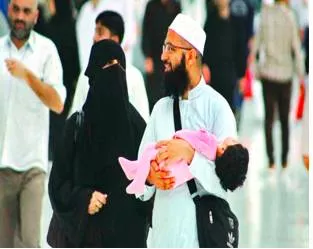
Some musings on the uniform civil code
Though Article 44 of the Constitution has wanted a Uniform Civil Code, which also protects the rights of women, it has taken a long time coming.I insist I have the right to marry up to four wives at a time. If I wish to marry more, I can divorce one of the current spouses and take on a fifth. Concomitant with my insistence, the law insists that if I happen to be caught having stolen someone’s property, my hand would be cut off as punishment. My response would be: “No, no, no; the Indian Penal Code given by Lord Macaulay will be sufficient.”
The Constitution of 1950 is satisfactory and all other laws are acceptable, except when it comes to marriage and divorce. Article 30 of our national document allows me to follow my religion. Heads I win, tails you lose, because I am a spoilt child of the country. That is why I do not live in the State of Goa, where only one civil law applies. It does not admit the privileges of a spoilt child.
Actually, all other laws of my country are rational and correct. My grandfather decided we should stay back in India and not migrate to Pakistan when Partition was declared. When I grew up, my grandfather explained to me why he chose Hindustan over Pakistan.
Here, with Jawaharlal Nehru and hopefully his daughter in power after him, we could expect special treatment as their favourite children. The reason is that the great man was culturally a Muslim, so much so that his wedding invitation card, issued from Prayagraj (then Allahabad), was printed in the Urdu language. Moreover, he needed our vote because staunch Hindus would not touch him; they would go for the Jana Sangh.
No doubt, Article 44 of the Constitution has wanted a Uniform Civil Code (UCC), which also protects the rights of women. But my grandfather had assured me that this Article would remain in cold storage for as long as we liked. It would indeed have been so, but for Nehru’s grandson Rajiv Gandhi’s blunder in passing the Muslim Women’s Bill. Shah Bano was being awarded some `500 per month by the Supreme Court of India. Its memory would have faded out before long, but our leaders like Syed Shahbuddin, who were really bureaucrats, stepped in. Subsequently, without ever having visited Ayodhya, leaders like him took a strident stand over the Babri maqbara. It could not have been a masjid; it had to be a maqbara.
Firstly, there were hardly two years left in Babar’s life when his sidekick Mir Baqi began to demolish that temple. Baqi would have been a Shia cipher after Babar. He had, therefore, claimed it as an edifice in honour of Babar. If it were a masjid, where was its wuzoo and its mimbar? What did Muslims do when Hindus began their puja on the place’s chabutara (platform) and later inside? Our leaders only awakened and agitated Hindus, thus bringing first AB Vajpayee and eventually Narendra Modi — who is committed to Article 44 and the UCC — to power. In my grandfather’s words, had there been no resistance, the Babri balloon would have absorbed no gas and wouldn’t have burst into flames the way it did.
Does anyone realise that our Sharia helps to keep control, or rather act as deterrence, over our womenfolk? It is like a concealed Damocles’ sword over our married women, and thus maintains peace and balance in our community. As our Prophet commanded — and we obey — our community has been an expanding torrent. The third advantage has been that we have remained united. Unlike us, look at what happened to the Yahudis (Jews), who have shrunk or the Eesaais (Christians), who in the West have lost interest in the God who gave up his life on the cross for them. The only faith that has continually added to the capital of population is ours. Now, with the bringing in of the UCC, capital accumulation in terms of heads would cease. There are many countries whose capital is depleting: Japan, for instance, does not produce enough children nor allows immigration. I have heard it may not have any people in the coming hundred years.
They say democracy cannot function without secularism and uniformity of law. Furthermore, this Constitution guarantees equality for all citizens. But, think about it, our community has flourished without any democracy, although with uniform law(s) — for ourselves. Actually, it is democracy that came after India was free and also became a Dar-ul-Harb (the land where Islam does not rule). Until the beginning of 1858, the Mughal Bahadur Shah Zafar was the emperor; later, he was convicted and exiled. India was a Dar-ul-Islam till then.
Yet, many extremists go to any length and even quote Nehru on this subject. The Hindu Code Bill became a law in 1955. Answering a Lok Sabha member’s question, Nehru told Parliament: “Well, I should like a civil code which applies to everybody, but wisdom hinders. If he (the member) or anybody else brings forward a civil code, it will have my extreme sympathies. But I confess that I do not think that at the present moment, the time is ripe in India for me to try and push it through. I want to prepare the ground for it.”
Can quad restrain wayward china
May 29, 2022
Concerns over finland sweden joining nato
May 22, 2022
Sustainability road to a better future
May 16, 2022
Aap lays out its goal
May 11, 2022
Shanghai covid crisis a test for xi’s leadership
May 09, 2022
The idea of universal equality
May 06, 2022





Stay updated with The Hindu Editorial Vocab24 app, your definitive source for breaking news and comprehensive coverage from India and around the globe. Whether it's political developments, business updates, sports highlights, the latest technology trends, or current events, The Hindu brings live, accurate, and reliable news directly to your device.
Don’t fall for sensationalized or fake news shared online. Read and share accurate updates with friends and family through The Hindu Editorial Vocab24 app. Download it today!
News Coverage in The Hindu Editorial Vocab24 App
Breaking News: Receive instant notifications on breaking news stories as they unfold. Stay informed about major events and developments in India and around the world with live blogs, news in shorts videos, and concise articles.
Politics: Get the latest updates on Indian politics, including elections, policy changes, government decisions, and political events that shape the nation.
Business and Economy: Stay ahead in the economic landscape with detailed business news and market analysis. Learn about stock market trends, financial reports, corporate news, and economic developments to make informed investment decisions.
Current Events: Follow stories on social issues, policy changes, global events, and daily current affairs, tailored for UPSC and other competitive exam preparations.
Technology: Keep up with the latest gadgets, innovations, and tech trends. Read expert reviews and analyses in short, concise updates on cutting-edge technology from India and beyond.
Sports: Never miss a moment of your favorite sports. Get live scores, match reports, and expert analysis on cricket, football, tennis, and more.
International News: Stay informed about global events and geopolitical developments, including the Russia-Ukraine war, Israel-Palestine conflict, and other key international stories.
Local News: Stay connected to your community with the latest updates on city events, issues, and local news. Coverage includes hyperlocal updates from cities like Bangalore, Chennai, Delhi, Hyderabad, Mumbai, Kolkata, and more.
Trending Topics: Discover what's trending today with the most talked-about stories and hot topics across India and the world.
Experience journalism that values integrity, accuracy, and reliability. Download The Hindu Editorial Vocab24 app today and stay connected with the world.
Subscribe to our newsletter!







