

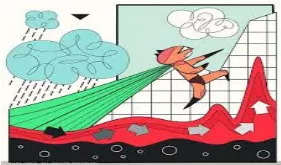
Sharpen the focus on growth
Now that the dust and din around the State Assembly elections have settled down, it is time for policymakers to turn their attention to the major task of accelerating economic growth. As of now the prospects are not encouraging. The Central Statistics Office’s second advanced estimates indicate that the growth rate of GDP for 2016-17 will be 7.1% as against 7.9% in 2015-16. The growth rate of gross value added at basic prices in 2016-17 will be 6.7% as against 7.8% in 2015-16. The growth rates projected for 2016-17 do not capture the impact of demonetisation, which when taken into account may bring down the projected growth rate by around 0.5%. The decline in the growth rate is not a recent phenomenon. It started in 2011-12. The persistence of relatively low growth over a five-year period calls for a critical examination. Even though the new numbers on national income give us some comfort, they do not tell the whole story. Determinants of growth Ultimately, the growth rate is determined by two factors — the investment rate and the efficiency in the use of capital. As the Harrod-Domar equation puts it, the growth rate is equal to the investment rate divided by the incremental capital-output ratio. The incremental capital-output ratio (ICOR) is the amount of capital required to produce one unit of output. The higher the ICOR, the less efficient we are in the use of capital. There are many caveats (चेतावनी/प्रतिवाद) to this bald proposition. As we look at the Indian performance in the last five years, two facts stand out. One is a decline in the investment rate and the second is a rise in ICOR; both of which can only lead to a lower growth rate. As growth was coming down sharply initially, the investment rate was falling only slowly, implying a rising ICOR. ICOR is a catch-all expression which is determined by a variety of factors including technology, skill of manpower, managerial competence and also macroeconomic policies. Thus delays in the completion of projects, lack of complementary investments in related sectors and the non-availability of critical inputs can all lead to a rise in ICOR. The Economic Survey of 2014-15 reported that there were in all 746 stalled projects, with 161 in the public sector and 585 in the private sector of a total value of Rs. 8.8 lakh crore. As of 2015-16, there were still 404 stalled projects, 162 in the public sector and 242 in the private sector with a total value of Rs. 5.5 lakh crore. In the short run, the biggest gain in terms of growth will be by getting “stalled projects” moving. of course some of them may be unviable (अविकासक्षम/अव्यवहार्य) because of changed conditions. A periodic reporting by the government on the progress of stalled projects will be of great help. Declining investment rate India’s investment rate reached a peak in 2007-08 at 38.0% of GDP. With an ICOR of 4, it was not surprising that a high growth rate of close to 9.4% was achieved. One sees a steady decline in the investment rate since then. The decline in the rate was small initially but has been more pronounced in the last two years. According to the latest estimates, the gross fixed capital formation rate fell to as low as 26.9% in 2016-17. With this investment rate, it is simply impossible to achieve a growth rate in the range of 8 to 9%. The major issue confronting us is: why did the investment rate fall? Why are not new investments forthcoming? In 2011 and 2012, in discussions on the Indian economy, the one phrase that used to be bandied (चर्चा करना/बहस करना) about was “policy paralysis”, pointing to the inability of the government to take policy decisions because of “coalition (गठबंधन) compulsions”. It is true that around this period, the government was preoccupied with answering many issues connected with graft (भ्रष्टाचार) . But that does not explain the steady fall in the investment rate except for a sense of uncertainty created in the minds of investors. The external environment was also not encouraging. The growth rate of the advanced economies remained low and the recovery from the crisis of 2008 was tepid which had an adverse impact on exports. However, India benefited by large capital inflows except in 2013. For almost three years beginning 2010, India had to cope with (सामना करना) a high level of inflation which also had an adverse impact on investment sentiment. Once the growth rate starts to decline, it sets in motion a vicious (अनैतिक/सदोष) cycle of decline in investment and lower growth. The acceleration principle begins to operate. We need to break this chain in order to move on to a higher growth path. Solutions What are the solutions, given the current situation? The standard prescription, whenever private investment is weak, is to raise public investment which can take a longer term view. This standard suggestion is very much appropriate in the present context as well. In the best of times, public investment has been 8% of GDP. The Central government’s capital expenditures even after some increase in the last two years, is only 1.8% of GDP. About 3 to 4% of GDP comes from public sector undertakings and the balance from State governments. What is needed now is for public sector undertakings to come out with an explicit statement indicating the extent of investment they intend to make during the current fiscal. And this intention must be monitored every quarter. This will inspire confidence among prospective private investors. However, it is also necessary to enhance private investment, and that too private corporate investment. During the high growth phase, corporate investment reached the level of 14% of GDP. Since then it has fallen. In fact, a recent study shows that the total cost of projects initiated by the corporate sector has come down from Rs. 5,560 billion in 2009-10 to Rs. 954 billion in 2015-16. This continuing trend must be reversed. Three things need attention. First, reforms to simplify procedures, speed up the delivery system and enlarge competition must be pursued vigorously (उत्साह सहित) . Some significant steps have been taken in this regard in recent years such as moving forward on the GST Bill, passing of the Bankruptcy Act, and enlarging the scope of foreign direct investment. Second, all viable (विकासक्षम/व्यवहार्य) “stalled” projects must be brought to completion. Third, financial bottlenecks (अवरोध) need to be cleared. The banking system is under stress. The non-performing loans of the system have risen and are rising. This has squeezed the profitability of banks with some showing loss. More distressing is the minimal flow of new credit. The problem is often referred to as the twin balance sheet problem. If corporate balance sheets are weak, automatically the banks’ balance sheets also become weak. Really speaking, it is two sides of the same coin. The solution to clean up the balance sheet of banks lies in taking some “haircuts”. At least some part of the accumulation of bad debts has been due to the slowdown of the economy. The old saying is “bad loans are sown in good times”. Even though a haircut cannot be avoided, wilful defaulters must not go unpunished. Asset restructuring companies are part of the solution and we have some experience of them. Long-term lending This is also the appropriate time to revive an idea which had withered away (क्षीण होना) during the reform process and that is to have institutions focussed on long-term lending such as IDBI and ICICI as they were before 1998. The details can be worked out. But the idea needs a rethink. Investment, as they say, is an act of faith in the future. If there has to be investment resurgence (पुनरुत्थान) , it is necessary to create the climate which promotes this faith. We have already outlined the actions that can be taken in the purely economic arena. But “animal spirits” are also influenced by what happens in the polity and society. Avoidance of divisive issues is paramount (प्रधान/सर्वोच्च) in this context. Undiluted attention to development is the need of the hour.


Economic Survey promises, impact of new labour codes
Mar 16, 2026
Preparing India for a true innovation-led economy
Mar 15, 2026
Cheaper loans likely as repo rate cut by 25 bps
Dec 08, 2025
Iip growth dips to three month low of 4 in sept
Oct 31, 2025





Stay updated with The Hindu Editorial Vocab24 app, your definitive source for breaking news and comprehensive coverage from India and around the globe. Whether it's political developments, business updates, sports highlights, the latest technology trends, or current events, The Hindu brings live, accurate, and reliable news directly to your device.
Don’t fall for sensationalized or fake news shared online. Read and share accurate updates with friends and family through The Hindu Editorial Vocab24 app. Download it today!
News Coverage in The Hindu Editorial Vocab24 App
Breaking News: Receive instant notifications on breaking news stories as they unfold. Stay informed about major events and developments in India and around the world with live blogs, news in shorts videos, and concise articles.
Politics: Get the latest updates on Indian politics, including elections, policy changes, government decisions, and political events that shape the nation.
Business and Economy: Stay ahead in the economic landscape with detailed business news and market analysis. Learn about stock market trends, financial reports, corporate news, and economic developments to make informed investment decisions.
Current Events: Follow stories on social issues, policy changes, global events, and daily current affairs, tailored for UPSC and other competitive exam preparations.
Technology: Keep up with the latest gadgets, innovations, and tech trends. Read expert reviews and analyses in short, concise updates on cutting-edge technology from India and beyond.
Sports: Never miss a moment of your favorite sports. Get live scores, match reports, and expert analysis on cricket, football, tennis, and more.
International News: Stay informed about global events and geopolitical developments, including the Russia-Ukraine war, Israel-Palestine conflict, and other key international stories.
Local News: Stay connected to your community with the latest updates on city events, issues, and local news. Coverage includes hyperlocal updates from cities like Bangalore, Chennai, Delhi, Hyderabad, Mumbai, Kolkata, and more.
Trending Topics: Discover what's trending today with the most talked-about stories and hot topics across India and the world.
Experience journalism that values integrity, accuracy, and reliability. Download The Hindu Editorial Vocab24 app today and stay connected with the world.
Subscribe to our newsletter!







