

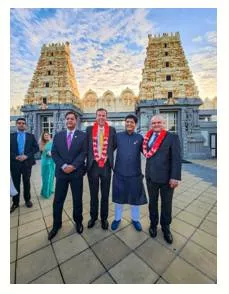
Sending a strategic message
The footings for stronger India-Australia ties have been set.At a recent meeting in New Delhi, Prime Minister Narendra Modi was almost forced to give a brief lecture on geological history to his colleagues while highlighting the importance of integrating the Indian and Australian economies in contemporary times. By way of a metaphor, he pointed out how India and Australia were part of the same supercontinent, the Gondwanaland, until both drifted apart during the Jurassic age. For a variety of reasons, almost till the beginning of this century, New Delhi and Canberra remained apart much after the original tectonic shifts had originally split them.
A historic deal
A pivotal moment in history for the two countries was struck on April 2, when Australia and India struck a trade deal after two decades of efforts. Mr. Modi described it as a “watershed moment for bilateral relations”. The India-Australia Economic Co-operation and Trade Agreement (IndAus ECTA) eliminates tariffs on more than 85% of Australian goods exports to India (valued at more than $12.6 billion a year).
With a GDP expected to grow at 9% in 2021-22, India is the world’s fastest growing major economy. Today, the growth opportunities for Australian businesses are larger in India than in any other market. Over the five years leading up to the pandemic, two-way trade and investment between Australia and India doubled. Now, IndAus ECTA is “expected to increase bilateral trade from AUD$36.7 billion to AUD$60 billion,” according to Commerce Minister Piyush Goyal.
Through IndAus ECTA, tariffs on a range of Australian exports to India, including coal, lentils, sheep meat, wool, lobsters and rare earths, will be eliminated. The deal also includes a phased reduction of tariffs on wine and agricultural products including avocados, cherries, nuts and blueberries. This is welcoming news to Australian businesses, particularly in the face of economic sanctions on a range of Australian produce they faced from China last year.
The deal also extends to enhancing services exports and strengthening our people-to-people links, including a quota for chefs and yoga teachers, post-study work visa of 2-4 years for Indian students on a reciprocal basis, mutual recognition of professional services and other licensed/regulated occupations, and work and holiday visa arrangements for young professionals. The role of the Indian diaspora as a key national economic asset should not be underestimated in this deal. Data from the India Economic Strategy Update confirm that nearly one in five overseas students in Australia are from India, making full fee-paying Indian students the largest group of overseas students.
But as a former Indian Ambassador to Australia tweeted, it is the strategic message of this ECTA that is as important as its economic content. With the turbulence faced by both nations in the Indo-Pacific region, the convergence of economic and geopolitical risks is real. ECTA is a clear response to those changing dynamics that both countries face. And the fact that India today counts on the support of Australia through the Quad and maritime security and now through a trade agreement shows the diversification of its strategic and economic approach.
A deal despite challenges
Yet the Russian invasion of Ukraine remains a ‘balancing act’ for India. Half of its arms imports come from Russia and some 70% of its military hardware is Russian-made. The need for India’s military diversification is now greater than ever. Australia is limited in its delivery on this front. And whilst India would no doubt like to rely less on Russia, the U.S. is not stepping up to supply India with its latest missiles.
It is a testament to the growing resilience and bandwidth of bilateral ties that despite differences over India’s reticence in condemning the war in Ukraine and its purchase of heavily discounted Russian oil, the trade deal was brought to a closure with remarkable alacrity. In the past, Canberra’s fierce response to India’s 1988 nuclear tests and the Indian media’s over-the-top reaction to attacks on Indian students in Melbourne in 2009-2010 had almost derailed ties.
While both countries have come from different places, they seem to have arrived at the same place, practising economic liberalisation at their own pace. Hailing from opposite sides of power blocs during the Cold War, they now have shared norms and democratic principles and support a rules-based order. While they will continue to face headwinds that create new geopolitical and economic uncertainties, the footings for a stronger relationship have been set. Their mutual commitment to economic advancement through IndAus ECTA is symbolic of how far the relationship has come. That means the future for both nations’ peoples is full of promise and opportunity.




Top court quashes FIRs against Gen Z protesters
Sep 04, 2026







Stay updated with The Hindu Editorial Vocab24 app, your definitive source for breaking news and comprehensive coverage from India and around the globe. Whether it's political developments, business updates, sports highlights, the latest technology trends, or current events, The Hindu brings live, accurate, and reliable news directly to your device.
Don’t fall for sensationalized or fake news shared online. Read and share accurate updates with friends and family through The Hindu Editorial Vocab24 app. Download it today!
News Coverage in The Hindu Editorial Vocab24 App
Breaking News: Receive instant notifications on breaking news stories as they unfold. Stay informed about major events and developments in India and around the world with live blogs, news in shorts videos, and concise articles.
Politics: Get the latest updates on Indian politics, including elections, policy changes, government decisions, and political events that shape the nation.
Business and Economy: Stay ahead in the economic landscape with detailed business news and market analysis. Learn about stock market trends, financial reports, corporate news, and economic developments to make informed investment decisions.
Current Events: Follow stories on social issues, policy changes, global events, and daily current affairs, tailored for UPSC and other competitive exam preparations.
Technology: Keep up with the latest gadgets, innovations, and tech trends. Read expert reviews and analyses in short, concise updates on cutting-edge technology from India and beyond.
Sports: Never miss a moment of your favorite sports. Get live scores, match reports, and expert analysis on cricket, football, tennis, and more.
International News: Stay informed about global events and geopolitical developments, including the Russia-Ukraine war, Israel-Palestine conflict, and other key international stories.
Local News: Stay connected to your community with the latest updates on city events, issues, and local news. Coverage includes hyperlocal updates from cities like Bangalore, Chennai, Delhi, Hyderabad, Mumbai, Kolkata, and more.
Trending Topics: Discover what's trending today with the most talked-about stories and hot topics across India and the world.
Experience journalism that values integrity, accuracy, and reliability. Download The Hindu Editorial Vocab24 app today and stay connected with the world.
Subscribe to our newsletter!







