

Sco and a new order
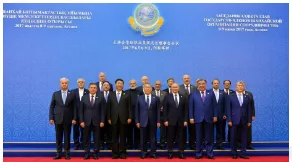
The Shanghai Cooperation Organisation (SCO) was an early initiative by China to knit together important regional countries in Asia in an organisation that had significant security overtones. The first meeting took place in 2001, with six founder members among which Russia and China were the most prominent, and with them there were some other major countries of Central Asia. The organization was aimed at opposing intervention by outside powers in the internal affairs of the members, and at safeguarding their independence. It was thus in some ways a response to uncertainties in the Eurasia region about the future path of NATO, which was at that time casting its net wide into Asia and aiming at wiping clean the remnants (अवशेष/आसार/उत्तरजीवी) of the Soviet system in the region. While nobody by then found any great value in defending the now more or less defunct (अप्रचलित/पुराना) Soviet way, there were regional concerns about the longer-term implications (तात्पर्य) of these developments. The authoritarian governments of Central Asia that had survived the Soviet fall were under pressure from the democratic ideology and newly expressed libertarian impulses of the time, supported by major international institutions like the IMF. It was feared that there could be a wholesale unsettling of established governments and a new political order could come into being, oriented away from the traditional leadership of the region. It was in this context that SCO first took shape, bringing together in their own interest a number of countries that felt threatened by unaccustomed winds of change. These countries were united by their readiness to oppose intervention (व्यवधान/हस्तक्षेप) in their internal affairs, which meant in effect standing up to nonregional pressures for change in Central Asia. SCO thus aimed at stabilising relations between the countries of the region and promoting solidarity (एकजुटता) in the face of a shared threat perception. It was not the first group of members alone that came together for this purpose: from the start other countries were drawn to SCO for the promise it embodied of political stability and good order. Iran and Mongolia were among those that attended early meetings as observers, before they could aspire to full membership. India and Pakistan also showed interest in the newly established body, and made their respective bids for membership a decade ago. The recent SCO meeting in Astana (Kazakhstan) confirmed the membership of these two South Asian countries and thereby gave a new dimension to SCO. The steady enlargement of its membership has made SCO a highly significant organisation whose influence is on the increase. Its major importance as a multilateral body is in the political arena, and the many accretions to its membership show that its message remains strong and relevant in the present-day. At one stage, in the early days of its setting up, exaggerated claims were sometimes heard about the significance of SCO, and some analysts considered that its structure and potential were such as to make it a rival to NATO in the post-Soviet world. That is not how its members saw and described the organisation, but the fact that such a substantial and potentially powerful international body had taken shape was not without strategic implications. The bare statistics tell their own story: SCO’s eight members comprise half of the world’s population and a quarter of its GDP; it includes two of the five permanent members of the UN Security Council in addition to several of the large emerging economies, and it is set to advance further and enlarge its sphere of activity. Though initially SCO’s focus was on political issues, it now gives much attention to economic and other matters, though security-related questions continue to be foremost (सर्वप्रथम/मुख्यतः) in its deliberations (विचार विमर्श) . These priorities reflect the enduring preoccupations of the member states. They also resonate strongly with Indian policy which has long been oriented towards highlighting such issues internationally, and repeatedly calling for suppression of terrorism, separatism and extremism. An expanding agenda is being developed by SCO, including items like joint military exercises to give substance to the anti-terror concerns that are at the core of the SCO consensus (सर्वसम्मति) . At the same time, there is an active desire to enlarge economic cooperation among the members. India apart, they are all part of the China led OBOR initiative, though where this concept could be leading is as yet not clear, and India is not the only regional entity to ask questions of the very far-reaching OBOR scheme for transport and infrastructure links within and beyond the region. However, having an eye to the dynamism of the region as a whole, and parallel developments elsewhere within the region, SCO looks set to bring about profound (गम्भीर) changes in the economic development of Eurasia. Already there is talk of a new Free Trade Area (FTA) to bind participating countries more closely, perhaps to emulate (की तरह काम करना/अनुसरण करना) other similar concepts elsewhere. Nor can the contrast be ignored between the upbeat economic message of SCO and the awkward developments in the Trans Pacific Partnership (TPP) caused by the withdrawal earlier this year of the USA, which was the weightiest of the founder members. What shape TPP will take in the future, whether USA will rejoin, and other questions about this major trans-regional organisation will need to be dealt with as the rest of the members come to terms with the abrupt withdrawal of the USA. In all events, these developments could presage (आगम कहना) a shift in the geo-political balance away from the West, and the manysided cooperation that has grown between China and Russia could have an expanding impact globally. SCO is thus more than just a functional body with specific benefits for its members, and it can help reshape the future global balance. For the moment, however, especially so far as the Indian media are concerned, the substantive results and the further potential of the SCO meeting in Astana have been upstaged by a handshake between the Prime Ministers of India and Pakistan. Indo-Pak relations are at a nadir (निम्नतम स्तर), exchanges between the two sides have been highly acrimonious (कटुतापूर्ण), so the handshake at Astana attracted a great deal of attention. The polite gesture triggered comment and expectation though both sides were at pains to play down unwarranted anticipation from the chance meeting of the PMs. Both were first time participants as full members of SCO, and even though their differences on many of the agenda items, particularly terror-related issues, have been loudly expressed, Indo-Pak relations have their own dynamic and tend to crowd out attention to other matters, as was the case at Astana. India has real concerns over questions of terrorism and extremism, which have helped drive it towards membership of SCO for collective action to curb these threats. It will expect concrete results from its participation in SCO.





Stay updated with The Hindu Editorial Vocab24 app, your definitive source for breaking news and comprehensive coverage from India and around the globe. Whether it's political developments, business updates, sports highlights, the latest technology trends, or current events, The Hindu brings live, accurate, and reliable news directly to your device.
Don’t fall for sensationalized or fake news shared online. Read and share accurate updates with friends and family through The Hindu Editorial Vocab24 app. Download it today!
News Coverage in The Hindu Editorial Vocab24 App
Breaking News: Receive instant notifications on breaking news stories as they unfold. Stay informed about major events and developments in India and around the world with live blogs, news in shorts videos, and concise articles.
Politics: Get the latest updates on Indian politics, including elections, policy changes, government decisions, and political events that shape the nation.
Business and Economy: Stay ahead in the economic landscape with detailed business news and market analysis. Learn about stock market trends, financial reports, corporate news, and economic developments to make informed investment decisions.
Current Events: Follow stories on social issues, policy changes, global events, and daily current affairs, tailored for UPSC and other competitive exam preparations.
Technology: Keep up with the latest gadgets, innovations, and tech trends. Read expert reviews and analyses in short, concise updates on cutting-edge technology from India and beyond.
Sports: Never miss a moment of your favorite sports. Get live scores, match reports, and expert analysis on cricket, football, tennis, and more.
International News: Stay informed about global events and geopolitical developments, including the Russia-Ukraine war, Israel-Palestine conflict, and other key international stories.
Local News: Stay connected to your community with the latest updates on city events, issues, and local news. Coverage includes hyperlocal updates from cities like Bangalore, Chennai, Delhi, Hyderabad, Mumbai, Kolkata, and more.
Trending Topics: Discover what's trending today with the most talked-about stories and hot topics across India and the world.
Experience journalism that values integrity, accuracy, and reliability. Download The Hindu Editorial Vocab24 app today and stay connected with the world.
Subscribe to our newsletter!







