

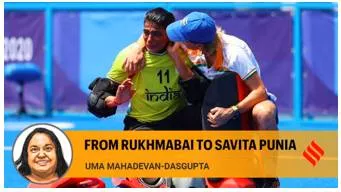
Savita punia and other women olympians walk the path laid by pioneering indian women
Girish Karnad’s memoir begins with his mother’s life. At the age of 84, Kuttabai Mankikar wrote her story. Not in a fresh clean notebook, but in an old diary kept by her husband. She scribbled her sentences into the empty spaces after he had written his daily accounts. This could be a metaphor for the way most women of that generation had to live their lives — curling and fitting themselves like side characters around their husbands’ central narratives.Kuttabai’s life story was 30 pages long. She yearned to study medicine and become a doctor. She never got that far. Married as a child, she became first a teenage mother, and then a child widow. After great struggle, she managed to train as a nurse. But when she remarried, she had to roll up her nursing certificates and put them away in a dusty trunk. She had children to raise.
Every sentence in Kuttabai’s life story is a punch to the gut. As a young girl, she was not allowed to study in a hostel. She was unmarried when she came of age, a matter of shame for her parents. Shortly after, her husband died of malaria. The young widow had to go live in her brother-in-law’s house. When the time came to remarry, her second husband hesitated. He was already married, but bigamy was not what worried him. What would society say if he married a widow?
Education — how they hungered for it, the girls and women of those times. Karnad notes how his mother recalled with wonder, 75 years later: “One Sarlabai Nayak even got an MA.”
In her new book Lady Doctors, Kavitha Rao writes about the lives of India’s first women in medicine. Even just typing in the names of these trailblazers is exhilarating. Anandibai Joshi, Kadambini Ganguly, Rukhmabai Raut, Muthulakshmi Reddy, Haimabati Sen, Mary Poonen Lukose — pioneers who, from the 1860s to the 1930s, made so much possible for women who came after them.
They were not just entering a new professional field. They were taking on the might of patriarchy and religious conservatism.
“Society has a right to our work as individuals,” said Anandibai, the first Indian woman to get a western medical degree. As a girl, Rukhmabai fought child marriage, not only through legal challenge but also by writing two powerful letters in a national newspaper which brought the issue into public consciousness. After a long court battle, the judge finally ruled that she must join her husband within a month, or face six months’ imprisonment. She said she would rather go to prison.
At school, Muthulakshmi sat behind a curtain in a classroom because she was a girl and the daughter of a devadasi. Later in life, she would introduce legislation against the exploitative devadasi system and child marriage; set up a shelter where girls could stay, acquire skills and earn a livelihood; and also set up the Adyar Cancer Institute. Today, Tamil Nadu’s celebrated maternity benefit scheme, acknowledged for its impact, is named after Muthulakshmi Reddy.
At the age of nine, Haimabati was married to a widower five times her age. When she was 12, her husband died. As a child widow, she faced the fury of society and even her own mother for bringing “misfortune”. At medical college, although Haimabati stood first, the boys threatened to go on strike if the gold medal was given to a girl. She was given a silver medal for “standing first in class.”
This week, watching the Indian women at the Olympics, I thought of Rukhmabai, Haimabati and the others. Typing these names, too, is exhilarating. Rani Rampal, whose mother would wake her up for training after looking out at the sky, because there was no clock at home. Vandana Katariya, who practised alone, with tree branches, to avoid the disapproving stares of village elders. Savita Punia, who had to endure long bus rides with conductors kicking her hockey kits. Salima Tete from Simdega, who used a bamboo stick to learn the game.
Girls who were told not to run around in skirts; who were told not to play; who were told not to. Girls who survived the worst sex ratios; who pushed back against regressive social norms; who made a noise instead of staying silent; who ran around, even though the world asked them not to take up space.
It’s a long road from Rukhmabai to Savita Punia, with many obstacles along the way. In some places the road doesn’t even exist — the approach to Lovlina Borgohain’s house was built only after her Olympic medal. Even where there is a path, there is a need for allies, like the truckers who dropped Saikhom Mirabai Chanu to her training centre.
When I thought about the Rukhmabais and Kadambinis, Ranis and Salimas and Mirabais, I thought of the tangled threads that connect the lives of Indian women. I thought of my grandmothers, who never even finished school — wise women who kept their families together with a watchful eye and tough love. I thought about the anganwadi supervisor who went to check on a malnourished toddler and, finding a home where the fire hadn’t been lit for days, cooked a meal and showed the mother how to bathe her child.
I thought about the ASHAs who have worked indefatigably through this year and a half of the pandemic, walking from house to house to convey reassuring, science-based information about Covid and vaccination.
And finally, I thought of the child marriages we still fight against. Little girls as young as nine, 10, 12, who send messages for help through their school friends, begging to be rescued from forced marriage. Kadambini and Anandibai may have crossed the kaala paani over a 100 years ago, but for many girls in India even today, the road to empowerment is long and arduous.











Stay updated with The Hindu Editorial Vocab24 app, your definitive source for breaking news and comprehensive coverage from India and around the globe. Whether it's political developments, business updates, sports highlights, the latest technology trends, or current events, The Hindu brings live, accurate, and reliable news directly to your device.
Don’t fall for sensationalized or fake news shared online. Read and share accurate updates with friends and family through The Hindu Editorial Vocab24 app. Download it today!
News Coverage in The Hindu Editorial Vocab24 App
Breaking News: Receive instant notifications on breaking news stories as they unfold. Stay informed about major events and developments in India and around the world with live blogs, news in shorts videos, and concise articles.
Politics: Get the latest updates on Indian politics, including elections, policy changes, government decisions, and political events that shape the nation.
Business and Economy: Stay ahead in the economic landscape with detailed business news and market analysis. Learn about stock market trends, financial reports, corporate news, and economic developments to make informed investment decisions.
Current Events: Follow stories on social issues, policy changes, global events, and daily current affairs, tailored for UPSC and other competitive exam preparations.
Technology: Keep up with the latest gadgets, innovations, and tech trends. Read expert reviews and analyses in short, concise updates on cutting-edge technology from India and beyond.
Sports: Never miss a moment of your favorite sports. Get live scores, match reports, and expert analysis on cricket, football, tennis, and more.
International News: Stay informed about global events and geopolitical developments, including the Russia-Ukraine war, Israel-Palestine conflict, and other key international stories.
Local News: Stay connected to your community with the latest updates on city events, issues, and local news. Coverage includes hyperlocal updates from cities like Bangalore, Chennai, Delhi, Hyderabad, Mumbai, Kolkata, and more.
Trending Topics: Discover what's trending today with the most talked-about stories and hot topics across India and the world.
Experience journalism that values integrity, accuracy, and reliability. Download The Hindu Editorial Vocab24 app today and stay connected with the world.
Subscribe to our newsletter!







