

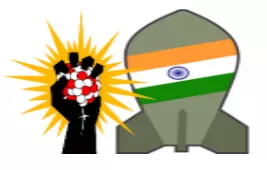
Revisiting india’s nuclear doctrine
Calls for reassessing India’s nuclear doctrine (a stated principle of government policy, mainly in foreign or military affairs.) are a regular feature of our strategic landscape. Depending on where the person asking for this reconsideration sits on the strategic spectrum, the demand for revision rests either on scepticism (संशयवाद) about India’s commitment to a No First Use posture or the intention to retaliate (make an attack in return for a similar attack.) massively to any nuclear first strike, no matter what the yield of the weapon used first. What seems to receive much less attention, however, is the declaration that India reserves the right to nuclear retaliation “in the event of a major attack against India, or Indian forces anywhere, by biological or chemical weapons”. In doing so, we are clubbing (combine with others) together nuclear first use — which has not occurred since 1945 — and biological and chemical first use which, especially chemical, continues to occur sporadically (at irregular intervals.) , whether by state or non-state actors. The further question of degree, as in “major attack”, only further muddies these already murky waters. Use of chemical weapons The dramatic assassination in Malaysia last month of North Korean Kim Jong-nam by the chemical agent VX, which was almost certainly orchestrated (गुप्त रूप से आयोजित करना) by elements within the North Korean state, adds another layer to questions about making sponsors of chemical attacks accountable. The ease with which deadly chemicals can be transported across state borders, as demonstrated by the assault, gives further pause. This is not to try to equate a political assassination with a military attack using chemical weapons. The fact remains, however, that the 1992 Chemical Weapons Convention has succeeded in only partly making their use utterly reprehensible (निन्दनीय) ; their use is beyond the pale but will not alter the course of history in the manner that we expect will follow a nuclear explosion. Quite simply, there is a fairly strong norm governing the non-use of nuclear weapons; the norm (मानक/मानदंड) against the use of chemical and biological weapons is still coalescing (संगठित होना/साथ बढ़ना). Despite being banned, chemical weapons have not gone away. They have cropped up frequently in Syria and Iraq, where their recent use has been attributed to the Islamic State. The murder of Kim Jong-nam was the stuff of a spy thriller: two young women approached the estranged half-brother of North Korean leader Kim Jong-un and poisoned him with VX, a nerve agent so deadly that a drop on exposed skin is lethal (जानलेवा) . The execution was breathtaking in its simplicity: the women delivering the VX were apparently duped into believing they were taking part in a reality TV prank. This was, however, not out of the pages of a spy thriller, but from the playbook of a regime that appears not to fear the consequences of using an internationally banned chemical substance for a political assassination on foreign soil. Analogous methods might be employed to use other chemical and biological weapons by other players. If a roughly similar attack were carried out against Indians, whether military personnel, politicians or indeed civilians, how would New Delhi define “major”? This is, of course, assuming India could definitely pin the blame on a state. It might be worth recalling that Bashar al-Assad used the nerve agent sarin against civilians in the Damascus suburb of Ghouta in August 2013, killing over 1,400 people. And yet, former President Barack Obama, having famously invoked a ‘red line’ about the movement of chemical weapons in the region in unprepared remarks a year earlier, eventually stepped back from a military response to that attack. All the rhetoric issuing from Washington in the year between Mr. Obama’s statement on the red line and the Ghouta attack led observers within and away from Washington to expect punitive (दंडात्मक) military action against Mr. Assad. However, at the very last moment (by some accounts, the day before the expected air strikes), Mr. Obama stopped short of authorising military action. A diplomatic solution was eventually found with the help of Russian President Vladimir Putin; Syria agreed to give up and dismantle (विघटित करना) a stockpile of 1,300 tonnes of chemical agents and acceded (स्वीकार करना/मान लेना) to the Chemical Weapons Convention (though Damascus’ adherence to the Convention has been patchy (existing or happening in small), to say the least). By most standards, the surrendering and destruction of such a massive stockpile would be chalked up in the ‘success’ column of international diplomacy. Yet, Mr. Obama’s handling of Syria’s chemical weapons will remain a question mark, if not a blemish (दाग/कलंक) , on his foreign policy record. But had he not drawn that red line and still achieved the same results, the analysis would probably be quite different. For those inclined to criticise him, Mr. Obama had weakened American credibility by appearing to threaten military action and then walking away from it. Credibility – that will-o’-the-wisp (something that is difficult or impossible to reach or catch.) of international dealings upon which so much is said to rest — can be a straitjacket (बाधक) that limits a government’s options for creative diplomacy in times of crisis. Mr. Obama was able to step back in part because it soon became apparent that the American public had no appetite for military retribution (प्रतिकार) for a chemical attack against foreigners on foreign soil. However, would New Delhi be able to resist popular pressure for decisive retaliation if Indians suffered a chemical or biological attack, especially when India appears to have committed itself to considering a nuclear response to such an attack? A game changer Nuclear weapons deter other nuclear weapons. To require them to do more is to imbue (रंजित करना/रंग देना/असर करना (figuratively)) these weapons with even more political meaning than they now carry. This ultimate weapon is already a political force: from the limited number of states who can possess them, to the devastating generational and environmental consequences of their use, nukes are, in the late K. Subrahmanyam’s words, “the million pound note” that is not to be squandered lightly. That is why a policy of No First Use works well: it builds stability into deterrence by credibly promising nuclear retaliation in the face of extreme provocation of a nuclear first strike by one’s adversary. It promises to take both you and your adversary to the abyss (a catastrophic situation seen as likely to occur.) and raises the cost of the adversary’s first strike immeasurably. That is all we need these weapons to do militarily. At the end of the day, nuclear weapons are not just another weapon in the military toolkit but a game changer. The toolkit approach to deterrence treats them like different drill bits to ensure that one can drill the correct hole in whatever material one is attempting to breach. A nuclear strike, however, with all the attendant effects that go with the uncontrolled splitting of the atom is not the making of a hole but the bringing down of the entire wall. You don’t need different drill bits for this. And you need to be very clear that the action for which this is taken is worth the losing of the entire wall.Sporadically (adverb)
At irregular intervals. कभी कभी
Synonyms: Occasionally, Irregularly, Uncommonly, Unusually
Example: As a result of the storm, planes are leaving the airport at a sporadic pace.
Coalesce (verb)
To grow together/ to unite into a whole. संगठित होना/साथ बढ़ना
Synonyms: Unite, Join Together, Combine, Merge, Amalgamate, Consolidate, Integrate
Example: The ice masses coalesced into a glacier over time.
Lethal (adjective)
Sufficient to cause death./ very harmful or destructive. जानलेवा/घातक
Synonyms: Fatal, Deadly, Destructive, Mortal
Example: A gun is considered a lethal weapon because it can be deadly.
Reprehensible (adjective)
Deserving censure or condemnation. निन्दनीय
Synonyms: Condemnable, Censurable, Culpable, Blameworthy, Reproachable
Example: Your behavior towards the other team was truly reprehensible, so you're being suspended from the next three games.
Punitive (adjective)
Inflicting, involving, or aiming at punishment. दंडात्मक
Synonyms: Punishing, Penal
Example: The government will take punitive action against the company that polluted the river.
Accede (verb)
Agree to a demand, request, or treaty/ to express approval. स्वीकार करना/मान लेना
Synonyms: Agree, Accept, Assent, Acquiesce, Comply With, Grant
Example: Rather than risk losing my home, I made the decision to accede to the finance company’s conditions.
Blemish (noun)
A small mark or flaw which spoils the appearance of something./spoiled by flaw. दाग/कलंक
Synonyms: Defect, Deformity, Disfigurement, Fault, Flaw, Imperfection
Example: The allegations of corruption blemished the career of famous politician.
Straitjacket (noun)
A severe restriction on freedom of action, development, or expression. बाधक
Synonyms: Restriction, Prohibition, Embargo, Constraint
Example: The newly formed treaty should not be used as a tool to straitjacket international trade.
Retribution (noun)
Something given or exacted in recompense/ punishment imposed (as on a convicted criminal) for purposes of repayment or revenge for the wrong committed प्रतिकार/ दंड
Synonyms: Payback, Reprisal, Requital, Retaliation
Example: During a trial, it is the jury’s job to determine fair retribution.
Imbue (verb)
To permeate or influence./ to cause to be strongly influenced by a quality or emotion. (रंजित करना/रंग देना/असर करना (figuratively))
Synonyms: Inculcate, Ingrain, Infuse
Example: The purpose of singing the school song is to imbue school spirit among the students and faculty.









Stay updated with The Hindu Editorial Vocab24 app, your definitive source for breaking news and comprehensive coverage from India and around the globe. Whether it's political developments, business updates, sports highlights, the latest technology trends, or current events, The Hindu brings live, accurate, and reliable news directly to your device.
Don’t fall for sensationalized or fake news shared online. Read and share accurate updates with friends and family through The Hindu Editorial Vocab24 app. Download it today!
News Coverage in The Hindu Editorial Vocab24 App
Breaking News: Receive instant notifications on breaking news stories as they unfold. Stay informed about major events and developments in India and around the world with live blogs, news in shorts videos, and concise articles.
Politics: Get the latest updates on Indian politics, including elections, policy changes, government decisions, and political events that shape the nation.
Business and Economy: Stay ahead in the economic landscape with detailed business news and market analysis. Learn about stock market trends, financial reports, corporate news, and economic developments to make informed investment decisions.
Current Events: Follow stories on social issues, policy changes, global events, and daily current affairs, tailored for UPSC and other competitive exam preparations.
Technology: Keep up with the latest gadgets, innovations, and tech trends. Read expert reviews and analyses in short, concise updates on cutting-edge technology from India and beyond.
Sports: Never miss a moment of your favorite sports. Get live scores, match reports, and expert analysis on cricket, football, tennis, and more.
International News: Stay informed about global events and geopolitical developments, including the Russia-Ukraine war, Israel-Palestine conflict, and other key international stories.
Local News: Stay connected to your community with the latest updates on city events, issues, and local news. Coverage includes hyperlocal updates from cities like Bangalore, Chennai, Delhi, Hyderabad, Mumbai, Kolkata, and more.
Trending Topics: Discover what's trending today with the most talked-about stories and hot topics across India and the world.
Experience journalism that values integrity, accuracy, and reliability. Download The Hindu Editorial Vocab24 app today and stay connected with the world.
Subscribe to our newsletter!







