

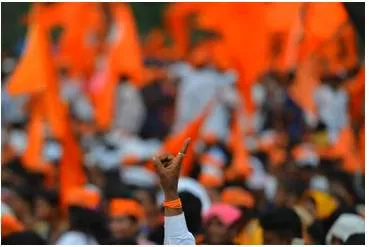
Reinforcing caste hierarchies on maratha quota
The Maratha quota is a case in point of what a progressive Indian polity should not be doing.The description “backward” to define communities is yet another colonial relic which we, as a collective, embrace with such enthusiasm, that we almost forget what it is supposed to mean. Nowhere is this more apparent than in the arguments in favour of reservations by landowning castes that are politically and economically dominant. The demand for being classified as “backward” by Marathas has been ongoing since the 1990s. With the announcement of the inclusion of Marathas into the Socially and Educationally Backward Communities (SEBC), the Maharashtra government has, once again, yielded to the demands of this powerful caste group. This would be the third attempt in the last five years to grant this quota, which has been repeatedly struck down by the courts.
Turning to the state
The ferocity with which dominant castes, mostly rich, landowning, politically influential communities (Marathas in Maharashtra, Patidars in Gujarat, Jats in Haryana, Kapus in Andhra Pradesh), have turned towards the state and the public sector, demanding quotas in jobs and higher education, indicates that the economic growth in the last two decades, such as it was, did not manage to swing the fortunes of a large proportion of these communities upward enough. Their demand for being included in the quota bandwagon can be seen as an expression of their desire for good jobs and stable sources of livelihood for their youth, as their traditional sources of livelihoods become more fragile due to a widespread and multifaceted agrarian crisis.
Yet, quotas are not magic wands that create jobs. And everyone would like a good job or a decent stable source of livelihood. Given that public sector jobs represent a shrinking and much coveted pie, what should the yardstick be to determine the validity of the demand for quotas?
Insights from data
What does the evidence tell us?
Rajesh Ramachandran and I looked at data from the India Human Development Survey (IHDS), and compared Jats in Haryana, Patels in Gujarat and Marathas in Maharashtra. We compared these to Brahmins, non-Brahmin forward castes, existing Other Backward Classes (OBC) and Scheduled Castes-Scheduled Tribes, in their respective States.
The results are very stark. Marathas, similar to Jats and Patels, are more likely to own or cultivate land than all other social groups in their respective States. Marathas have a lower per capita consumption expenditure than Maharashtra Brahmins, but are at the same level as other forward castes and OBCs, and significantly higher than SC-STs. Marathas, on an average, are as poor as Brahmins and other forward castes, but less poor than OBCs and SC-STs. Maratha households have greater access to electricity compared to SC-STs. Marathas are 6 and 14 percentage points more likely than OBCs and SC-STs, respectively, to have access to a flush toilet in Maharashtra. The average years of education for Marathas is 6.58, which is lower than Brahmins by 2.18 years, but is similar to other forward castes and OBCs, and 1.22 years more than the SC-STs. The Marathas are 13 percentage points less likely to have completed 12 years or more of education as compared to the Brahmins, but are very similar to the forward castes, and do 2 and 6 percentage points better than the OBCs and SC-ST, respectively. Summing up, in most of the crucial socio-economic indicators, the Marathas are second only to Brahmins in the State, and are significantly better off than all other social groups.
The main bone of contention and the main motivation for quotas is access to government jobs. The surprising fact is that even before being included in the quota, the access of Marathas to government jobs is already similar to that of Brahmins, and higher than that for other forward castes and OBCs, and not different from that for SC-STs.
We examined both rounds of the IHDS data to see whether the position of these dominant communities deteriorated relative to the other groups. The short answer is no.
In terms of average per capita expenditure, their position has improved over time. In terms of probability of being poor, there is no worsening. There is, however, some evidence of a decline in the probability of owning or cultivating land, which could be the reason for the heightened anxiety.
Factors underlying anxieties
The Marathas are a predominantly agricultural community which benefited from the Green and White Revolutions. The structural transformation of the Indian economy, especially the declining importance of agriculture, and growth of corporatised agriculture and water shortages affecting productivity, have meant that these groups feel increasingly vulnerable.
Yet, data show that the Marathas have lower levels of casualisation of the labour force in both the agricultural and non-agricultural sectors, as compared to the OBCs and SC-STs.
Overall, there is discontent among powerful farming communities due to the perception that real economic power lies in the hands of the big corporations, and the state, overtly or covertly, acts in their interest. These communities feel their power slipping away or eroding, in addition to feeling ill-prepared to shift towards urban, formal sector livelihood opportunities Individuals or communities who feel strongly that the odds of economic success are stacked against them are more likely to feel deprived. Other estimates from IHDS panel data show that “forward castes were about 30 per cent more likely to feel that they were worse off in 2011-12 than in 2004-05”. Thus, perceptions of being worse-off are real: our analysis suggests that these perceptions are exactly that — feelings — not supported by evidence on the ground.
Having said this, economic changes that give rise to widespread anxieties, definitely need to be understood and genuine grievances, including those that might come from forward castes dealing with agrarian transformations, need to be addressed.
However, is reservation the real answer? Given increasing privatisation, the base, i.e. total jobs that are eligible for reservations, is already shrinking. Our other research shows how existing OBCs and SC-STs are further lagging behind upper castes on a range of material indicators. In this context, extending quotas to relatively richer and powerful groups would amount to diluting the already small and shrinking entitlement for communities that are truly disadvantaged and discriminated against.
A dilution
Recently, the Marathas have had two main demands: one, being made quota beneficiaries, and two, the repeal of the Scheduled Castes and the Scheduled Tribes (Prevention of Atrocities) Act. The State government has, once again, given in to the first. Should it consider the second, ours would be no country for the most marginalised.
Quite apart from turning the term “backward” on its head, the writing on the wall is clear. Despite the rhetoric that accompanied the 10% quota, the plan is not to move to a caste-free system. It is to dilute the entitlement of castes that are objectively “backward”, stigmatised and discriminated against.
In the context of the lynching of Dalits for pursuing their traditional occupations, snatching away their livelihoods in the name of cow protection, violence targeted at inter-caste marriages, and other violence related to temple entry or for not following the illegal social norms dictated by untouchability, this move would legally reinforce the obnoxious hierarchies of the caste system. A forward-looking, progressive Indian polity should be discussing instruments to weaken the deadly tentacles of caste, not embolden and reinforce existing hierarchies.



Top court quashes FIRs against Gen Z protesters
Sep 04, 2026







Stay updated with The Hindu Editorial Vocab24 app, your definitive source for breaking news and comprehensive coverage from India and around the globe. Whether it's political developments, business updates, sports highlights, the latest technology trends, or current events, The Hindu brings live, accurate, and reliable news directly to your device.
Don’t fall for sensationalized or fake news shared online. Read and share accurate updates with friends and family through The Hindu Editorial Vocab24 app. Download it today!
News Coverage in The Hindu Editorial Vocab24 App
Breaking News: Receive instant notifications on breaking news stories as they unfold. Stay informed about major events and developments in India and around the world with live blogs, news in shorts videos, and concise articles.
Politics: Get the latest updates on Indian politics, including elections, policy changes, government decisions, and political events that shape the nation.
Business and Economy: Stay ahead in the economic landscape with detailed business news and market analysis. Learn about stock market trends, financial reports, corporate news, and economic developments to make informed investment decisions.
Current Events: Follow stories on social issues, policy changes, global events, and daily current affairs, tailored for UPSC and other competitive exam preparations.
Technology: Keep up with the latest gadgets, innovations, and tech trends. Read expert reviews and analyses in short, concise updates on cutting-edge technology from India and beyond.
Sports: Never miss a moment of your favorite sports. Get live scores, match reports, and expert analysis on cricket, football, tennis, and more.
International News: Stay informed about global events and geopolitical developments, including the Russia-Ukraine war, Israel-Palestine conflict, and other key international stories.
Local News: Stay connected to your community with the latest updates on city events, issues, and local news. Coverage includes hyperlocal updates from cities like Bangalore, Chennai, Delhi, Hyderabad, Mumbai, Kolkata, and more.
Trending Topics: Discover what's trending today with the most talked-about stories and hot topics across India and the world.
Experience journalism that values integrity, accuracy, and reliability. Download The Hindu Editorial Vocab24 app today and stay connected with the world.
Subscribe to our newsletter!







