

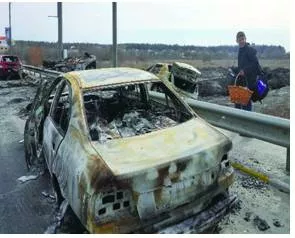
Putin has set a new world order in making
The EU assurance and the promised protection by the NATO could not save Ukraine from Russian attacks. This has finally resulted into the end of the US dominance in global politics to a great extent. This episode has redefined the post Cold War global power calculus for now Maidan Revolution — the very name of the movement born out of the “Independence Square” known as Maidan and located at the heart of Ukraine capital city Kyiv — reached its zenith in February 2014, when for the first time Ukarianians demonstrated the bond of unity against the then remote-controlled regime of Russian-backed President Viktor Fedorovych Yanukovych.The movement gained traction and its strength and size shot up to take the shape of a mass movement, later termed as the “Revolution of Dignity” (Revoliutsiia Hidnosti, which played an important role in the ouster of Yanukovych, the fourth President of Ukraine).
The protest was popularised as “Euro-Maidan Revolution”. Precisely, Euro-Maidan was used in the beginning as a hashtag on Twitter after an account on the micro blogging site was created on the very first day of the movement so as to reach out to more and more people across the country and amplify the message of the movement. The name consisted of two parts: “Euro” came from Europe and “Maidan” came from the Maidan Nezalezhnosti (Independence Square).
Why this movement started? In fact, the root of this revolution goes back to November 21, 2013. That time Yanukovych chose not to sign an agreement called “Association Agreement” with the European Union that would have integrated the nation more closely with the group. That time around, young journalist turned activist Mustafa Nayem addressed his countrymen through Facebook on this matter. Nayem wrote, “Come on guys, let’s be serious, don’t just like this post. Write that you are ready, and we can try to start something new.” He urged people to gather on Maidan Square that evening. From a crowd of just 50 people, the demonstrators swelled to 1,000. And all of them stayed there at the Square and students took the centre stage. However, gradually, a cross section of people marched towards the centre of the capital city.
The movement had two principal demands: First, to remove the Government of Yanukovych; second the immediate restoration of the 2004 amendments to the Constitution of Ukraine. The 2004 amendment (Law No. 2222-IV) was passed during the time of then President Leonid Kuchma. The set of reforms brought by the new amendment seriously limited the powers of the President. Under the new law, the President lost the power to nominate the Prime Minister and it was handed over solely to the unicameral Parliament known as “Verkhovna Rada” or “Rada”.
The President could only appoint the Defence and Foreign Ministers. The President also lost the right to dismiss the members of the Cabinet, but he could dissolve the Parliament. But during the time of Yanukovych, this historic amendment was overturned by the Constitution Court of Ukraine, branding them as purely unconstitutional. Thus, the demonstrators of the Maidan Revolution wanted the same to be revoked and desired that the powers of the President be limited like before.
How is it different from the Orange Revolution of 2004-05? The Orange Revolution was the result of fraudulent presidential election of 2004 when the Russian-backed Yanukovych contested against the Opposition candidate Viktor Yushchenko. In fact, this presidential election brought Ukraine to the brink of a civil war like situation. This election was a tug of war between those who seek closer ties with the EU, NATO and the West and those who favour stronger alignment with Russia.
After two rounds of controversial voting, Yanukovych won the presidential race against Yushchenko. Then the latter’s supporters, dressed in orange colour, Yushchenko’s election colour took to the streets and forced a revote in December the same year. Finally, Yushchenko won the election. Clearly, this was a stern warning for Russia as it was a second colour revolution in a post-Soviet State, the first being Georgia’s Rose Revolution in 2003.
However, in Maidan Revolution, the crowd, unlike the Orange Revolution, did not give way for deep disappointment. It prompted more urgent actions and kept the outside world more involved under the auspices of the EU and the IMF. The new government inherited an economy that was almost bankrupt. The huge government debt was unpayable without help from outside agencies. Inflation rocketed Ukraine and its currency Hryvnia lost half of its value in 2004. And Bloomberg that year recorded Hryvnia as the worst performing currency in the world. That year ironically Russian intervention moved from banning Ukrainian products and influencing political parties to Russian soldiers annexing Crimea and supporting a separatist movement in the Donbass region. Since then Moscow has been aiding the separatists with arms & ammunition and finances till the declaration of the independence of the two republics of Luhansk and Donetsk in February 2022.
Interestingly, with the Maidan Revolution, the people of Ukraine learnt the lessons from the Orange Revolution and pushed for immediate reforms in their country. The post-Maidan Revolution era witnessed the signing of the Association Agreement with the EU.
As a result, a slew of reforms started taking place. Hence, the Orange Revolution soon slipped into oblivion unlike the Euro-Maidan Revolution. The latter brought subsequent changes and lobbed Ukraine at the centre stage of the strategy making of the West.
Volodymyr Zelensky is the sixth President of Ukraine who came to power in 2019. With all the sixth presidents, including Zelensky, the influence of the West and Russia are clearly evident. All these years, the struggle between the Russian Federation and the combined pressure of the NATO and the EU were fully acting over Ukraine. The saddest part is that till date, no single group or party has either given full support or security to Kyiv.
What happened in Ukraine in the beginning of 2014 is worthy of noting. It primarily ushered in a transformation of the country’s society and the post-Soviet State that gradually turned into a rent-seeking one since 1991. The first victory of the revolution came when the protesters removed the thuggish rule of Yanukovych from Kyiv. During the four years of his reign, he and his cronies looted about $100 billion from a country that came out of the clutches of the USSR. Sadly, the EU’s key decisions came frustratingly late to Ukraine since the beginning of its separation from the USSR.
Today, Ukraine has finally come under the boots of Russia. Putin was quietly waiting for the last eight years to grab this opportunity. At this moment, when the Russians are at the gates of Kyiv and the whole world is simply watching the bloody war, the people of Ukraine are encountering the enemy alone. The war that has already completed half a month is rightly seen as David vs Goliath.
Ukraine is crying for help from the most powerful countries of the world. But all are turning their back on Ukraine, except imposing severe sanctions on Russian oligarchs and top legislators of that country. Clearly, no single sanction is directly targeted at Putin.
However, the sanctions that are already imposed on Moscow are considered one of the severest in recent times. But now the question is that can the world prevent a man like Putin with such sanctions from launching further offensives in the coming years? Definitely not.
Such sanctions were imposed over Moscow immediately after the annexation of Crimea in 2014, but Putin could hardly be stopped from the offensive in this February against Ukraine. Rather, such sanctions have emboldened him to become more aggressive.
At this juncture, when we look back and see the outcomes of the Maidan Revolution, what we observe is that the assurances from the EU and the expected protection from the NATO finally could not save Ukraine from Russia. For all these years, the NATO could not embrace Ukraine and offer full guarantee of its territorial integrity. After witnessing the Crimean annexation, the Western allies of Ukraine should have been more cautious. Now everything is lost.
Russia is not solely responsible for the current war against Ukraine. The NATO and the EU must share the blame equally. After the breakdown of the USSR in 1991, the NATO quickly moved into former Soviet Republics and Communist bastions of Eastern Europe to fill in the security vacuum. Both the groups have almost formed a security ring around the Russian Federation. And, Ukraine is the only country left in that bloc. Therefore when the NATO was already inching closer to Ukraine, Russia became too cautious. For long, Putin was sending warning signals to the NATO and the EU. Today, by attacking Ukraine, Putin has set a new world order in the making. And this has finally resulted into the end of the US dominance in global politics to a great extent. Truly, this episode has redefined the post Cold War global power calculus for now.
The Maidan era has long gone. The Orange Revolution has slipped into oblivion. Hope the sovereignty of Ukraine will be respected by Russia. But there is little hope.
Can quad restrain wayward china
May 29, 2022
Concerns over finland sweden joining nato
May 22, 2022
Sustainability road to a better future
May 16, 2022
Aap lays out its goal
May 11, 2022
Shanghai covid crisis a test for xi’s leadership
May 09, 2022
The idea of universal equality
May 06, 2022




Stay updated with The Hindu Editorial Vocab24 app, your definitive source for breaking news and comprehensive coverage from India and around the globe. Whether it's political developments, business updates, sports highlights, the latest technology trends, or current events, The Hindu brings live, accurate, and reliable news directly to your device.
Don’t fall for sensationalized or fake news shared online. Read and share accurate updates with friends and family through The Hindu Editorial Vocab24 app. Download it today!
News Coverage in The Hindu Editorial Vocab24 App
Breaking News: Receive instant notifications on breaking news stories as they unfold. Stay informed about major events and developments in India and around the world with live blogs, news in shorts videos, and concise articles.
Politics: Get the latest updates on Indian politics, including elections, policy changes, government decisions, and political events that shape the nation.
Business and Economy: Stay ahead in the economic landscape with detailed business news and market analysis. Learn about stock market trends, financial reports, corporate news, and economic developments to make informed investment decisions.
Current Events: Follow stories on social issues, policy changes, global events, and daily current affairs, tailored for UPSC and other competitive exam preparations.
Technology: Keep up with the latest gadgets, innovations, and tech trends. Read expert reviews and analyses in short, concise updates on cutting-edge technology from India and beyond.
Sports: Never miss a moment of your favorite sports. Get live scores, match reports, and expert analysis on cricket, football, tennis, and more.
International News: Stay informed about global events and geopolitical developments, including the Russia-Ukraine war, Israel-Palestine conflict, and other key international stories.
Local News: Stay connected to your community with the latest updates on city events, issues, and local news. Coverage includes hyperlocal updates from cities like Bangalore, Chennai, Delhi, Hyderabad, Mumbai, Kolkata, and more.
Trending Topics: Discover what's trending today with the most talked-about stories and hot topics across India and the world.
Experience journalism that values integrity, accuracy, and reliability. Download The Hindu Editorial Vocab24 app today and stay connected with the world.
Subscribe to our newsletter!







