

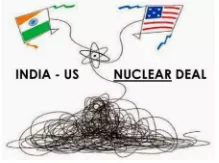
Powered by a pause delay in indo u s nuclear deal
Ever since it was announced in 2005, the Indo-U.S. civil nuclear agreement has faced one obstacle after another. So this week’s news that its operationalisation may be further delayed owing to Westinghouse’s financial difficulties and Japan’s procedural issues in ratifying the deal with India should come as no surprise. This sets back “work toward finalising the contractual arrangements by June 2017” for six reactors to be built in Andhra Pradesh by Toshiba-owned Westinghouse and the Nuclear Power Corporation of India Ltd. (NPCIL). But India has little control over both circumstances, and rather than seeing them as a setback, the government and officials should use this as an opportunity to re-examine the country’s engagement with nuclear energy for future needs. Westinghouse’s near-bankruptcy is part of a larger pattern of worldwide cost overruns and delivery delays across the nuclear energy industry. Nuclear manufacturer Areva (in partnership with Mitsubishi) has a similarly precarious position despite hopes of a bailout by the French government. Even Russian supplier Rosatom’s Kudankulam units 1 and 2, in the only foreign collaboration now operational in India, were built in double the time budgeted, while units 3 and 4 could see delays. The cost of importing reactors, relative to those based on indigenous design, is another concern. Land acquisition issues remain, along with the need for large water reservoirs for the reactors, which will only grow if the government goes ahead with its plans for 55 reactors of 63,000 MW in total by 2032. In addition, given concerns about a possible tsunami scenario along the Andhra coast, where many of these reactors are planned, the Department of Atomic Energy and NPCIL are looking for options farther inland. The promise of nuclear power has thus far outweighed all of these concerns, and India has reason to be proud of its technology and determination to look for non-fossil alternatives in its energy planning. However, with rapid progress in technology in other renewable energy sources such as wind and solar power, the collapse of oil prices and the expansion in gas projects as a viable and clean alternative, that promise has dimmed. These could also be more cost-effective for a developing country such as India, as the energy can be made available in smaller units, and then built up, unlike nuclear plants where nothing can be transmitted until the whole plant is complete and attains critical status. Above all, the risk surrounding nuclear safety is yet to be fully mapped, post-Fukushima. A Japanese court ruling holding both the state regulator and the operator responsible for the 2011 triple meltdown has sent sobering signals to the industry. This is the best time for India’s energy planners and government to use the breathing space provided by the delays in the Indo-U.S. civil nuclear deal and take a long, hard look at the cost-benefit analysis on the nuclear power balance sheet








Stay updated with The Hindu Editorial Vocab24 app, your definitive source for breaking news and comprehensive coverage from India and around the globe. Whether it's political developments, business updates, sports highlights, the latest technology trends, or current events, The Hindu brings live, accurate, and reliable news directly to your device.
Don’t fall for sensationalized or fake news shared online. Read and share accurate updates with friends and family through The Hindu Editorial Vocab24 app. Download it today!
News Coverage in The Hindu Editorial Vocab24 App
Breaking News: Receive instant notifications on breaking news stories as they unfold. Stay informed about major events and developments in India and around the world with live blogs, news in shorts videos, and concise articles.
Politics: Get the latest updates on Indian politics, including elections, policy changes, government decisions, and political events that shape the nation.
Business and Economy: Stay ahead in the economic landscape with detailed business news and market analysis. Learn about stock market trends, financial reports, corporate news, and economic developments to make informed investment decisions.
Current Events: Follow stories on social issues, policy changes, global events, and daily current affairs, tailored for UPSC and other competitive exam preparations.
Technology: Keep up with the latest gadgets, innovations, and tech trends. Read expert reviews and analyses in short, concise updates on cutting-edge technology from India and beyond.
Sports: Never miss a moment of your favorite sports. Get live scores, match reports, and expert analysis on cricket, football, tennis, and more.
International News: Stay informed about global events and geopolitical developments, including the Russia-Ukraine war, Israel-Palestine conflict, and other key international stories.
Local News: Stay connected to your community with the latest updates on city events, issues, and local news. Coverage includes hyperlocal updates from cities like Bangalore, Chennai, Delhi, Hyderabad, Mumbai, Kolkata, and more.
Trending Topics: Discover what's trending today with the most talked-about stories and hot topics across India and the world.
Experience journalism that values integrity, accuracy, and reliability. Download The Hindu Editorial Vocab24 app today and stay connected with the world.
Subscribe to our newsletter!







