

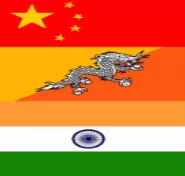
Power games at the tri junction
We should by now be accustomed to Sino-Indian summits occurring with the backdrop of border trouble, and Friday’s G20 meeting between a smiling Prime Minister Narendra Modi and a less enthused (उत्साहित) Chinese President Xi Jinping was no exception. But the Doka La stand-off, at the southern tip of the Chumbi Valley where India, Bhutan, and China meet, is perhaps the most significant of all the border confrontations that have roiled(to cause (someone or something) to become very agitated or disturbed) the India-China relationship in recent years. This is not because of its size, dwarfed by the Sumdorong Chu crisis of 1986-87, or duration, still only a few days longer than the Daulat Beg Oldi stand-off of 2013. Rather, the importance of the incident is threefold. What it implies One factor is the unique position of the Chumbi Valley, which is at once a dangerous conduit into the slender(of something abstract) barely sufficient in amount or basis.) Siliguri Corridor and a dangerous choke point, exposed on both sides, for Chinese forces. A second factor is that this tussle is formally over the interests and rights of a third country, Bhutan, echoing the wider competition for influence in smaller countries — Nepal, Bangladesh, Myanmar, Sri Lanka, the Maldives, and elsewhere — across the Indo-Pacific region. Third, the stand-off comes in a period when it is clear that the wheels are coming off the India-China wagon, with Indian trust in Chinese intentions collapsing steadily and Beijing taking an ever-more strident tone. At the military level, India has good reason to prevent Chinese road building near Doka La. Chinese activity has steadily increased in the area beneath Bhutan’s claim-line, pushing the area under its de facto control about 5 km southwards, towards a crucial ridge-line. This has a number of implications. It would widen the area of Chinese control in an otherwise very narrow valley, from around 8-9 km (Batang La to the Amo Chu river) to 12-13 km (Gamochen to the river), thereby easing the logistics of moving large numbers of troops. Control of the dominating ridgeline would also give China a strong position, by some accounts even domination, over Indian posts to the west, and Bhutanese ones to the south and east. India is still well short of matching the impressive infrastructure development in Tibet over the past decade, with two-thirds of sanctioned roads on the Line of Actual Control (LAC) still un-built. But Chinese forces moving through the Chumbi Valley — 90 km from top to bottom — would have long, exposed flanks. India has a formidable set of forces arrayed to the west, with mountain divisions in Gangtok (17th), Kalimpong (27th), and Binaguri (20th) further to the south, all of which are part of the Siliguri-based 33 Corps. Furthermore, the 59th division of 17 Corps, India’s first mountain strike corps, raised for the purpose of offensive operations into Tibet, is headquartered in Panagarh and will reportedly be operational this year. It’s worth noting that former National Security Advisor (NSA) Shivshankar Menon has argued, in his 2016 book Choices, that Beijing backed down in the 2013 Depsang incident “to a great extent because of India’s improved capabilities, which left the Chinese in no doubt that India could embarrass them”. The Bhutan advantage Another of India’s military advantages is its privileged relationship with Bhutan. This allows it to bring to bear large forces from the east. A sizeable Indian Military Training Team (IMTRAT) is permanently based in western Bhutan, while other units regularly cooperate with the Royal Bhutan Army. Bhutan’s involvement highlights the way in which Sino-Indian competition is increasingly channelled through third countries, as China relentlessly expands into India’s periphery through strategic investments, trading relationships and arms sales. India’s willingness to intervene forcefully in a bilateral Bhutan-China dispute is a reflection both of India’s own vital interests in the Chumbi Valley and of its commanding position in Bhutan, which might otherwise have ceded the Doklam plateau to China in a territorial swap many years ago. The India-Bhutan Friendship Treaty, though revised in 2007 to give Thimpu more autonomy, still notes that the two countries “shall cooperate closely with each other on issues relating to their national interests”. In this sense, Bhutan is a special case. But in stepping across an international border and defying Chinese expectations, India has also signalled a degree of confidence that will resonate more widely. This in part explains the especially vituperative (अपमानपूर्वक/निंदापूर्ण) rhetoric that has seeped out(to come out of) of hyper-nationalist outlets like the Global Times in recent days, such as lurid (घोररूप/विवर्ण) promises to “liberate” Sikkim and Bhutan, as well as subtler (तीक्ष्ण/सूक्ष्म) steps such as this week’s travel advisory for Chinese citizens in India. There is a reasonable chance that this stand-off will end within weeks, with China quietly halting road construction and Indian troops returning westward to their posts. The risk of escalation appears low. More broadly, the thicket(very thick in density) of border agreements accumulated over the past 30 years — in 1988, 1993, 1996, 2003, and 2013 — serve as an important cushion whose value is still not fully appreciated. But the wider context is one of relentlessly hardening attitudes, on both sides. Beijing is aggrieved by the Dalai Lama’s visit to Tawang in April, India’s aggressive repudiation(अस्वीकरण) of the Belt and Road Initiative in May, and India’s forward-leaning posture in the South China Sea — the latter underscored by Vietnam’s two-year extension of a 2006 oil concession to ONGC Videsh last week. India’s complaints are too numerous and familiar to elaborate, but they span international institutions (membership of the Nuclear Suppliers Group), terrorism (Masood Azhar), sovereignty (China-Pakistan Economic Corridor) and, in a more inchoate (अविकसित/प्रारम्भिक) way, questions of the basic security order in Asia. Relationship in a flux “India-China relations are undergoing a change,” wrote former Foreign Secretary Shyam Saran on July 3. “China believes that India should acknowledge the power disparity between the two sides and show appropriate deference to China.” India has always repudiated this idea. But it is likely to become bolder in doing so. This is evident in last month’s U.S.-India joint statement, where China was unmentioned but all pervasive in areas from North Korea, to trade, to freedom of navigation. It is on display in the Bay of Bengal, where one of the largest-ever iterations (पुनरावृत्ति) of the Malabar exercise series is getting underway with aircraft carriers/helicopter carrier from India, the U.S., and Japan. We see it also in this weekend’s news, reported in this newspaper, that the government is conducting a national security review of Chinese investment in South Asia. Perhaps, in the coming weeks, 17 Corps will suddenly find that the purse strings have become looser too.





Stay updated with The Hindu Editorial Vocab24 app, your definitive source for breaking news and comprehensive coverage from India and around the globe. Whether it's political developments, business updates, sports highlights, the latest technology trends, or current events, The Hindu brings live, accurate, and reliable news directly to your device.
Don’t fall for sensationalized or fake news shared online. Read and share accurate updates with friends and family through The Hindu Editorial Vocab24 app. Download it today!
News Coverage in The Hindu Editorial Vocab24 App
Breaking News: Receive instant notifications on breaking news stories as they unfold. Stay informed about major events and developments in India and around the world with live blogs, news in shorts videos, and concise articles.
Politics: Get the latest updates on Indian politics, including elections, policy changes, government decisions, and political events that shape the nation.
Business and Economy: Stay ahead in the economic landscape with detailed business news and market analysis. Learn about stock market trends, financial reports, corporate news, and economic developments to make informed investment decisions.
Current Events: Follow stories on social issues, policy changes, global events, and daily current affairs, tailored for UPSC and other competitive exam preparations.
Technology: Keep up with the latest gadgets, innovations, and tech trends. Read expert reviews and analyses in short, concise updates on cutting-edge technology from India and beyond.
Sports: Never miss a moment of your favorite sports. Get live scores, match reports, and expert analysis on cricket, football, tennis, and more.
International News: Stay informed about global events and geopolitical developments, including the Russia-Ukraine war, Israel-Palestine conflict, and other key international stories.
Local News: Stay connected to your community with the latest updates on city events, issues, and local news. Coverage includes hyperlocal updates from cities like Bangalore, Chennai, Delhi, Hyderabad, Mumbai, Kolkata, and more.
Trending Topics: Discover what's trending today with the most talked-about stories and hot topics across India and the world.
Experience journalism that values integrity, accuracy, and reliability. Download The Hindu Editorial Vocab24 app today and stay connected with the world.
Subscribe to our newsletter!







