

Plastic waste what man has wrought the bugs try solve
It is estimated that 60 cities across India generate over 15,000 tons of plastic waste every day and almost 6 million tons per year.The tiny landlocked African country Rwanda has banned plastic bags since a few years. The ban has made this war-torn nation much cleaner. Kenya has just announced a ban on plastic bags, and a fine of 4 years in prison and/or $40,000. The Kenyan seacoast has mountains of plastic waste, making life on land, and in the sea, difficult. Another African nation, Morocco, with a coastline of 1,800 km, has had such a ban for almost a decade. It is time that India, with its 7,500-km coastline, learns from these Africans and bans plastic bags and related stuff before we too choke our seacoasts—and land, too—into a man-made disaster.
The Task Force on plastic pollution, set up by the Planning Commission in 2014, estimated that 60 cities across the country generate over 15,000 tons of plastic waste every day—almost 6 million tons per year. This is what we see daily as we walk around the streets. And cattle and other animals, which freely move around the streets, unknowingly devour some of this plastic material, which is not digested but stays put in their stomachs. Ruminants like the cow and buffalo end up dying a slow and painful death. The holy cow meeting an unholy end!
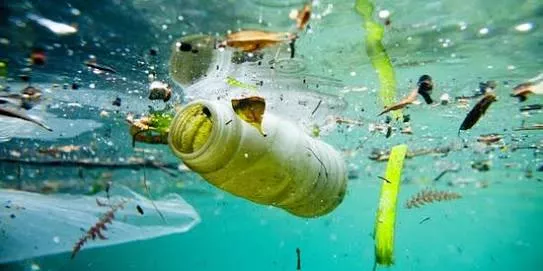
This dump we see daily is just part of the problem. A much greater, and not so visible disaster looms underwater, a lot of this plastic waste from across the world eventually ends up in the oceans, which cover over 70% of the earth’s surface and hold 97% of the earth’s water. The amount of plastic rubbish reaching the oceans is 8 million tons per day—that is, one truckload every minute. This would mean that by 2050, there will be more plastic in the world’s oceans than fish!
What can science do about it? An interesting theoretical analysis was recently made by Professor Richard Sole of the Pompeu Fabra University in Barcelona, Spain. He estimated that of the huge amounts of plastic thrown in the oceans, the amount floating around is hardly 1%. The rest is sunk way down and/or slowly being degraded or broken down. Which plant, animal or microbe in the ocean might be doing this? And if we identify them, we may have a biological solution to at least part of the problem. The site http://www.dailymail.co.uk/sciencetech/article-4555014/Plastic-eating-microbes-evolved-ocean.html#ixzz4r7uHOSH2 is well worth visiting to learn more.
Degrading plastic
There is some interesting research being done towards identifying, isolating and studying the biological species that seem to degrade plastics into small molecules that are usable for safer purposes. The species identified so far are some fungi and bacteria. An elementary review on such ‘biodegradation of plastics’ by A. Muthukumar and S. Veerappanpillai of VIT Vellore lists as many as 32 species of microbes which degrade a variety of plastics which go to make water bottles, carry bags, industrial material and such (see their paper in Intl. J. Pharm. Sci. Rev. Res. 2015; 31 (2:, 204-209; free access). And of immediate relevance to the Indian coastline is a report by Sangeetha Devi and others from Bharathidasan University, Tiruchi, also in 2015 (Marine Pollution Bulletin, 2015; 96: 32-40, no free access). They found that two strains of the fungus aspergillus spp, found in the waters of the Gulf of Mannar degrade the plastic HDPE (which is used to make milk and fruit juice bottles, grocery bags and such).
These fungi seem to release some enzymes which degrade HDPE, essentially breaking up the polymeric molecule into smaller pieces; these enzymes are being studied in some detail by the Tiruchi group. It is clear that further research work from marine organisms will reveal more microbes that are capable of degrading polymeric and plastic wastes. It would also be possible to find their cousins on earth which can degrade these wastes. And, once we study the basic biology and genetics of these plastic-eating bugs, we can genetically modify them in order to make them more efficient and versatile in handling a variety of wastes.
And more data is becoming available on the types of wastes that are being handled by these microbes. In March 2016, a group from Kyoto University found an two enzymes from the microbe they named as Ideonella sakainesis (after the town Sakai in Japan), capable of breaking down the polymer PET (polyethylene terephthalate, used in making packaging trays, polyester clothing and others) into its basic monomeric molecules terephthalic acid and ethylene glycol (S. Yoshida et al., Science 2016; 351: 1196), which are used as building blocks for a variety of chemicals. The microbe is found in soil, sediment, waste water and similar material.
Most recently, a group of Pakistani, Sri Lankan and Chinese scientists together showed that the fungus Aspergillus tubigensis can degrade yet another major plastic material called polyurethane or PU (Sehroon Khan et al, Environmental Pollution, 2017; 225: 469-480). PU is used in the manufacture of car tyres, gaskets, bumpers, fibres, plastic foam, synthetic leathers and so on. The group found this bug in a general city waste disposal site in Islamabad, which suggests that it would very likely be found at several places in India too.
No place for cynicism
A cynical wag once said: what science made, let it unmake. It appears that whether it be in water or land (maybe even in the sky), if we work with focus, we would be able to find such plastic waste degrading organisms, and thus try to ‘unmake’ the problem. We can even genetically modify them to suit the purpose. This type of research will bring a great deal of benefit to not only terrestrial life forms but those living under water as well. Ironically enough, work of this kind could even fetch a Nobel Prize for safely breaking down plastics, just as Nobels were given for making plastics in the first place.






Stay updated with The Hindu Editorial Vocab24 app, your definitive source for breaking news and comprehensive coverage from India and around the globe. Whether it's political developments, business updates, sports highlights, the latest technology trends, or current events, The Hindu brings live, accurate, and reliable news directly to your device.
Don’t fall for sensationalized or fake news shared online. Read and share accurate updates with friends and family through The Hindu Editorial Vocab24 app. Download it today!
News Coverage in The Hindu Editorial Vocab24 App
Breaking News: Receive instant notifications on breaking news stories as they unfold. Stay informed about major events and developments in India and around the world with live blogs, news in shorts videos, and concise articles.
Politics: Get the latest updates on Indian politics, including elections, policy changes, government decisions, and political events that shape the nation.
Business and Economy: Stay ahead in the economic landscape with detailed business news and market analysis. Learn about stock market trends, financial reports, corporate news, and economic developments to make informed investment decisions.
Current Events: Follow stories on social issues, policy changes, global events, and daily current affairs, tailored for UPSC and other competitive exam preparations.
Technology: Keep up with the latest gadgets, innovations, and tech trends. Read expert reviews and analyses in short, concise updates on cutting-edge technology from India and beyond.
Sports: Never miss a moment of your favorite sports. Get live scores, match reports, and expert analysis on cricket, football, tennis, and more.
International News: Stay informed about global events and geopolitical developments, including the Russia-Ukraine war, Israel-Palestine conflict, and other key international stories.
Local News: Stay connected to your community with the latest updates on city events, issues, and local news. Coverage includes hyperlocal updates from cities like Bangalore, Chennai, Delhi, Hyderabad, Mumbai, Kolkata, and more.
Trending Topics: Discover what's trending today with the most talked-about stories and hot topics across India and the world.
Experience journalism that values integrity, accuracy, and reliability. Download The Hindu Editorial Vocab24 app today and stay connected with the world.
Subscribe to our newsletter!







