

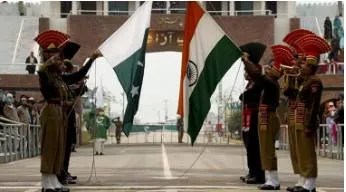
Pieces of peace
Peace initiatives on LoC, and internally in J&K, must be enthusiastically welcomed, but not taken at face value.At 6 pm on May 29, the Director Generals of Military Operations (DGMOs) of India and Pakistan reportedly spoke to each other as part of the weekly Tuesday call and agreed to effectively implement the informal November 26, 2003, ceasefire at the Line of Control (LoC) in J&K. While there is much debate about who made the first move, that is irrelevant. All one should do as the first response is to welcome the move while being circumspect (Careful and unwilling to take risks) about it.
There has been destruction and loss of lives of civilians and soldiers on both sides. A few days ago in a television programme, in the wake of large-scale violations by Pakistan, I said that either there is peace or India should undertake vertical and horizontal escalation to draw Pakistan into a war of attrition at the LoC, including deploying the army at the Jammu international border (IB). We should be glad that the idea of peace has prevailed.
The move towards proper implementation of the informal ceasefire of 2003 should not come as a surprise. It is, however, important to note some facts about the 2003 ceasefire and its history through the subsequent 15 years in order to get a clearer perspective of the current decision and its possible effectiveness and longevity. In November 2003, there were backroom parleys (A discussion between two groups of people, especially to end an argument.) which led to the much-touted Musharraf initiative; India allowed the credit to go Pakistan’s way. Infiltration attempts were still rife and the proxy conflict in J&K was sustained through the numbers that successfully penetrated the Indian dragnet at the LoC.
The ceasefire facilitated the construction of the Anti-Infiltration Obstacle System (AIOS) in a quicker time frame. In November 2003, the war in Afghanistan had been on for about two years. Pakistan was not under any international pressure except to support the US operations. Unfriendly terrorists had not yet appeared on Pakistan’s internal security radar. It is generally believed that Musharraf risked it but it was motivated by seriousness to pursue his four-point formula with then Prime Minister Atal Bihari Vajpayee. However, it lacked the support of Pakistan’s powerful corps commanders.
Musharraf’s intent was timed with then Chief Minister Mufti Mohammad Sayeed’s serious effort to bring into effect his “healing touch” policy; a humanitarian effort to calm the internal environment in J&K. It was preceded by PM Vajpayee’s April 2003 initiative, urging treatment of the people of J&K with greater compassion.
The ceasefire lasted in letter and spirit as long as Musharraf was in power. Even before the Mumbai attacks, violations had begun. The effectiveness got progressively diluted till it hit a nadir this year. For Pakistan, in the face of the waning effectiveness of its capability to calibrate the hinterland situation in J&K, tension at the LoC became an instrument to remind the international community of the existence of the J&K issue.
Surprisingly, the ceasefire along the 750-km LoC held effectively in the Kargil and Siachen sectors of the Ladakh division and only sporadic (Occurring at irregular internals.) violations occurred in the Kashmir segment where, except for Uri and occasionally Tangdhar, the LoC remained peaceful. An age-old notion that ceasefire violations occurred primarily to aid infiltration was also laid to rest as infiltration attempts continued primarily in Kashmir although a few attempts were also made in the Jammu division and along the IB. The targeting of the Hindu population in the Jammu division, including the IB sector, was generally ascribed to Pakistan’s intent to cause greater communal dissension within the people of J&K and fracturing of the polity to aid the turbulence it aimed for in the hinterland.
So what has changed and why should keen observers have sensed something in the offing towards the current peace move? First, the situation in Pakistan is none too stable. Financially, Pakistan has just borrowed a billion USD from China to sustain its forex reserve and avoid having to go to the IMF. Its forex reserve has fallen to $10.8 billion. Second, it is on the back foot with the Financial Action Task Force (FATF) which is due to review its grey listing to see whether Pakistan has fulfilled obligations to prevent terror financing. A blacklisting would place Pakistan in the dock. Third, for some time now, the security establishment in Pakistan has been playing games to test the environment — the Bajwa Doctrine with its vagueness, backroom talks between the National Security Advisors and a couple of Track 2 dialogues in which the Indians remained non-committal due to the trust deficit.
The Indian decision to stick to a robust response at the LoC/IB was creating problems notwithstanding the Pakistani bravado with which the civilian areas were targeted. Fourth, the cessation of operations in J&K was received positively by the people with Pakistan acting as the spoiler at the border. With the FATF watchful, Pakistan was muted on the Indian initiative, although terror groups rejected it outright. It was perhaps a combination of factors in which the tentative (Not certain or fixed) political environment of Pakistan, too, played its part.
Although peace initiatives at the LoC or internally in J&K must receive enthusiastic welcome, they must never be taken at face value. Unless matching add-ons accompany such initiatives, they at best remain uncertain. What needs to be pursued holistically is a follow-up to get the DGMOs to meet, free of political baggage and in a proper format quite unlike the flag meeting format adopted the last time in 2013.
Enablers to formalise the ceasefire through drawn up rules of engagement must be equally pursued; that was an agreed weakness the last time. Alternate hotlines need to be established at lower levels in identified sectors to allow lower commanders to speak without hesitation and clarify local misgivings. Pakistan, on its part, must desist from supporting infiltration — the single issue which can upset the applecart. (To ruin or interfere with one’s plans or goals.)
India needs to take the ceasefire and the cessation of operations in the hinterland together and create an environment of hope, notwithstanding the maverick elements who will continue to act as spoilers. Perhaps the J&K chief minister’s words of wisdom, that the decisions need to be taken one step at a time, is a good mantra. These should be examined for their individual and combined worth and efforts undertaken to strengthen them even as other efforts are made to try and bring about some trust to sustain the situation and improve on it.












Stay updated with The Hindu Editorial Vocab24 app, your definitive source for breaking news and comprehensive coverage from India and around the globe. Whether it's political developments, business updates, sports highlights, the latest technology trends, or current events, The Hindu brings live, accurate, and reliable news directly to your device.
Don’t fall for sensationalized or fake news shared online. Read and share accurate updates with friends and family through The Hindu Editorial Vocab24 app. Download it today!
News Coverage in The Hindu Editorial Vocab24 App
Breaking News: Receive instant notifications on breaking news stories as they unfold. Stay informed about major events and developments in India and around the world with live blogs, news in shorts videos, and concise articles.
Politics: Get the latest updates on Indian politics, including elections, policy changes, government decisions, and political events that shape the nation.
Business and Economy: Stay ahead in the economic landscape with detailed business news and market analysis. Learn about stock market trends, financial reports, corporate news, and economic developments to make informed investment decisions.
Current Events: Follow stories on social issues, policy changes, global events, and daily current affairs, tailored for UPSC and other competitive exam preparations.
Technology: Keep up with the latest gadgets, innovations, and tech trends. Read expert reviews and analyses in short, concise updates on cutting-edge technology from India and beyond.
Sports: Never miss a moment of your favorite sports. Get live scores, match reports, and expert analysis on cricket, football, tennis, and more.
International News: Stay informed about global events and geopolitical developments, including the Russia-Ukraine war, Israel-Palestine conflict, and other key international stories.
Local News: Stay connected to your community with the latest updates on city events, issues, and local news. Coverage includes hyperlocal updates from cities like Bangalore, Chennai, Delhi, Hyderabad, Mumbai, Kolkata, and more.
Trending Topics: Discover what's trending today with the most talked-about stories and hot topics across India and the world.
Experience journalism that values integrity, accuracy, and reliability. Download The Hindu Editorial Vocab24 app today and stay connected with the world.
Subscribe to our newsletter!







