

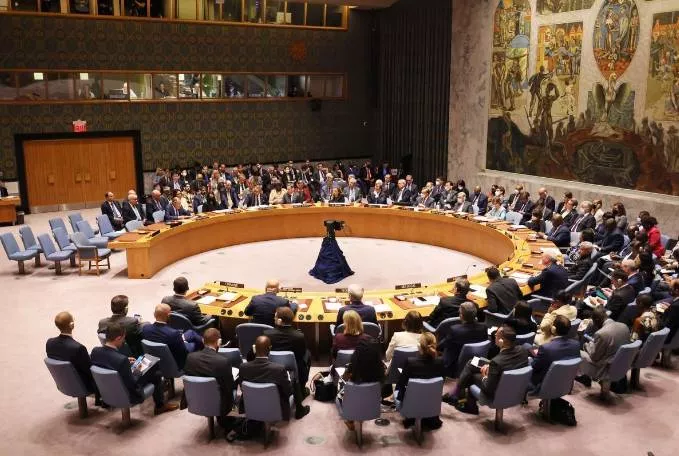
Permanent membership of the unsc is another story
There should be no illusion about how states view membership in the United Nations Security Council — India must realise that it is all about national interest.There is a buzz in India about the prospects of the country becoming a permanent member of the United Nations Security Council. India’s External Affairs Minister has been actively canvassing for the country’s candidature, meeting his counterparts from several countries. He has repeated the call, made often in the past, for a text-based negotiation on what has been euphemistically referred to as the reform of the United Nations Security Council (UNSC), i.e., negotiation on a written document outlining the proposed reform instead of ju+st holding forth verbally.
The five permanent members of the UNSC — China, France, the Russian Federation, the United Kingdom and the United States — constitute what is the last, most exclusive club in international relations. All other clubs have been breached. Until a quarter century ago, the nuclear weapon club had five members, the same five as the P-5. India, Pakistan, North Korea and Israel have since joined the club. The P-5 could do nothing to stop the latter countries from forcing themselves into membership of the nuclear club. But the permanent membership of the Security Council is another story.
Declarations that deserve scepticism
The inescapable fact is that none of the P-5 wants the UNSC’s ranks to be increased. One or the other of them might make some noise about supporting one or more of the aspirants. Each is confident that someone among them will torpedo the enlargement of the club. Declarations of support for India’s candidature need to be taken with a fistful of salt.
When delegations of 50 countries were drafting the Charter of the future United Nations at Dumbarton Oaks near Washington DC in 1944-45, the article regarding the Security Council, particularly the right of veto, was the subject of maximum debate and controversy. Many countries opposed it. The British representative made it clear: either you have a United Nations with veto or there will be no United Nations. The other participating nations had to lump it. The chief Indian delegate said that it was better to have an imperfect United Nations than not to have one.
Intricacies of membership
There is considerable unhappiness among membership at large in the UN about the right of veto. The debate about veto is most often raked up when the western members of the P-5 club are not able to have their way. It is true that Russia, in its incarnations as the Soviet Union and the Russian Federation, has cast more vetoes (estimated to be 120 times, ‘or or close to half of all vetoes’) than the three western members of the club. But the western members have used their privileged position any number of times to protect Israel when the Palestinian question was being discussed. They also used veto to prevent sanctions being imposed on the apartheid regime of South Africa. There are no saints there.
India needs to be circumspect about veto. We ought to remember that the Russians have bailed India out on many occasions on the question of Kashmir. Most importantly, Russia helped India by vetoing unfavourable resolutions during the war of Bangladesh liberation in 1971. Looking ahead, we can never rule out the possibility of the Kashmir issue being raised in the Council at some time in the future. While we might expect, though not be certain of, Russia to come to our help, we must rule out either Britain or America from casting a negative vote against Pakistan. Going by the Chinese position of repeatedly blocking India’s efforts to include confirmed Pakistani terrorists in the sanctions list, we can be sure of Chinese hostility towards us for a long time.
There are four declared candidates for permanent membership: India, Japan, Brazil and Germany, called the G-4. Africa and Latin America and the Caribbean are unrepresented in the permanent category at present. Africa’s claim for two permanent seats has wide understanding and support, but the Africans have yet to decide which two countries these are to be. As for India, we can discount Pakistan’s opposition; China will not support India nor will it ever support Japan. Brazil has regional opponents and claimants. As for Germany, Italy is firmly opposed to its claim. Italy has an interesting argument. If Germany and Japan — both Axis powers during the Second World War, and hence ‘enemy’ states — were to join as permanent members, that would leave out only Italy, the third founding member of the Axis group. In any case there are already three western nations among the P-5. Even if India enjoyed near universal support, there is no way that India alone can be elected; it will have to be a package deal involving countries from other groups.
There is quite a debate going on about whether the aspiring countries should accept permanent membership without the right of veto. There is no ambiguity regarding the position of the P-5. Every one of them is firmly opposed to conferring the veto power to any prospective new permanent member. Not just the P-5. The vast majority of members do not want any more veto-wielding members in the Council. There is a proposal to the effect that a resolution can be defeated only by a negative vote of at least two permanent members. This also is a non-starter; the P-5 are firmly opposed to any dilution of their privileged position.
Changing the membership of the Council requires amending the Charter. This involves consent of two-thirds of the total membership of the U N, including the concurring votes of P-5. This means that each of the five has a veto. The Charter was amended once in the 1960s to enlarge the Council by additional non-permanent seats.
Even now, if the proposal was to add a few non-permanent seats only, it would be adopted with near unanimity or even by consensus. It is the permanent category that poses the problem. One can have a good idea of the difficulty of amending the Charter by the fact that the ‘enemy clause’ contained in Article 107 of the Charter remains in it even though some of the enemy states such as Germany, Japan, Italy, etc. are very active members, often serve on the Council, and are close military allies of some of the victors in the war.
A new category is an idea worth considering
A distinguished group of experts suggested a few years ago that a new category of semi-permanent members should be created. Countries would be elected for a period of eight to 10 years and would be eligible for re-election. India ought to give serious consideration to this idea.
Some experts are of the opinion that India should not accept permanent membership without the right of veto. “We cannot accept second class status”, is what they say. First, nobody is offering India permanent membership. Second, membership with veto power should be firmly ruled out. If by some miracle we are offered or manage to obtain permanent membership without veto, we must grab it. Even a permanent membership without veto will be tremendously helpful in protecting our interests. For, there should be no illusion about how states view membership in the Council. It is all about national interest; nobody is there for any worthy cause such as human rights or even war and peace. India will be and should be no different.
Chinmaya R. Gharekhan is former Permanent Representative of India to the United Nations.



Top court quashes FIRs against Gen Z protesters
Sep 04, 2026






Stay updated with The Hindu Editorial Vocab24 app, your definitive source for breaking news and comprehensive coverage from India and around the globe. Whether it's political developments, business updates, sports highlights, the latest technology trends, or current events, The Hindu brings live, accurate, and reliable news directly to your device.
Don’t fall for sensationalized or fake news shared online. Read and share accurate updates with friends and family through The Hindu Editorial Vocab24 app. Download it today!
News Coverage in The Hindu Editorial Vocab24 App
Breaking News: Receive instant notifications on breaking news stories as they unfold. Stay informed about major events and developments in India and around the world with live blogs, news in shorts videos, and concise articles.
Politics: Get the latest updates on Indian politics, including elections, policy changes, government decisions, and political events that shape the nation.
Business and Economy: Stay ahead in the economic landscape with detailed business news and market analysis. Learn about stock market trends, financial reports, corporate news, and economic developments to make informed investment decisions.
Current Events: Follow stories on social issues, policy changes, global events, and daily current affairs, tailored for UPSC and other competitive exam preparations.
Technology: Keep up with the latest gadgets, innovations, and tech trends. Read expert reviews and analyses in short, concise updates on cutting-edge technology from India and beyond.
Sports: Never miss a moment of your favorite sports. Get live scores, match reports, and expert analysis on cricket, football, tennis, and more.
International News: Stay informed about global events and geopolitical developments, including the Russia-Ukraine war, Israel-Palestine conflict, and other key international stories.
Local News: Stay connected to your community with the latest updates on city events, issues, and local news. Coverage includes hyperlocal updates from cities like Bangalore, Chennai, Delhi, Hyderabad, Mumbai, Kolkata, and more.
Trending Topics: Discover what's trending today with the most talked-about stories and hot topics across India and the world.
Experience journalism that values integrity, accuracy, and reliability. Download The Hindu Editorial Vocab24 app today and stay connected with the world.
Subscribe to our newsletter!







