

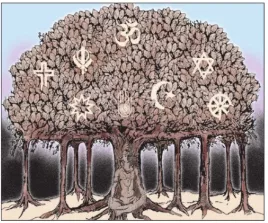
Not hindutva but bhartiyata
Hindutva, the notion of a common national cultural identity promulgated (promote or make widely known (an idea or cause).) by VD Savarkar in the 1920s, was aimed at unifying Indians and building a greater Bharat.Thus far it has failed to do both. Instead, it is deepening divisions, inflaming religious extremism, and removing any hope that the country's different religions can come together to build a great nation.There is no need to revile (criticize) Savarkar however. Uniting Indians is a worthy cause. And India does need a rallying cry (a word or phrase that is used to make people join together to support an idea, cause, etc.) that brings together the majority Hindus. Where Savarkar goes wrong is in asking Hindus to think parochially (having a limited or narrow outlook or scope.), rather than being broadminded and lofty (of a noble or elevated nature.) in their aims.
He also fails to offer a practical system of government where minorities can share power with the majority and thus become true partners in building our nation. And his plan lacks a visionary blueprint for Bharat to expand in size and global influence.
Hindutva is too intertwined (connect or link (two or more things) closely.) with the majority's religion. This failing was evident from before the country's partition. One could assign blame, but the fact remains that Savarkar's grand strategy that “Hindusthan must ever remain one and indivisible” didn't succeed. Rather than provide the glue to keep a culturally diverse people together, Hindutva pushed Hindus and Muslims apart. It also drove wedges between those wise and amiable (having or displaying a friendly and pleasant manner.) leaders, Gandhi, Nehru, Shyama Prasad Mookerjee, DeendayalUpadhyaya, and of course, Savarkar himself. These differences have kept Hindus divided now for nearly a century.
Savarkar's plan proposed just the opposite. He set out to remove differences among the various Hindu sects and castes, so they would unite against the British and think of themselves as a single nation. He coined the term Hindutva to offer an organising principle different from Hinduism, which he thought was “essentially sectarian”. “Hindutva refers not only to the religious aspect of the Hindu people as the word Hinduism does,” said Savarkar, “but comprehends even their cultural, linguistic, social and political aspects as well.” His Hindutva was an instrument of political mobilization.
But since Savarkar's Hindutva was indistinguishable from Hinduism, and a political movement, it was quickly seen as an attempt at establishing Hindu hegemony (dominance) . Under his plan the minorities were to be given equal rights and protection, but no share in power.
So how can Hindutva be revamped (give new and improved form, structure, or appearance to.) to fulfil Savarkar's dream of building a greater Bharat?
Hindus are tough to unite. The religion is not based on a single belief, or an organised church, or on one book. So whenever an attempt is made to impose one way of being Hindu, Hindus revolt. Also, Hinduism's fundamental philosophy that one must not hurt or harm others goes against any plan to oppose others because of their religion.
This is why Savarkar's Hindutva was always rejected by most Hindus. Even today, presumably (used to convey that what is asserted is very likely though not known for certain.) at its peak, Hindutva doesn't garner its flag bearer, BJP, anywhere near full Hindu support. Modi became prime minister in 2014, but BJP received only 32% of the vote in a country that is 80% Hindu. Similarly in 2017, Yogi Adityanath rode history's biggest Hindutva wave in UP but obtained less than 40% of the vote in an 80% Hindu state.
Hindus do wish to be united, but it will take a more uplifting concept than Hindutva. It will require an idea that proclaims Hinduism's all-embracing universalism, rather than one that makes it an organised religion. Hindus want to be big-hearted, they will gladly follow a call for unity that is true to their philosophy of serving all mankind regardless of religious differences.
The first challenge in revamping Hindutva is the name itself. It breaks the general principle that a name is most effective when it doesn't need explanation. Savarkar took thousands of words to describe it, just to say that it is not Hinduism. Current explanations are also almost apologetic, that Hindutva is synonymous with Indianness, or Bhartiyata, but not Hinduism. Renaming Hindutva as Bhartiyata makes the most sense provided the concept also adopts other principles described here.
Second, unlike Hindutva, Bhartiyata must stand on the principle that minorities can have a fair share in power. This requires a system of government that provides them opportunities at local, state and central government levels. The best way is to adopt the presidential form of government, which was devised specifically to restrict majorities from ruling alone.
Third, local governments under Bhartiyata must be given greater autonomy in handling local affairs. Where Muslims are in the majority, in Kashmir for example, Bhartiyata must assign them the same rights and responsibilities as all other state governments.
Fourth, Bhartiyata must also enact laws that deliver genuine secularism. They must be based on principles of freedom of religion, equality before law, and separation of religion and state. For a greater Bharat, we must pass a Uniform Civil Code, and a constitutional amendment restricting governments from involvement with any religion.
Last, Bhartiyata must present a vision of a growing Bharat. By giving autonomy to states for self-government but not self-determination ¬secession (withdrawal of something) would not be an option ¬Bhartiyata would secure the country's territorial integrity. But it should go beyond by offering a federation to neighbouring countries. Like minded nations that wish to benefit from Bharat's size and vigor (effort, energy, and enthusiasm.) should be invited to join.
We all dream of a greater Bharat. So did Savarkar. Let's make his idea of Hindutva more uplifting and practical, so together we can build the nation of our dreams.







Stay updated with The Hindu Editorial Vocab24 app, your definitive source for breaking news and comprehensive coverage from India and around the globe. Whether it's political developments, business updates, sports highlights, the latest technology trends, or current events, The Hindu brings live, accurate, and reliable news directly to your device.
Don’t fall for sensationalized or fake news shared online. Read and share accurate updates with friends and family through The Hindu Editorial Vocab24 app. Download it today!
News Coverage in The Hindu Editorial Vocab24 App
Breaking News: Receive instant notifications on breaking news stories as they unfold. Stay informed about major events and developments in India and around the world with live blogs, news in shorts videos, and concise articles.
Politics: Get the latest updates on Indian politics, including elections, policy changes, government decisions, and political events that shape the nation.
Business and Economy: Stay ahead in the economic landscape with detailed business news and market analysis. Learn about stock market trends, financial reports, corporate news, and economic developments to make informed investment decisions.
Current Events: Follow stories on social issues, policy changes, global events, and daily current affairs, tailored for UPSC and other competitive exam preparations.
Technology: Keep up with the latest gadgets, innovations, and tech trends. Read expert reviews and analyses in short, concise updates on cutting-edge technology from India and beyond.
Sports: Never miss a moment of your favorite sports. Get live scores, match reports, and expert analysis on cricket, football, tennis, and more.
International News: Stay informed about global events and geopolitical developments, including the Russia-Ukraine war, Israel-Palestine conflict, and other key international stories.
Local News: Stay connected to your community with the latest updates on city events, issues, and local news. Coverage includes hyperlocal updates from cities like Bangalore, Chennai, Delhi, Hyderabad, Mumbai, Kolkata, and more.
Trending Topics: Discover what's trending today with the most talked-about stories and hot topics across India and the world.
Experience journalism that values integrity, accuracy, and reliability. Download The Hindu Editorial Vocab24 app today and stay connected with the world.
Subscribe to our newsletter!







