

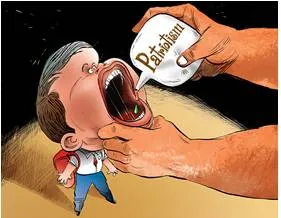
No sir we are not sheep sir nobody students or adults wants patriotism to be forced down their throats
As the sun set on the outgoing year, the Gujarat government decided that it was time to further the cause of patriotic fervour. The command came in the form of an official circular from the state secondary and higher secondary education board and the director of primary education.It spelt out the rationale and scope quite imperiously: “In order to instil nationalism from a young age, it is directed that students of all schools, government, grant-in-aid as well as private, should say ‘Jai Bharat’ or ‘Jai Hind’, instead of ‘Yes Sir’ or ‘Present Sir’ across the state from January 1, 2019. Ensure that this is followed across all schools.”
Of course, patriotism is a good thing. All citizens of a nation should have it. But must students be forced to carry it on their sleeves, or, in this case on their lips, during a routine and mundane exercise of a school roll call? I am not sure if other mature democracies insist upon this kind of public display of patriotism. I wonder, for instance, what the reaction would be in America if students during roll call in schools were forced to say ‘Long live America’ when their name is called out!
Illustration: Uday Deb
Like in most good things, the danger is of erring in excess. This danger was discussed by the Supreme Court in the context of the national anthem being played in cinema halls. While the SC had in November 2016 concurred with the government’s directive in this regard, in January 2018 it reviewed its decision, making compliance optional. The thinking of the court had become clear in the interim. In October 2017, it observed that people “cannot be forced to carry their patriotism on their sleeves”, and it cannot be assumed that if a person does not stand up for the national anthem he is “less patriotic”.
The same logic would apply to school students. Is a student saying ‘Yes Sir’ or ‘Present Sir’, less patriotic than one who says ‘Jai Hind’ or ‘Jai Bharat’? According to the Gujarat government the answer would be yes, but I think many people would rightly disagree. Reducing a citizen’s love for one’s country to a rigid formula is beset with problems. Who has the ordained right to devise these formulas?
And, what are the limits to this kind of tokenism? What if somebody came up with the bright idea that babus in offices should only greet each other, and their seniors, by saying ‘Jai Hind’ or ‘Jai Bharat’? Or, a senior, before issuing a reprimand, must mandatorily, in the interests of national unity, say ‘Jai Hind’ or ‘Jai Bharat’?
Such questions may sound facetious, but they are precisely what the SC, in revising its order on the issue of the national anthem, took into account. Observing that society did not need this kind of “moral policing”, the court wondered what would happen if next time the “government will want people to stop wearing T-shirts and shorts to cinemas saying this would disrespect the national anthem”. In fact, the sartorial field presents infinite possibilities for the evangelists of patriotism. Perhaps, the Gujarat government will next come out with a circular that all school uniforms must be in the colours of the national flag to instil even greater nationalism in children!
Besides, there is a disturbingly exclusionist aspect to this kind of mindless symbolism. Patriotism must be a matter of enlightened choice, not blind fiat. Those who don’t follow the fiat, become automatically less patriotic, and must bear the stigma of this arbitrary exclusion. We then have a society segmented, according to some minister’s whim, into less patriotic and more patriotic people. A student, who says ‘Present Sir’ instead of ‘Jai Hind’, simplistically becomes less patriotic.
And then, there is the question of reprisal. How would you punish a student who, inadvertently or otherwise, says ‘Present Sir’? Would you expel him? The punishment must be commensurate with the crime. In this case, it is lack of ‘sufficient patriotism’, which some over-zealous school principal may equate with treason, and deal with the student accordingly, thereby further entrenching an institutionalized system of societal ostracism.
I think the time has come when we put a stop to this reckless business of playing about with patriotism. Once sanctioned, this is a very slippery slope. Anything and everything can be dubbed as anti-national by the self-appointed arbiters of patriotic ardour. The danger is particularly ominous for those who have the democratic temerity to question government policies.
The government can claim that it alone has the right to devise policies in national interest. Any questions posed to those policies ipso facto become anti-national. This is not a hypothetical possibility. There are already examples of this kind of juvenile reaction.
The fact is that compulsion, like familiarity, breeds contempt. Nobody, students or adults, wants patriotism to be forced down their throats, especially when their love for their country is not in doubt. Routinising a noble sentiment to mechanical ritual, and that too by diktat, is the worst thing we can do to further patriotism. Will the Gujarat government reconsider its ill-advised measure? Or worse, will other state governments, like Uttar Pradesh, emulate the Gujarat decision? Before this patriotic excess becomes endemic, perhaps the SC may need to intervene again.











Stay updated with The Hindu Editorial Vocab24 app, your definitive source for breaking news and comprehensive coverage from India and around the globe. Whether it's political developments, business updates, sports highlights, the latest technology trends, or current events, The Hindu brings live, accurate, and reliable news directly to your device.
Don’t fall for sensationalized or fake news shared online. Read and share accurate updates with friends and family through The Hindu Editorial Vocab24 app. Download it today!
News Coverage in The Hindu Editorial Vocab24 App
Breaking News: Receive instant notifications on breaking news stories as they unfold. Stay informed about major events and developments in India and around the world with live blogs, news in shorts videos, and concise articles.
Politics: Get the latest updates on Indian politics, including elections, policy changes, government decisions, and political events that shape the nation.
Business and Economy: Stay ahead in the economic landscape with detailed business news and market analysis. Learn about stock market trends, financial reports, corporate news, and economic developments to make informed investment decisions.
Current Events: Follow stories on social issues, policy changes, global events, and daily current affairs, tailored for UPSC and other competitive exam preparations.
Technology: Keep up with the latest gadgets, innovations, and tech trends. Read expert reviews and analyses in short, concise updates on cutting-edge technology from India and beyond.
Sports: Never miss a moment of your favorite sports. Get live scores, match reports, and expert analysis on cricket, football, tennis, and more.
International News: Stay informed about global events and geopolitical developments, including the Russia-Ukraine war, Israel-Palestine conflict, and other key international stories.
Local News: Stay connected to your community with the latest updates on city events, issues, and local news. Coverage includes hyperlocal updates from cities like Bangalore, Chennai, Delhi, Hyderabad, Mumbai, Kolkata, and more.
Trending Topics: Discover what's trending today with the most talked-about stories and hot topics across India and the world.
Experience journalism that values integrity, accuracy, and reliability. Download The Hindu Editorial Vocab24 app today and stay connected with the world.
Subscribe to our newsletter!







