

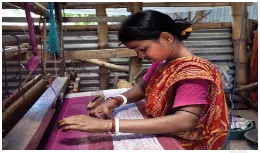
No economy for women
According to a recent report by the International Labour Organisation (ILO), India and Pakistan have the lowest rates of women’s labour force participation in Asia, in sharp contrast to Nepal, Vietnam, Laos and Cambodia that have the highest, with richer nations like Singapore, Malaysia and Indonesia falling in between. Moreover, even this low rate of labour force participation seems to be declining. The National Sample Survey found that while in 1999-2000, 25.9% of all women worked, by 2011-12 this proportion had dropped to 21.9%. This is in stark contrast to worldwide trends. Of the 185 nations that are part of the ILO database, since the 1990s, 114 countries have recorded an increase in the proportion of women in the workforce, and only 41 recorded declines, with India leading the pack. So what does this tell us about India’s growth story? The importance of access A heartening explanation could be that with rising incomes, women have the opportunity to escape harsh labour in farms and on construction sites, and focus on their families. But a more pessimistic and possibly realistic explanation might be that with declining farm sizes, rising mechanisation, and consequently dwindling labour demands in agriculture, women are being forced out of the workforce. If true, this has serious implications for future policy. Research has shown that when women have access to more work opportunities, they gladly take them. The India Human Development Survey (IHDS), jointly organised by researchers from the National Council of Applied Economic Research (NCAER) and the University of Maryland, finds that the provision of work under the Mahatma Gandhi National Rural Employment Guarantee Act (MGNREGA) has brought more rural women into wage labour. Among MGNREGA workers in 2011-12, a whopping (भारी/बहुत बड़ा) (figuratively very large that can make impact) 45% were not in wage labour before the scheme was initiated. Moreover, the provision of MGNREGA work has far greater impact on women’s paid work than that of men. Increased availability of wage work also enhances women’s control over household decision-making. Since NREGA work by itself cannot be expected to provide consistent stable employment for women, it is imperative to explore other avenues (पथ /मार्ग) . From a policy perspective, two main challenges have to be addressed for augmenting (बढ़ना/वृद्धि करना) women’s workforce participation rates. First, in view of shrinking farm work, we need to create opportunities for women to move from agricultural to non-agricultural manual work. Second, we must foster a work environment that allows more women, especially urban and educated women, to take up salaried jobs. In her research, Lei Lei, a sociologist at the University of Maryland, finds that in villages where roads were constructed between the first (2004-05) and second (2011-12) waves of IHDS, both men and women were more likely to undertake non-agricultural work but this effect was greater for women. Such work has a cascading effect as construction of concrete roads also improves transportation services such as buses, which, in turn, could facilitate movement of the rural workforce, especially women, into non-agricultural work in neighbouring villages and towns. At the other end of the employment spectrum, however, there is a need to make it possible for educated women to continue to work even while raising families. In a context where women continue to bear the major share of household work and childcare, the prevalence of a rigid work environment in India and the dearth (कमी/अभाव) of family-friendly work institutions create impediments (अवरोध/बाधा) to women’s access to white-collar jobs in the formal sector. Second, long distances between the home and the workplace increase both commuting time and work burdens, leaving workers with even less time for family duties. Another aspect of the skewed work-family equation for women in India is the demand for investing in children’s education over professional achievement. Research by Alaka Basu, a sociologist at Cornell University, and Sonalde Desai (co-author of this article) highlights the contrast between the reasons for fertility decline in the West, where it was fuelled by the desire for self-fulfilment among both men and women, and in India, where small families have emanated from the desire to promote future achievements of children by focusing on their education rather than on better employment prospects for the parents. This has led to urban and educated Indian women dropping out of the labour pool in contradistinction (विरोध/मुक़ाबला) to their counterparts in Japan and Korea, for example, who have instead opted out of marriage, resulting in a dip in fertility rates in the latter countries to barely 1.3 child(ren) per couple. Neither of these, however, seems an optimal outcome for society. The only way this conundrum (समस्या) can be addressed is by encouraging workplaces to become more responsive to family needs and to promote sharing of household responsibilities between both genders — something that Scandinavian countries have emphasised. Sharing the burden Few organisations are willing to consider challenges involved in generating a work-life balance. Even before the influx of global firms in India, work structures in Indian companies and even the government were highly inflexible. Over the past two decades, these demands have grown. With rising global competition, Indian firms have chosen to follow the American model with demands for extended work hours as well as attendance on Saturdays and Sundays. This creates a time bind for both men and women where something must give. An interesting repercussion (अप्रत्यक्ष परिणाम/अप्रत्यक्ष प्रभाव) of this work dynamic is reflected in a recent study titled ‘Millennial Careers: 2020 Vision’, by Manpower Group, conducted across 25 countries and encompassing 19,000 working millennials and 1,500 hiring managers. The study found that young workers in India worked 52 hours per week as against, say, 42 hours by their counterparts in Canada. Work-family balance requires increased participation by men in household chores and caring for children. However, workplace inflexibility makes for difficult choices, involving trade-offs between investing in careers of husbands vis-a-vis those of wives, often resulting in women taking a back seat and at times even dropping out of the workforce. The Economic Survey 2016-17 expressed concern that the demographic dividend is already receding (घटना/कम होना), reducing the opportunity for the Indian economy to catch up with its East Asian counterparts. However, the numeric consequences of reducing obstacles to women’s full economic participation far exceed the demographic advantages of having a larger pool of young workers. It is thus high time to talk of the gender dividend (लाभ/फायदा) rather than the demographic dividend.Whopping (adjective)
Extremely large. भारी/बहुत बड़ा
Synonyms: Colossal, Massive, Big, Extraordinary, Gargantuan, Giant, Gigantic, Great
Example: The Revenant, a Hollywood film acted by Leonardo DiCaprio was a whopping success.
Avenue (noun)
A way of approaching a problem or making progress towards something. पथ /मार्ग
Synonyms: Line, Path, Direction, Route; Method, Approach, Course of Action
Example: We plan to pursue all available avenues to get our message to the public.
Augment (verb)
Make (something) greater by adding to it; increase. बढ़ना/वृद्धि करना
Synonyms: Amplify, Magnify, Raise, Grow Up
Example: We need the business loan in order to augment our warehouse so we can fulfill more orders.
Dearth (noun)
A scarcity or lack of something. कमी/अभाव
Synonyms: Lack, Scarcity, Shortage, Deficiency, Insufficiency, Inadequacy, Paucity
Example: Although the lake is filled with water, the dearth of aquatic life makes it a gloomy sight.
Impediment (noun)
A hindrance or obstruction in doing something. अवरोध/बाधा
Synonyms: Barrier, Interruption, Hindrance , Obstruction, Block, Restriction, Deterrence
Example: According to a number of teachers, the biggest impediment to working in a small town is the low salary paid to educators.
Contradistinction (noun)
Distinction made by contrasting the different qualities of two things. विरोध/मुक़ाबला
Synonyms: Antithesis, Contradiction, Contrast, Oppositeness
Example: There is a contradistinction between what he said yesterday and what he said today.
Conundrum (noun)
A confusing and difficult problem or question/ a difficult problem that seems to have no solution. समस्या
Synonyms: Problem, Difficulty, Quandary, Enigma, Riddle
Example: Although the mechanic tried to identify the conundrum with the car, he was unable to pinpoint the issue.
Repercussion (noun)
An action or effect given or exerted in return: a reciprocal action or effect/ a widespread, indirect, or unforeseen effect of an act, action, or even. अप्रत्यक्ष परिणाम/अप्रत्यक्ष प्रभाव
Synonyms: Consequence, Result, Effect, Outcome
Example: Your decision not to go to college will have repercussions you'll feel for years to come.
Trade off (noun)
A balance achieved between two desirable but incompatible features./ a balancing of factors all of which are not attainable at the same time. समंजन/समझौता
Synonyms: Barter, Commutation, Quid Pro Quo, Swap
Example: The product launch was unsuccessful because the company couldn’t make trade off with the market competitiveness.
Dividend (noun)
A benefit from an action or policy. लाभ/फायदा
Synonyms: Benefit, Advantage, Gain, Bonus, Divvy
Example: The reward money was an unexpected dividend for our good deed.










Stay updated with The Hindu Editorial Vocab24 app, your definitive source for breaking news and comprehensive coverage from India and around the globe. Whether it's political developments, business updates, sports highlights, the latest technology trends, or current events, The Hindu brings live, accurate, and reliable news directly to your device.
Don’t fall for sensationalized or fake news shared online. Read and share accurate updates with friends and family through The Hindu Editorial Vocab24 app. Download it today!
News Coverage in The Hindu Editorial Vocab24 App
Breaking News: Receive instant notifications on breaking news stories as they unfold. Stay informed about major events and developments in India and around the world with live blogs, news in shorts videos, and concise articles.
Politics: Get the latest updates on Indian politics, including elections, policy changes, government decisions, and political events that shape the nation.
Business and Economy: Stay ahead in the economic landscape with detailed business news and market analysis. Learn about stock market trends, financial reports, corporate news, and economic developments to make informed investment decisions.
Current Events: Follow stories on social issues, policy changes, global events, and daily current affairs, tailored for UPSC and other competitive exam preparations.
Technology: Keep up with the latest gadgets, innovations, and tech trends. Read expert reviews and analyses in short, concise updates on cutting-edge technology from India and beyond.
Sports: Never miss a moment of your favorite sports. Get live scores, match reports, and expert analysis on cricket, football, tennis, and more.
International News: Stay informed about global events and geopolitical developments, including the Russia-Ukraine war, Israel-Palestine conflict, and other key international stories.
Local News: Stay connected to your community with the latest updates on city events, issues, and local news. Coverage includes hyperlocal updates from cities like Bangalore, Chennai, Delhi, Hyderabad, Mumbai, Kolkata, and more.
Trending Topics: Discover what's trending today with the most talked-about stories and hot topics across India and the world.
Experience journalism that values integrity, accuracy, and reliability. Download The Hindu Editorial Vocab24 app today and stay connected with the world.
Subscribe to our newsletter!







