

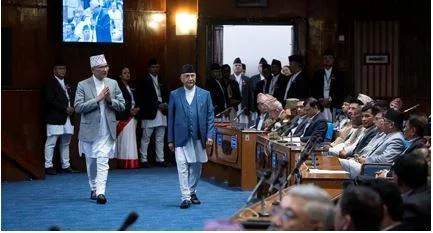
Nepal’s ruling parties’ attempt to change poll laws could deal a blow to inclusivity
The CPN-UML and Nepali Congress seek to raise the threshold for parties’ seats in Parliament, potentially cutting representation of the marginalised communities down; analysts say the ‘pursuit of chimera’ in name of ‘stability’ would risk undermining the cornerstone of the country’s Constitution.Nepal’s two big parties, which formed a coalition government six months ago calling for constitutional amendments “for political stability”, have walked back on that promise. Instead, they are now working on revising the law to change the electoral system — a move that many say could deal a blow to the principle of inclusivity.
With Prime Minister K.P. Sharma Oli recently saying a constitutional amendment is not possible before 2030, his party, the Communist Party of Nepal (Unified Marxist-Leninist), or CPN-UML, and the Nepali Congress (NC) are planning to increase the threshold for parties.
The threshold determines the number of seats parties are allocated based on the vote shares received under the proportional representation (PR) system. Currently, the threshold for parties in the Federal Parliament is 3%, which the ruling coalition is trying to increase to 5%.
PR is one of the two systems Nepal follows, the other being the first-past-the-post (FPTP), under which whoever wins more votes gets elected, to elect the Federal Parliament and Provincial Assemblies.
In Nepal’s 275-member House of Representatives, 165 members are elected under FPTP and the remaining 110 under the PR system. This mixed system makes it extremely difficult for a single party to win a majority, hence the last two elections since the promulgation of the Constitution in 2015 have resulted in hung parliaments, and multiple governments.
Shifting goalposts
“Stability” has been the common refrain of leaders of the NC and the CPN-UML lately, who are rooting their argument in the frequent change of governments in the last 10 years since the new Constitution. In the latest such change, in July last year, the two largest parties came together to unseat the Pushpa Kamal Dahal ‘Prachanda’-led government. They said they would amend the Constitution in such a way that it would ensure a party wins a majority to govern for five years.
“It was clear from the outset that they were aiming to dismantle the PR system. But since they lack the numbers to amend the Constitution, they are now talking about changing the electoral system,” said Tula Shah, a political analyst. “Increasing the threshold would mean reducing the representation of women and the disadvantaged groups, which will be a setback for the principle of inclusivity.”
Analysts say the PR system is considered the hallmark of inclusivity in a diverse country like Nepal, and any move to scrap or tweak it will be regressive.
Dr. Baburam Bhattarai, a former Prime Minister and leader of the Nepal Samajwadi Party, says the big parties’ commitment to inclusivity was always in question, and what they are aiming for now just proves that.
“Underneath their constitutional amendment plan lay an ominous intent to scrap the PR system. Now, they are making a futile attempt to increase the threshold,” said Dr. Bhattarai. “To cover up their failure, they are now trying to change the rules of the game halfway.”
Experts say Nepali parties’ tendency to blame the lack of stability for all ills is flawed and stems from their desire for power.
Chief Election Commissioner Dinesh Chandra Thapaliya recently lashed out at the ruling parties publicly for attempting to increase the threshold.
“The current constitutional provisions and laws are not a barrier to securing a majority for any party,” said Mr. Thapaliya. “If Nepali parties cannot convince their voters to vote them into a majority, how can they find fault with the current system and arrangements?”
Nepal has not seen any government complete its full term ever since the restoration of democracy in 1990.
However, it’s not for the lack of a majority for any party in the last three and a half decades. The 1991 and 1999 elections gave the mandate to one party or the other to form a majority government, but the parties’ failure led to the dissolution of the House on both occasions.
“Proportional representation is one of our biggest achievements. Our democracy is an inclusive democracy,” said Mr. Thapaliya. “No law can be enacted by ignoring inclusivity.”
Mr. Thapaliya’s remarks were in response to the two big parties’ push to raise the threshold before presenting a Bill to amend and consolidate the election law, prepared by the Election Commission (EC), in Parliament.
Dr. Bhattarai said blaming the electoral system for their failure and lack of political culture is unethical on the part of the big parties. “Any attempt to increase the threshold would meet with resistance,” he said. “And even if they do manage to increase it, it is not possible for big parties like the NC or the UML to win a majority.”
Raising the threshold means the bigger parties, which often tend to field the privileged and men unless necessitated by the law, will get an edge. On the contrary, smaller and regional parties field the marginalised, and they will suffer.
Dangerous games
Analysts say the idea of increasing the threshold is even more dangerous because it will reduce the representation of women and historically excluded groups.
“In the pursuit of this chimera called stability lies the risk of undermining inclusivity, which is the cornerstone of Nepal’s 2015 Constitution,” said Dr. Bhattarai. “Instead of improving our democracy to make it more inclusive, progressive and refined, ruling parties are heading down the path of regression.”
Mr. Thapaliya, the Chief Election Commissioner, even questioned what “stability” actually means.
“In our country, every time there was a majority of a single party, the Parliament faced a sudden death,” said Mr. Thapaliya. “Do not these parties need to justify their past actions when they say stability can be achieved only when there is a majority of a single party?”



Top court quashes FIRs against Gen Z protesters
Sep 04, 2026






Stay updated with The Hindu Editorial Vocab24 app, your definitive source for breaking news and comprehensive coverage from India and around the globe. Whether it's political developments, business updates, sports highlights, the latest technology trends, or current events, The Hindu brings live, accurate, and reliable news directly to your device.
Don’t fall for sensationalized or fake news shared online. Read and share accurate updates with friends and family through The Hindu Editorial Vocab24 app. Download it today!
News Coverage in The Hindu Editorial Vocab24 App
Breaking News: Receive instant notifications on breaking news stories as they unfold. Stay informed about major events and developments in India and around the world with live blogs, news in shorts videos, and concise articles.
Politics: Get the latest updates on Indian politics, including elections, policy changes, government decisions, and political events that shape the nation.
Business and Economy: Stay ahead in the economic landscape with detailed business news and market analysis. Learn about stock market trends, financial reports, corporate news, and economic developments to make informed investment decisions.
Current Events: Follow stories on social issues, policy changes, global events, and daily current affairs, tailored for UPSC and other competitive exam preparations.
Technology: Keep up with the latest gadgets, innovations, and tech trends. Read expert reviews and analyses in short, concise updates on cutting-edge technology from India and beyond.
Sports: Never miss a moment of your favorite sports. Get live scores, match reports, and expert analysis on cricket, football, tennis, and more.
International News: Stay informed about global events and geopolitical developments, including the Russia-Ukraine war, Israel-Palestine conflict, and other key international stories.
Local News: Stay connected to your community with the latest updates on city events, issues, and local news. Coverage includes hyperlocal updates from cities like Bangalore, Chennai, Delhi, Hyderabad, Mumbai, Kolkata, and more.
Trending Topics: Discover what's trending today with the most talked-about stories and hot topics across India and the world.
Experience journalism that values integrity, accuracy, and reliability. Download The Hindu Editorial Vocab24 app today and stay connected with the world.
Subscribe to our newsletter!







