

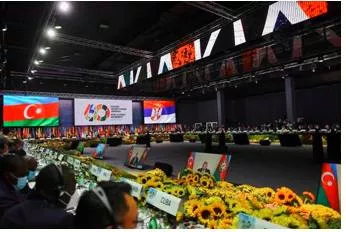
Nam at 60 marks an age of indian alignment
The ideological moorings of India’s non-alignment faded along with Jawaharlal Nehru’s idealism.The birth anniversary of Jawaharlal Nehru this month and the 60th anniversary of the Non-Aligned Movement prompt reflection on Nehru’s major contribution to the field of international relations. The concept of not aligning a country’s policy with others can be traced to the Congress of Vienna (1814-15) when the neutrality of Switzerland, by which that country would keep out of others’ conflicts, was recognised.
One world and free India
Mahatma Gandhi, icon of Indian Independence, believed in non-violent solutions and spirituality, with India having a civilising mission for mankind which accorded well with Nehru’s desire to innovate in world politics and his conception of modernity. In 1946, six days after Nehru formed the national government, he stated, “we propose... to keep away from the power politics of groups aligned against one another... it is for One World that free India will work.” Nehru, the theoretician, saw world problems as interlinked; not a binary of right and wrong, but as a practical person, his instructions to delegates at international meetings were to consider India’s interests first, even before the merits of the case; this was the paradox of a moral orientation in foreign policy and the compulsions of the real world.
In essence, Indian non-alignment’s ideological moorings began, lived and died along with Nehru’s idealism, though some features that characterised his foreign policy were retained to sustain diplomatic flexibility and promote India while its economic situation improved sufficiently to be described as an ‘emerging’ power. Nehru was opposed to the conformity required by both sides in the Cold War, and his opposition to alliances was justified by American weapons to Pakistan from 1954 and the creation of western-led military blocs in Asia. Non-alignment was the least costly policy for promoting India’s diplomatic presence, a sensible approach when India was weak and looked at askance by both blocs, and the best means of securing economic assistance from abroad. India played a lone hand against colonialism and racism until many African states achieved independence after 1960.
India played a surprisingly prominent role as facilitator at the 1954 Geneva Peace Conference on Indochina, whereafter non-alignment appeared to have come of age. The difficulty was always to find a definition of this policy, which caused a credibility gap between theory and practice. In the early years, there was economic dependence on donor countries who were nearly all members of western military pacts. Indian equidistance to both Koreas and both Vietnams was shown by India recognising neither; yet it recognised one party in the two Chinas and two Germanies, and the Treaty of peace, friendship and cooperation between India and the Union of Soviet Socialist Republics of 1971, fashioned with the liberation war of Bangladesh in view, came dangerously close to a military alliance,
NAM’s failures
When Yugoslavia and Egypt became non-aligned by defying the great powers and convened the first Summit Conference of the Non-Aligned Movement in 1961, Nehru, who never endorsed confrontational methods, became a third but hesitant co-sponsor, because in theory, a coalition or movement of non-aligned nations was a contradiction in terms. According to then Defence Minister Krishna Menon’s epigram, true non-alignment was to be non-aligned towards the non-aligned. Nehru’s misgivings were confirmed when only two members, Cyprus and Ethiopia, of the conference supported India in the war with China. Among the Non-Aligned Movement’s members was a plenitude of varying alignments, a weakness aggravated by not internalising their own precepts of human rights and peaceful settlement of disputes on the grounds of not violating the sacred principle of sovereign domestic jurisdiction. Other failures were lack of collective action and collective self-reliance, and the non-establishment of an equitable international economic or information order. The Movement could not dent, let alone break, the prevailing world order.
The years following Nehru’s death saw the atrophy of his idealism, and non-alignment during his successors moved from pragmatism under Indira Gandhi and opportunism after the dissolution of the former Soviet Union, to the semi-alignment of today. Prime Minister Narendra Modi’s party, by ideology, inclination and threat perception, is inclined to greater alignment with the United States whether under the nebulous rubric of the Indo-Pacific or otherwise.
Longevity of organisations
The Centre for Policy Research produced a document in 2012 titled ‘Non-alignment Mark 2.0’ which left no trace; the same body’s paper, ‘A rethink of foreign policy’, this year elides it altogether. Every international organisation has a shelf life, though many survive for years in semi-neglect. The League of Nations was given the coup de grâce after seven years of inactivity only in 1946, even after the United Nations had come into being. The Commonwealth will last only as long as the British find it useful. It is hard to see any future for Brazil-Russia-India-China-South Africa (BRICS) or its various institutional offspring, given the state of India-China relations. The South Asian Association for Regional Cooperation (SAARC) has faded into oblivion. Few among even our serving diplomats could tell what transpired at the last Non-aligned Conference or where the next will be held, while the symbolic anniversary, unanimously agreed upon in 1981 of ‘The First September, Day of Non-alignment’, has come and gone unnoticed.

Atiqa records two top-four finishes in WSK Final Cup
Sep 05, 2026









Stay updated with The Hindu Editorial Vocab24 app, your definitive source for breaking news and comprehensive coverage from India and around the globe. Whether it's political developments, business updates, sports highlights, the latest technology trends, or current events, The Hindu brings live, accurate, and reliable news directly to your device.
Don’t fall for sensationalized or fake news shared online. Read and share accurate updates with friends and family through The Hindu Editorial Vocab24 app. Download it today!
News Coverage in The Hindu Editorial Vocab24 App
Breaking News: Receive instant notifications on breaking news stories as they unfold. Stay informed about major events and developments in India and around the world with live blogs, news in shorts videos, and concise articles.
Politics: Get the latest updates on Indian politics, including elections, policy changes, government decisions, and political events that shape the nation.
Business and Economy: Stay ahead in the economic landscape with detailed business news and market analysis. Learn about stock market trends, financial reports, corporate news, and economic developments to make informed investment decisions.
Current Events: Follow stories on social issues, policy changes, global events, and daily current affairs, tailored for UPSC and other competitive exam preparations.
Technology: Keep up with the latest gadgets, innovations, and tech trends. Read expert reviews and analyses in short, concise updates on cutting-edge technology from India and beyond.
Sports: Never miss a moment of your favorite sports. Get live scores, match reports, and expert analysis on cricket, football, tennis, and more.
International News: Stay informed about global events and geopolitical developments, including the Russia-Ukraine war, Israel-Palestine conflict, and other key international stories.
Local News: Stay connected to your community with the latest updates on city events, issues, and local news. Coverage includes hyperlocal updates from cities like Bangalore, Chennai, Delhi, Hyderabad, Mumbai, Kolkata, and more.
Trending Topics: Discover what's trending today with the most talked-about stories and hot topics across India and the world.
Experience journalism that values integrity, accuracy, and reliability. Download The Hindu Editorial Vocab24 app today and stay connected with the world.
Subscribe to our newsletter!







