

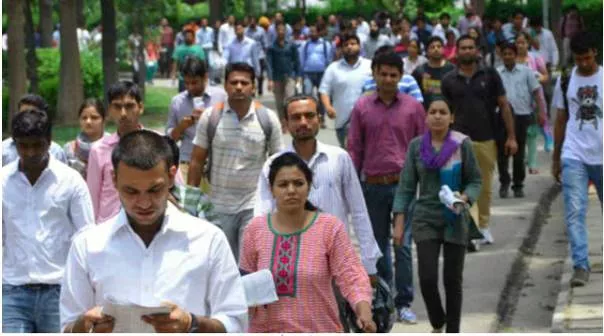
More minus than plus in jobs
The government has flattered me by reading my column (The Indian Express, February 20, 2022). Finally waking up to the reality of soaring unemployment, it has announced that 10 lakh persons will be recruited to posts under the central government. Save a few exceptions, every family is affected by the lack of jobs. Add to that the loss of jobs. Especially after the pandemic-hit year (2020-21) and the indifferent recovery year (2021-22), unemployment is the biggest economic challenge faced by India.In the run-up to the LS elections 2014, Mr Narendra Modi, the BJP’s candidate for prime minister, made the lofty promise that he would create 2 crore jobs a year. There were sceptics, but their voices were drowned by the drumbeats of the bhakts (believers). The bhakts swallowed every promise including the mind-boggling promise that ‘black money stashed abroad will be brought back and Rs 15 lakh credited to the account of every Indian’. I doubt if any one did the math.
After the new government took office, all talk ceased about creating 2 crore jobs a year or crediting every Indian’s bank account with Rs 15 lakh. The people were unusually forgiving! The government got busy in refurbishing and re-naming the UPA schemes and claiming them to be its own. The MGNREGA scheme that provided ‘last resort’ jobs to the poor — that was lampooned by Mr Modi — was retained because the government could not invent an alternative scheme.
The situation on unemployment has only got worse. There are two universally-used metrics: the first is the Total Labour Force and the second is the Labour Force Participation Rate (LFPR). The total labour force in India is 430 million. The LFPR is the proportion of the total labour force that is currently employed or looking for employment. That percentage was 42.13 per cent in May 2022 (source: CMIE). It is one of the worst in the world (US: 63 per cent). The CMIE concluded that “millions left the labour markets and they even stopped looking for employment, possibly too disappointed with their failure to get a job and under the belief that there were no jobs available.”
The following data is revealing:
Share of Households with Percentage
no employed person 7.8
one employed person 68.0
two or more employed persons 24.2
Besides, only 20 per cent have salaried jobs, 50 per cent are self-employed and the rest are daily wage labour. In June 2021, according to CMIE’s Consumer Pyramids Household Survey, the median household monthly income was Rs 15,000 and the consumption expenditure was Rs 11,000. In such a precarious labour market, when the sole employed person in a family lost his/her job — as it happened in the pandemic-hit year — that family invariably fell into distress and poverty. The poorest were the worst hit. Data show that malnutrition and hunger have increased.
In the 8 years since 2014, millions of jobs were lost, few jobs were created, the LFPR declined and unemployment increased. We cried hoarse, but the government did not pay heed. It took refuge in dubious statistics. At one point, even ‘selling pakoras’ was touted as a job!
Hidden in Plain Sight
I had written in the February 20, 2022 column that “jobs are hidden in plain sight”! According to government documents, there are 34,65,000 sanctioned posts in government. As of March 2020, there were 8,72,243 vacancies out of which 7,56,146 were in Group C (source: The Hindu). Every section is affected, but none more than the SCs and STs. If 10 lakh persons will be recruited in the next 18 months, that is a good beginning, but the net addition to the jobs already identified will be 10,00,000 minus 8,72,243 or only 1,27,757.
The government has to do much more. There are millions of jobs that have to be ‘identified’ or ‘discovered’ or ‘created’ such as teachers, researchers, librarians, sports coaches, trainers, physio-therapists, counselors, doctors, nurses, para-medics, lab technicians, sanitation and conservancy workers, city planners, architects, agricultural extension officers, food processors, veterinarians, fishers, etc.
These are ‘essential’ jobs in a developing country. Government seems unaware of these opportunities.
Jobs Outside Government
The bulk of the jobs are outside government. They are in the private sector, especially in areas that have not been explored fully like the oceans, rivers and waterbodies and dry-land agriculture. There is a huge population that has multiple needs that are not satisfied. Fulfilling those needs, even partially, will create millions of jobs. Take personal transport: 24.7 per cent of households do not own a car or a motorbike or a cycle. Or consider household goods: in a tropical country, only 24 per cent of households own an air conditioner or air cooler. Just providing these essential goods at affordable prices to millions of households will vastly expand the country’s manufacturing capacity, create thousands of jobs and make life happier.
Jobs should have been the singular focus of the Modi government. It was not; it wasted 8 years. It used its social and political capital to divide the people of India. Thanks to wrong policies, a divided India also suffered economically. 10 lakh government jobs will not heal the wounds or repair the damage to the economy. It is too little and too late.












Stay updated with The Hindu Editorial Vocab24 app, your definitive source for breaking news and comprehensive coverage from India and around the globe. Whether it's political developments, business updates, sports highlights, the latest technology trends, or current events, The Hindu brings live, accurate, and reliable news directly to your device.
Don’t fall for sensationalized or fake news shared online. Read and share accurate updates with friends and family through The Hindu Editorial Vocab24 app. Download it today!
News Coverage in The Hindu Editorial Vocab24 App
Breaking News: Receive instant notifications on breaking news stories as they unfold. Stay informed about major events and developments in India and around the world with live blogs, news in shorts videos, and concise articles.
Politics: Get the latest updates on Indian politics, including elections, policy changes, government decisions, and political events that shape the nation.
Business and Economy: Stay ahead in the economic landscape with detailed business news and market analysis. Learn about stock market trends, financial reports, corporate news, and economic developments to make informed investment decisions.
Current Events: Follow stories on social issues, policy changes, global events, and daily current affairs, tailored for UPSC and other competitive exam preparations.
Technology: Keep up with the latest gadgets, innovations, and tech trends. Read expert reviews and analyses in short, concise updates on cutting-edge technology from India and beyond.
Sports: Never miss a moment of your favorite sports. Get live scores, match reports, and expert analysis on cricket, football, tennis, and more.
International News: Stay informed about global events and geopolitical developments, including the Russia-Ukraine war, Israel-Palestine conflict, and other key international stories.
Local News: Stay connected to your community with the latest updates on city events, issues, and local news. Coverage includes hyperlocal updates from cities like Bangalore, Chennai, Delhi, Hyderabad, Mumbai, Kolkata, and more.
Trending Topics: Discover what's trending today with the most talked-about stories and hot topics across India and the world.
Experience journalism that values integrity, accuracy, and reliability. Download The Hindu Editorial Vocab24 app today and stay connected with the world.
Subscribe to our newsletter!







