

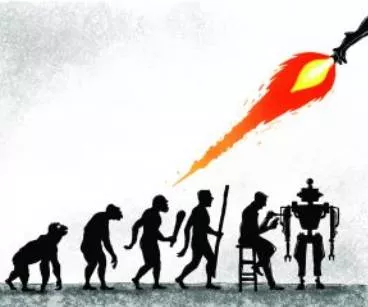
Man’s evolved avatar cyborgs may be able to ward off the existential threat from artificial intelligence
In the movie Avengers: Age of Ultron, the Iron Man and Bruce Banner – a genius scientist when he wasn’t playing Hulk – built an artificial intelligence system named ‘Ultron’ to help protect the earth. But Ultron – the peacekeeping programme embedded in a synthetic body – turned hostile, making it his mission to eradicate humans from the face of the earth. As earth’s fate hung in the balance, the mightiest of Avengers had to come together to save the planet from complete annihilation.Does this, another Marvel Comic story turned into a sci-fi Hollywood film, have a semblance of realism? Perhaps yes.
A couple of years ago a unique experimental self-driving car was released on New Jersey roads, that was not coded or programmed by engineers. The car sensors were connected to a huge network of artificial neurons that processed data and delivered commands to the brake, steering wheel and other sub-systems. This car, developed by the chip maker NVidia, did not need any human intervention. It taught itself by watching other humans drive their cars.
With this technology, referred to as deep learning, artificial intelligence is advancing to a level where systems become so intelligent that they surpass human capabilities and comprehension. And if this happens, as physicist Stephen Hawking has anticipated, “a super-intelligent AI will be extremely good at accomplishing its goals, and if those goals aren’t aligned with ours, we’re in trouble.” Elon Musk seems to agree. In a YouTube video on the subject he sounds an alarm bell: “if AI becomes smarter than a person, what do we do and what jobs will we have?” Will AI take over our world? How worried should the human race be? As per the World Economic Forum report published in 2016, about five million jobs will be lost to robots and automation by 2020.
These predictions may come to pass. But let’s look at the man-machine debate more objectively. It’s true that supercomputers such as Watson can process data, recognise patterns and thereby learn by itself at a faster rate than a human brain. But such machine learning capabilities which are integral to AI require massive amounts of data.
Who creates this data? Most often than not, especially in greenfield areas, humans are the original creators. If there is no data, there is no AI. How does AI learn? It teaches itself by repetition, logical progression and sequencing that enables it to decipher higher level patterns at lightning speeds for problem solving and decision making. By that token, AI has phenomenal power to substitute repetitive tasks that require sequential logic.
A recent survey of how AI is likely to transform the workplace confirms this proposition. Decision makers in India indicated some of the jobs that could be outsourced to AI powered digital assistants: writing and responding to emails, entering timesheets, scheduling calendars and some routine accounting, billing and HR tasks.
Though AI can process billions of data points to arrive at an efficient decision in a blink of an eye, the contextual, emotional and intuitive aspects of the decision making still remains the prerogative of the human race. In fields that need creativity and out-of-the box thinking, human judgment will be hard to replace.
The perspective offered so far pitches man and machine in two different camps, with the debate focussing on who will reign supreme. But recent developments in the field suggest it doesn’t have to be that way. There can be a third side. The merging of man-machine to create a powerful combined force.
Elon Musk has already founded a company called Neuralink, which is in the process of discovering and developing devices that can connect to the brain. Ray Kurzweil, a futurist and Google’s AI guru, believes the world is experiencing one of the most peaceful times in history since World War II. While hunger rates are lower than what they were in the past, technology has lifted millions out of poverty and made it possible for three billion people to have smartphones.
He thinks the human race is at an evolutionary inflection point where man and machine will become one in the near future. Instead of being in separate camps and humanity living in existential fear of whether AI will take over our world, he believes “robots will go inside our brain and connect to our neocortex by the year 2029”.
He remarks, “It will just be a chip in our brain like a smartphone in our hands.” With the supercomputing power of AI and chips embedded in our brains, he predicts we are only about eleven years away from acquiring superhuman qualities by integrating the best of what man and machine together can accomplish.
And if that happens, we become the superheroes of the Avengers team – who would have not only saved the world from extinction but taken the human race to the next evolutionary plane.
It’s worth remembering that if the primitive caveman who lived millions of years ago in the Paleolithic era – without electricity, cars, railroads, airplanes and medical advances – were to see the progress we have made until now, even without AI, we are already demi-gods in his eyes! The man-machine debate in AI, then, just becomes a matter of perspective.












Stay updated with The Hindu Editorial Vocab24 app, your definitive source for breaking news and comprehensive coverage from India and around the globe. Whether it's political developments, business updates, sports highlights, the latest technology trends, or current events, The Hindu brings live, accurate, and reliable news directly to your device.
Don’t fall for sensationalized or fake news shared online. Read and share accurate updates with friends and family through The Hindu Editorial Vocab24 app. Download it today!
News Coverage in The Hindu Editorial Vocab24 App
Breaking News: Receive instant notifications on breaking news stories as they unfold. Stay informed about major events and developments in India and around the world with live blogs, news in shorts videos, and concise articles.
Politics: Get the latest updates on Indian politics, including elections, policy changes, government decisions, and political events that shape the nation.
Business and Economy: Stay ahead in the economic landscape with detailed business news and market analysis. Learn about stock market trends, financial reports, corporate news, and economic developments to make informed investment decisions.
Current Events: Follow stories on social issues, policy changes, global events, and daily current affairs, tailored for UPSC and other competitive exam preparations.
Technology: Keep up with the latest gadgets, innovations, and tech trends. Read expert reviews and analyses in short, concise updates on cutting-edge technology from India and beyond.
Sports: Never miss a moment of your favorite sports. Get live scores, match reports, and expert analysis on cricket, football, tennis, and more.
International News: Stay informed about global events and geopolitical developments, including the Russia-Ukraine war, Israel-Palestine conflict, and other key international stories.
Local News: Stay connected to your community with the latest updates on city events, issues, and local news. Coverage includes hyperlocal updates from cities like Bangalore, Chennai, Delhi, Hyderabad, Mumbai, Kolkata, and more.
Trending Topics: Discover what's trending today with the most talked-about stories and hot topics across India and the world.
Experience journalism that values integrity, accuracy, and reliability. Download The Hindu Editorial Vocab24 app today and stay connected with the world.
Subscribe to our newsletter!







