

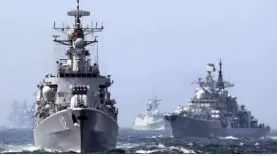
Making waves
The current week has seen the waters of the Bay of Bengal roiled by frothy wakes of warships and submarines of three navies as their jets streak across the skies. The 21st edition of exercise “Malabar” has two aircraft-carriers, a helicopter-carrier, nuclear and diesel submarines, cruisers, destroyers and maritime patrol aircraft belonging to the Indian, Japanese and US navies participating. For a week, these units, divided into “Red” and “Blue” forces will be pitted against each other in mock-combat, involving, surface, under-water and aerial warfare. Naval exercises don’t get more complex or sophisticated (परिष्कृत) than Malabar-2017. For the Indian Navy (IN) it has been a long journey from professional isolation of the non-aligned era, to being the belle of the Malabar ball. Soviet patronage and naval hardware had commenced flowing in the 1960s, but since they never undertook professional interaction or exercises at sea, the IN found itself clinging to outdated NATO doctrines. The disintegration of the USSR saw India losing not only its steadfast (resolutely or dutifully firm and unwavering.) political ally and sole purveyor (a person who sells or deals in particular goods.) of arms, but also the inhibitions (अवरोध/निषेध) that went with non-alignment. The US, perhaps waiting for this moment, lost no time in dispatching Pacific Army Commander, General Claude M. Kicklighter, with proposals for military-to-military cooperation in 1991. Keen to shed its insularity, the IN initiated the first ever Indo-US naval drills in May 1992. These became the precursor (अग्रगामी) for bilateral exercises with the navies of a dozen other nations, which have become an annual feature on the IN calendar. Having got off to a good start, the Indo-US exercises named “Malabar” were interrupted by US sanctions imposed after India’s 1998 nuclear tests. Resumed in 2001, these naval interactions have not only provided the IN invaluable insights into the tactics, doctrines, warfare techniques and best practices of the US Navy, but also enabled periodic self-assessment, using the world’s most powerful navy as a professional yardstick (मानदण्ड) . The path of these exercises has neither been smooth nor untroubled. Externally, China has sustained a determined opposition to Malabar because of its paranoid suspicion that India is colluding (गुट करना) with the US in an attempt at “containment”. Consequently, when the 2007 edition of this bilateral exercise, held off Okinawa, was enlarged to accommodate Australia, Singapore and Japan, China issued a shrill demarche (कार्यवाही), conveying its fear and displeasure. It took another eight years before Japan was formally admitted to make Malabar a tri-lateral. Domestic opposition to Malabar has come from diverse sources. Notwithstanding the steep decline of Communism as a political force, there is a strong residual streak of leftist ideology in many of India’s political parties. At the same time, the right wing has its ultra-nationalists and xenophobes. Thus, an accusation of being “pro-American” can still become a damaging political tool. Another factor that sometimes poses an impediment (अवरोध/रुकावट) is the public anger about America’s continuing economic and military assistance to Pakistan despite its use of jihad as a strategy and its duplicity vis-a-vis anti-India terrorist groups. However, it is the far-reaching geo-political impact of these exercises that needs to be kept firmly in sight. Although India’s traditional strategy of “non-alignment”, and its more recent mutation, “strategic autonomy”, have served to preserve its freedom of action, India’s past leadership did not allow it to come in the way of national interest. The aftermath (परिणाम) of the 1962 Sino-Indian crisis as well as the impending 1971 Indo-Pak War saw our leaders suspend their beliefs in national interest — in the first case, to seek military aid from the West, and in the second, to sign a treaty of friendship with the USSR. With the 1998 nuclear tests and the 2005 Indo-US nuclear deal having resulted in a fundamental transformation of India’s status, PM Modi has also given clear indications that India’s foreign policies will be guided by pragmatism and national interest, rather than idealism. As we note the hostility and aggressive posturing by a rising China, both on our land borders and at sea, we need to recall the words of Greek historian, Thucydides. “It was the rise of Athens,” he said, “and the fear that this inspired in Sparta, that made war inevitable.” Today, realpolitik demands that India take necessary steps to avoid the “Thucydides Trap” by ensuring a favourable regional balance-of-power, through cooperation and partnerships; striking short-term alliances if necessary. Apprehensions about the Trump administration’s stance on Indo-US naval relations have been set at rest by repeated mentions, in the recent Trump-Modi joint statement, of Indo-Pacific security, of maritime cooperation and of the significance of exercise Malabar. Japan, too, is easing its laws vis-a-vis foreign military relations. The stage is, therefore, set for the three navies to expand their linkages beyond exercises at sea. In the realm of maritime warfare, the three navies could derive mutual benefit from their diverse operational expertise. Given China’s sinister (giving the impression that something harmful or evil is happening or will happen.) intent in acquiring bases in the Indian Ocean, and increasingly frequent transit of PLA naval units through our waters, cooperation in strategic anti-submarine warfare as well as maritime domain awareness deserve top priority. Equally, amphibious operations, trade-warfare, maritime interception operations, anti-access concepts and, of course, disaster relief, must receive due importance. Our navy’s indigenous warship-building programme is still heavily reliant on key inputs from foreign sources. We must seek help from the advanced US and Japanese military industrial complexes to acquire the competence for designing and building our own weapons and sensors. Heading our wish list should be electric-drive technology for our amphibious-warfare ships and (hold your breath) nuclear reactors to propel our submarines as well as aircraft-carriers. Indo-US naval cooperation has, for 25 years, formed the sheet-anchor of bilateral relations, stoically weathering political and diplomatic storms. With the invaluable accession of Japan to this partnership, the India-Japan-US triad must, now, be elevated to strategic status. A proposal worthy of contemplation would be the creation of a “maritime-infrastructure and economic initiative” that reaches out to smaller Indian Ocean nations in an endeavour to wean them away (अलग करना) from the Dragon’s maw.Sophisticated (adjective)
In a well organized and highly developed manner/ developed to a high degree of complexity. परिष्कृत
Synonyms: Refined, Advanced, Practiced, Matured
Example: My knowledge of computers is too limited for me to be able to really use a software program of high sophisticated level.
Demarche (noun)
A political step or initiative. कार्यवाही
Synonyms: Action, Step, Proceeding, Move, Maneuver
Example: The GST demarche led by the government is commendable.
Steadfast (adjective)
(Resolutely or dutifully firm and unwavering.) अविचल/अटल
Synonyms: Loyal, Faithful, Committed, Devoted, Dedicated, Steady, Staunch
Example: It was your steadfast support towards Vocab24 that led us to 1 million Vocabians.
Purveyor (noun)
(A person who sells or deals in particular goods.) व्यापारी/ सौदागर
Synonyms: Seller, Vendor, Trader, Supplier, Provider, Stockist
Example: The purveyor of luxury goods has decided to replace some old rags with shiny new stock for spring.
Inhibition (noun)
Something that forbids, debars, or restricts. अवरोध/निषेध
Synonyms: Hindrance, Hampering, Obstruction, Impediment
Example: Fear can inhibit people from expressing their opinions.
Precursor (noun)
A person or thing that comes before another of the same kind; a forerunner. अग्रगामी/पूर्ववर्ती
Synonyms: Forerunner, Predecessor, Forefather, Antecedent, Progenitor
Example: 18th-century lyric poets like Robert Burns were precursors of the Romantics
Yardstick (noun)
A standard used for comparison. मानदण्ड
Synonyms: Standard, Measure, Gauge, Scale, Indicator, Criterion
Example: Vocab 24 is going to introduce new feature of yardstick, where students will be able to compare themselves with toppers.
Collude (verb)
To work with others secretly especially in order to do something illegal or dishonest गुट करना
Synonyms: Conspire, Connive, Intrigue, Be Hand In Glove, Plot, Participate In A Conspiracy
Example: Several local officials are in jail on charges of colluding with the Mafia.
Sinister (adjective)
(Giving the impression that something harmful or evil is happening or will happen.) अशुभ/भयावह
Synonyms: Menacing, Threatening, Ominous, Baleful, Eerie
Example: The villain laughed sinisterly as he tied the mother of hero to the railroad tracks in a Bollywood film.
Wean away (Phrasal verb)
Detach the affections of / accustom (someone) to managing without something which they have become dependent on. अलग करना
Synonyms: Detach, Dissociate, Sever, Divorce
Example: After recovery the doctor tried to wean her away the sleeping pills.






Stay updated with The Hindu Editorial Vocab24 app, your definitive source for breaking news and comprehensive coverage from India and around the globe. Whether it's political developments, business updates, sports highlights, the latest technology trends, or current events, The Hindu brings live, accurate, and reliable news directly to your device.
Don’t fall for sensationalized or fake news shared online. Read and share accurate updates with friends and family through The Hindu Editorial Vocab24 app. Download it today!
News Coverage in The Hindu Editorial Vocab24 App
Breaking News: Receive instant notifications on breaking news stories as they unfold. Stay informed about major events and developments in India and around the world with live blogs, news in shorts videos, and concise articles.
Politics: Get the latest updates on Indian politics, including elections, policy changes, government decisions, and political events that shape the nation.
Business and Economy: Stay ahead in the economic landscape with detailed business news and market analysis. Learn about stock market trends, financial reports, corporate news, and economic developments to make informed investment decisions.
Current Events: Follow stories on social issues, policy changes, global events, and daily current affairs, tailored for UPSC and other competitive exam preparations.
Technology: Keep up with the latest gadgets, innovations, and tech trends. Read expert reviews and analyses in short, concise updates on cutting-edge technology from India and beyond.
Sports: Never miss a moment of your favorite sports. Get live scores, match reports, and expert analysis on cricket, football, tennis, and more.
International News: Stay informed about global events and geopolitical developments, including the Russia-Ukraine war, Israel-Palestine conflict, and other key international stories.
Local News: Stay connected to your community with the latest updates on city events, issues, and local news. Coverage includes hyperlocal updates from cities like Bangalore, Chennai, Delhi, Hyderabad, Mumbai, Kolkata, and more.
Trending Topics: Discover what's trending today with the most talked-about stories and hot topics across India and the world.
Experience journalism that values integrity, accuracy, and reliability. Download The Hindu Editorial Vocab24 app today and stay connected with the world.
Subscribe to our newsletter!







