

Making sense of the wuhan reset
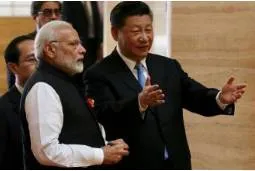
The ‘informal summit’ must be seen in the context of Beijing preparing for a pole position in the global sweepstakes.On the cards was a possible reset of ties between India and China in the wake of the ‘informal summit’ in Wuhan (April 27-28) between Prime Minister Narendra Modi and Chinese President Xi Jinping. The outcome is uncertain, however. The choice by China of Wuhan, a city situated in the middle reaches of the Yangtze, though was not accidental. Wuhan is symbolic of China’s resilience (the capacity to recover quickly from difficulties) and economic might today. It was possibly chosen by Mr. Xi to showcase China’s progress since Mr. Modi (as Chief Minister of Gujarat) had last paid a visit to the region. As Mr. Xi proceeds towards his next goal, ‘Made in China 2025’, he may also have wanted to demonstrate the wide gulf that seems to separate his programme from Mr. Modi’s own struggles to make a success of India’s ‘Make in India’ programme. The visit to the museum and the boat ride on the lake, in turn, were possibly intended (planned) to demonstrate the extent of China’s soft power.
Trust-building exercise
An ‘informal summit’ is different from a regular summit. India clearly viewed this ‘informal summit’ as a trust-building exercise, hoping to quietly sort out problems that existed between the two countries, including the vexed border issue. Absence of any formal joint communiqué (an official announcement or statement, especially one made to the media) that is sacrosanct ((especially of a principle, place, or routine) regarded as too important or valuable to be interfered with) for any summit also enables each side to spell out its own impressions of any outcomes. India has already used this to project that India and China are on the same page in dealing with global problems. It cannot be certain though that China sees the world through this same prism.
Mr. Modi used the occasion to convey his ideas on what was needed to be achieved, viz. a shared vision, a shared thought process, a shared resolve, a strong relationship and better communication, between the two countries. He further emphasised the importance of a global leadership role for both nations — two major powers linked by history across more than two millennia. He provided his vision of the Five Principles defining the relationship: Soch (thought), Sampark (contact), Sahyog (cooperation), Sankalp (determination) and Sapne (dreams).
Enumerating the main takeaways, in the absence of a joint communiqué, is not easy. One outcome was to have more such summits, alongside an agreement between the leaders for provision of greater ‘strategic communications’ at the highest level. Another was the opportunity it provided to give ‘strategic guidance’ to the respective militaries to build trust and understanding for ‘prudent (acting with or showing care and thought for the future) management of differences with mutual sensitivity’. A third was the agreement between India and China to work together jointly on an economic project in Afghanistan, with details to be worked out through diplomatic channels.
Both sides also reiterated the need to cooperate on counter-terrorism, and to strengthen the dialogue mechanism to deal with contentious (Disputable) issues and concerns. Both have agreed on the importance of maintaining peace and tranquility in all areas of the India-China border. The claim by the Indian side that the two countries today have ‘wider and overlapping regional and global interests’ meriting sharper ‘strategic communications’ is, however, subject to interpretation.
On the border issue, the summit appears to have reinforced the validity of the April 2005 Document on ‘Political Parameters and Guiding Principles for the Settlement of the Boundary Question’, which was signed in the presence of then Prime Minister Manmohan Singh and the then Chinese Premier Wen Jiabao. This document happens to be one of the very few that implicitly (in a way that is not directly expressed) acknowledges India’s claims to certain ‘disputed’ areas in the Arunachal sector of the India-China border. Ever since signing on to the ‘Political Parameters and Guiding Principles’ in 2005, China has been trying to reinterpret the contents of the document. If the informal summit, as claimed by the Indian side, has endorsed adherence (attachment) to the letter and spirit of the 2005 Agreement, it marks an important milestone in the settlement of the border issue.
The wisdom of holding an informal summit when other, and possibly better, avenues of diplomacy are available is debatable. India’s preference for an informal summit so as to be able to discuss contentious issues with China away from media glare and publicity — and the many trappings of diplomacy — is understandable. China’s acquiescence (assent) in this form of diplomacy is less understood. At best, China could have hoped to extract some concessions from India as the price for agreeing to an informal summit, viz. putting curbs on the Dalai Lama’s activities in India or backing away from the U.S. policy of containment of China in Asia.
A pivotal moment
China is today at a pivotal moment in its history, having embarked on preparations for a pole position in the global sweepstakes. The U.S. and the West are not ready to openly confront China, despite U.S. President Donald Trump’s rhetoric (the art of effective or persuasive speaking or writing). China currently has a vital role to play in the maintenance of peace in the Korean Peninsula, and in ensuring that the forthcoming Trump-Kim Jong-un talks are not jeopardised. The China-Russia equation today is much stronger than previously. China may be feared in East and South Asia, but no country here has the capacity to challenge China. It has established new equations in West Asia, including with Iran. In the South Asian neighbourhood, China is positioning itself as an alternative to India.
One must, hence, look for reasons elsewhere as to why China is adopting a less than belligerent attitude towards India. It appears that China is positioning itself for bigger things and to play bigger roles. This period is thus a defining one for China. Behind the rubric of a looming trade war between the U.S. and China — which is, without doubt, one of China’s major concerns — is China’s unstated struggle to redefine the rules governing economic and power relations worldwide. At a time when the U.S. is busy lining up the vast majority of Western democracies to checkmate China’s advance, the latter is equally anxious to build support in its favour in Asia and elsewhere to counter the U.S.
The India-China reset talks must, therefore, be seen in this wider perspective and context. It cannot be seen in isolation. At about the same time, on the India-China reset talks, Chinese Prime Minister Li Keqiang was in Tokyo to meet his Japanese counterpart Shinzo Abe as part of a major two-stage initiative. The Li-Abe meeting has reportedly helped remove many of the cobwebs in China-Japan trade and strategic relations. Leaders of China, Japan and South Korea also met in Japan at about the same time to devise measures that were needed to move ahead with the Regional Comprehensive Economic Partnership (India is a part of the RCEP, but a reinvigorated RCEP, alongside a China-Japan reset does not augur well for India).
No concessions
It should not, therefore, be surprising that in spite of China’s acquiescence in an informal summit, the report card from Wuhan does not add up to much in real terms. No manifest concessions appear to have been made by China. The Doklam issue (which was not discussed at the summit) remains unresolved, with China still in the driving seat. There are no indications that China has softened its attitude vis-à-vis India’s position in Arunachal Pradesh, or that it will refrain from accusing India of further transgressions here. China’s penetration of India’s neighbourhood is set to continue, with special emphasis on countries such as Nepal and the Maldives. China again has not conceded (allow) anything with reference to the China-Pakistan Economic Corridor. India may believe that it has demonstrated good faith by putting certain curbs on the Dalai Lama’s activities, but this is hardly likely to satisfy China’s concerns about his role.
Meanwhile, India should be concerned about Beijing’s defence budget for 2018. This is being increased by 8.1% over that of the previous year, and is in keeping with the decision of the Chinese 19th Party Congress (October 2017) to build a world class military. Mr. Li is on record that China would now focus on building strong naval and air defences, bolstered by the infusion of high technology. This can only further encourage China to expand its activities in the Indian Ocean region.

Atiqa records two top-four finishes in WSK Final Cup
Sep 05, 2026










Stay updated with The Hindu Editorial Vocab24 app, your definitive source for breaking news and comprehensive coverage from India and around the globe. Whether it's political developments, business updates, sports highlights, the latest technology trends, or current events, The Hindu brings live, accurate, and reliable news directly to your device.
Don’t fall for sensationalized or fake news shared online. Read and share accurate updates with friends and family through The Hindu Editorial Vocab24 app. Download it today!
News Coverage in The Hindu Editorial Vocab24 App
Breaking News: Receive instant notifications on breaking news stories as they unfold. Stay informed about major events and developments in India and around the world with live blogs, news in shorts videos, and concise articles.
Politics: Get the latest updates on Indian politics, including elections, policy changes, government decisions, and political events that shape the nation.
Business and Economy: Stay ahead in the economic landscape with detailed business news and market analysis. Learn about stock market trends, financial reports, corporate news, and economic developments to make informed investment decisions.
Current Events: Follow stories on social issues, policy changes, global events, and daily current affairs, tailored for UPSC and other competitive exam preparations.
Technology: Keep up with the latest gadgets, innovations, and tech trends. Read expert reviews and analyses in short, concise updates on cutting-edge technology from India and beyond.
Sports: Never miss a moment of your favorite sports. Get live scores, match reports, and expert analysis on cricket, football, tennis, and more.
International News: Stay informed about global events and geopolitical developments, including the Russia-Ukraine war, Israel-Palestine conflict, and other key international stories.
Local News: Stay connected to your community with the latest updates on city events, issues, and local news. Coverage includes hyperlocal updates from cities like Bangalore, Chennai, Delhi, Hyderabad, Mumbai, Kolkata, and more.
Trending Topics: Discover what's trending today with the most talked-about stories and hot topics across India and the world.
Experience journalism that values integrity, accuracy, and reliability. Download The Hindu Editorial Vocab24 app today and stay connected with the world.
Subscribe to our newsletter!







