

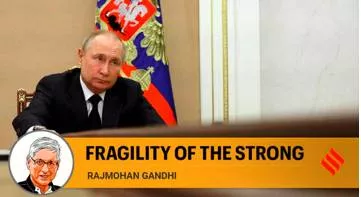
Lessons from ukraine on the fragility of the strong
Though the story of Russia’s brutal attack on Ukraine is yet to complete its course, some lessons may remain valid howsoever the story ends. A principal lesson is that strong and seemingly unchallengeable regimes can suddenly run into fragile moments. A related lesson is that a blunder can severely weaken any country, even one which, in military ranking, has remained second in the world for decades.Underestimating Ukrainian patriotism, President Putin also failed to consider three consequential factors. First, there was Ukraine’s fighting spirit. “He expected Ukrainians to bring roses to his tanks. But they brought Molotov cocktails.” This viral description is likely to endure. Second, European solidarity materialised as if from nowhere. Third, the frayed sheet of cloth tying Europe with America that was repaired with unexpected speed.
Putin also overestimated the capacities of Russia’s attacking divisions. He seems to have assumed what he wished to believe. It seems, too, that in Russia, where ultra-nationalism has fused with a personality cult, no one was willing to question the numero uno’s master plans.
Less widely known is the closeness between President Putin and 75-year-old Patriarch Kirill, head of Russia’s Orthodox Church. Apparently, these two men have shared the goal of resurrecting the glorious past, as imagined, of a unified Russian world, a past that included, in addition to today’s Russian Federation, not just Ukraine but other parts of what has been pictured as the Great Russian Civilisation or Empire of history.
Such a resurrection has been a wish that other Russians too have harboured, which perhaps explains the domestic support that Putin still seems to enjoy despite the Russian casualties in Ukraine, and the crippling burden of the war and subsequent sanctions.
In recent years, many a country has seen religious nationalism thrive. Buddhist nationalism has found fervent support in Myanmar and Sri Lanka. Islamic nationalism, of more than one type, has been the road to power in Afghanistan, Iran, Turkey, and elsewhere. Hindu nationalism is ascendant in India. A Russian nationalism linked to its Orthodox Church is no contrary phenomenon.
Nor was it a surprise when a few Indians who called themselves soldiers of a Hindu Sena demonstrated in Delhi in support of Putin’s move. Corresponding to the Great Russia remembered by Russia’s religious nationalists, the dream of a great Hindu entity larger than today’s India is nursed by a few contemporary Indians, even if most Hindu nationalists would be content with strengthening their ideology’s hold within India and among Indians worldwide.
Ukraine was viewed with derision by Russia’s religious nationalists, including Putin. When Donald Trump was the American president, he, too, was inclined to mock Ukraine. As the invasion began, Trump at first called Putin “smart” and a “genius”, although more recently, having observed America’s mood, he has called the invasion a crime against humanity. Despite the scorn that Ukraine had received, its “chaotic” democracy seems to have performed with remarkable courage, while Putin’s ambitious and supposedly efficient nationalism seems to have brought hardship and tragedy to Russians. A Jewish president and Caucasus-origin Muslims who shout “Allah hu Akbar” as they fling weapons at Russian tanks are only some of Ukraine’s varied forces standing up to Russian uniformity!
As for India’s Hindu nationalism, its durability is hard to predict. Election results are only part of the picture, and even there it is not clear how much of the BJP’s recent successes should be ascribed to Hindu nationalism and how much to populist welfarism, placation of caste groups, or other factors. Hindu nationalism’s undoubted influence over large sections of the media and its impact on judges are matters of deep concern to many, as was shown when senior editors publicly called on constitutional authorities to protect citizens from hate speech.
We cannot rely on it, but like Putin, the leaders of Hindu nationalism too may commit blunders. As for the idea that greatness is won by humiliating non-Hindus, the great majority of India’s Hindus surely detest that notion. In any case, portraying Muslims and Christians as disloyal and potentially traitorous elements is bound to backfire.
Today Hindus are being asked to revise the view that Muslims and Christians are fellow citizens entitled to dignity and equal rights. Tomorrow they will be told that their rejection of untouchability too was an error, that putting down Muslims and Christians is not enough. This is not unlikely, for the rejection of supremacy within Hindu society has been a slow and reluctant process, and one not usually accompanied by genuine conviction or repentance.
Finally, the need for global acceptance, goodwill, and trade is a serious hurdle for any exclusive or religious nationalism. Ukraine has shown that even Russia with its vast nuclear arsenal is finding it hard to face the worldwide sentiment in favour of the individual’s freedom and the autonomy of the less powerful.












Stay updated with The Hindu Editorial Vocab24 app, your definitive source for breaking news and comprehensive coverage from India and around the globe. Whether it's political developments, business updates, sports highlights, the latest technology trends, or current events, The Hindu brings live, accurate, and reliable news directly to your device.
Don’t fall for sensationalized or fake news shared online. Read and share accurate updates with friends and family through The Hindu Editorial Vocab24 app. Download it today!
News Coverage in The Hindu Editorial Vocab24 App
Breaking News: Receive instant notifications on breaking news stories as they unfold. Stay informed about major events and developments in India and around the world with live blogs, news in shorts videos, and concise articles.
Politics: Get the latest updates on Indian politics, including elections, policy changes, government decisions, and political events that shape the nation.
Business and Economy: Stay ahead in the economic landscape with detailed business news and market analysis. Learn about stock market trends, financial reports, corporate news, and economic developments to make informed investment decisions.
Current Events: Follow stories on social issues, policy changes, global events, and daily current affairs, tailored for UPSC and other competitive exam preparations.
Technology: Keep up with the latest gadgets, innovations, and tech trends. Read expert reviews and analyses in short, concise updates on cutting-edge technology from India and beyond.
Sports: Never miss a moment of your favorite sports. Get live scores, match reports, and expert analysis on cricket, football, tennis, and more.
International News: Stay informed about global events and geopolitical developments, including the Russia-Ukraine war, Israel-Palestine conflict, and other key international stories.
Local News: Stay connected to your community with the latest updates on city events, issues, and local news. Coverage includes hyperlocal updates from cities like Bangalore, Chennai, Delhi, Hyderabad, Mumbai, Kolkata, and more.
Trending Topics: Discover what's trending today with the most talked-about stories and hot topics across India and the world.
Experience journalism that values integrity, accuracy, and reliability. Download The Hindu Editorial Vocab24 app today and stay connected with the world.
Subscribe to our newsletter!







