

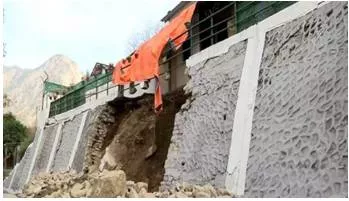
Joshimath the sinking land
Joshimath crisis points to the perils of not heeding alarm bells, disrespecting a fragile region’s ecology.The crisis unfolding in Joshimath speaks of the failure to respect the special and specific characteristics and idiosyncrasies of the fragile Himalayan mountain system while planning and executing developmental projects. More than 600 houses in the Uttarakhand town have, reportedly, developed cracks, putting the lives of at least 3,000 people in danger. Alarm bells had begun ringing about five decades back when the government constituted a committee under the chairmanship of the then Garhwal Commissioner Mahesh Chandra Mishra to investigate the cause of land subsidence in the area. In its report submitted in 1976, the committee said that major construction works should not be undertaken in Joshimath because it is located on a moraine — places where glacial debris accumulates. Subsequently, several studies flagged similar concerns. But these, by and large, went unheeded.
Joshimath is on the path of devotees headed towards at least three other important shrines — Badrinath, Kedarnath and Hemkund Sahib. Infrastructure development for such activities is not problematic if it respects the region’s carrying capacity. But in Joshimath, constructions have mushroomed on relatively loose soil, left behind by glacial and seismic activities — in contravention of the Mishra Committee’s recommendations. Located in a highly seismic zone, the town experiences regular tremors, making its topsoil highly unstable. Hydel power projects have also been guilty of disregarding and disrespecting the precautions advised by the Mishra panel. Several experts have blamed tunnel construction by the National Thermal Power Corporation’s Tapovan Vishnugad hydropower project. The NTPC has denied these charges, and the extent to which the corporation is responsible for the current crisis must be probed. But the fact also is that the Tapovan project has a history of upsetting the region’s complex hydrogeology. As pointed out by this newspaper, tunnelling by the power corporation punctured an aquifer in 2009. A year later, a Current Science article by Garhwal University scientists warned that this disruption could have long-term consequences for the region: “The sudden and large-scale dewatering has the potential of initiating ground subsidence.” Another aquifer breach was reported in 2012.
In August last year, a team of experts from IIT-Roorkee, Geological Survey of India, Wadia Institute of Himalayan Geology, Dehradun, Central Building Research Institute, Roorkee and the Uttarakhand Disaster Management Authority noticed signs of trouble — cracks like those surfacing currently in Joshimath — in other areas of Chamoli district. It blamed unscientific tourist activity, “particularly resorts that have mushroomed along the Joshimath Auli road,” and recommended enhancing drainage facilities and controlling erosion along segments of the Alaknanda river north of Joshimath. The team’s report may have come too late for residents of the beleaguered town. The Centre and state government are rightly giving top priority to the safety of Joshimath’s residents. The Centre has also asked scientists from the National Disaster Management Authority, Geological Survey of India, and National Institute of Hydrology to develop a “risk-sensitive urban developmental plan”. They could begin by revisiting the earlier studies on the region’s ecology.












Stay updated with The Hindu Editorial Vocab24 app, your definitive source for breaking news and comprehensive coverage from India and around the globe. Whether it's political developments, business updates, sports highlights, the latest technology trends, or current events, The Hindu brings live, accurate, and reliable news directly to your device.
Don’t fall for sensationalized or fake news shared online. Read and share accurate updates with friends and family through The Hindu Editorial Vocab24 app. Download it today!
News Coverage in The Hindu Editorial Vocab24 App
Breaking News: Receive instant notifications on breaking news stories as they unfold. Stay informed about major events and developments in India and around the world with live blogs, news in shorts videos, and concise articles.
Politics: Get the latest updates on Indian politics, including elections, policy changes, government decisions, and political events that shape the nation.
Business and Economy: Stay ahead in the economic landscape with detailed business news and market analysis. Learn about stock market trends, financial reports, corporate news, and economic developments to make informed investment decisions.
Current Events: Follow stories on social issues, policy changes, global events, and daily current affairs, tailored for UPSC and other competitive exam preparations.
Technology: Keep up with the latest gadgets, innovations, and tech trends. Read expert reviews and analyses in short, concise updates on cutting-edge technology from India and beyond.
Sports: Never miss a moment of your favorite sports. Get live scores, match reports, and expert analysis on cricket, football, tennis, and more.
International News: Stay informed about global events and geopolitical developments, including the Russia-Ukraine war, Israel-Palestine conflict, and other key international stories.
Local News: Stay connected to your community with the latest updates on city events, issues, and local news. Coverage includes hyperlocal updates from cities like Bangalore, Chennai, Delhi, Hyderabad, Mumbai, Kolkata, and more.
Trending Topics: Discover what's trending today with the most talked-about stories and hot topics across India and the world.
Experience journalism that values integrity, accuracy, and reliability. Download The Hindu Editorial Vocab24 app today and stay connected with the world.
Subscribe to our newsletter!







