

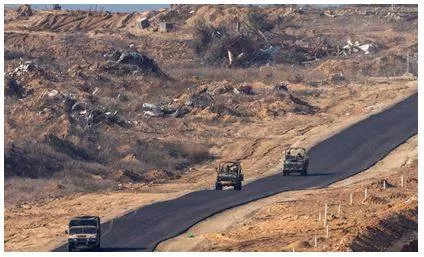
Israel controls 50% of gaza strip after razing land to expand its buffer zone
The largest contiguous area the Army controls is around the Gaza border, where the military has razed Palestinian homes, infrastructure to the point of uninhabitability, according to Israeli soldiers; PM Netanyahu says that even after defeating Hamas, Israel will maintain security control in Gaza.Israel has dramatically expanded its footprint in the Gaza Strip since relaunching its war against Hamas last month. It now controls more than 50% of the territory and is squeezing Palestinians into shrinking wedges of land.
The largest contiguous area the Army controls is around the Gaza border, where the military has razed Palestinian homes, farmland and infrastructure to the point of uninhabitability, according to Israeli soldiers and rights groups. This military buffer zone has doubled in size in recent weeks.
Israel has depicted its tightening grip as a temporary necessity to pressure Hamas into releasing the remaining hostages taken during the October 7, 2023, attack that started the war. But the land Israel holds, which includes a corridor that divides the territory’s north from south, could be used for wielding long-term control, human rights groups and Gaza experts say.
Prime Minister Benjamin Netanyahu said last week that even after Hamas is defeated, Israel will keep security control in Gaza and push Palestinians to leave.
The demolition close to the Israeli border and the systematic expansion of the buffer zone has been going on since the war began 18 months ago, five Israeli soldiers said.
‘Destroyed everything’
“They destroyed everything they could, they shot everything that looks functioning ... [the Palestinians] will have nothing to come back,” a soldier deployed with a tank squad guarding the demolition teams said.
A report documenting the accounts of soldiers who were in the buffer zone was released on Monday by Breaking The Silence, an anti-occupation veterans group. A handful of soldiers — including some who also spoke to AP — described watching the army turn the zone into a vast wasteland.
Asked about the soldiers’ accounts, the Israeli army said it is acting to protect its country and especially to improve security in southern communities devastated by the October 7 attack, in which 1,200 people were killed and 251 taken hostage. The army said it does not seek to harm civilians in Gaza, and that it abides by international law. In the early days of the war, Israeli troops forced Palestinians from communities near the border and destroyed the land to create a buffer zone more than a kilometre deep, according to Breaking The Silence.
Its troops also seized a swath of land across Gaza known as the Netzarim Corridor that isolated the north, including Gaza City, from the rest of the narrow, coastal strip, home to more than two million people.
When Israel resumed the war last month, it doubled the size of the buffer zone, pushing it as far as 3 km into Gaza in some places, according to a map issued by the military.
The buffer zone and the Netzarim Corridor make up at least 50% of the strip, said Yaakov Garb, an environmental studies professor, who has been examining Israeli-Palestinian land use patterns for decades.
Last week, Mr. Netanyahu said Israel intends to create another corridor that slices across southern Gaza, cutting off the city of Rafah from the rest of the territory. Israel’s control of Gaza is even greater taking into account areas where it recently ordered civilians to evacuate ahead of planned attacks.
Hundreds of thousands of Palestinians used to live in the land that now makes up Israel’s buffer zone, an area that was key to Gaza’s agricultural output.
When the ceasefire was announced in January, Nidal Alzaanin went back to his home in Beit Hanoun in northern Gaza. His property stood on the edge of the buffer zone and lay in ruins.
Photo remnants
All that remains is a photo of him and his wife on their wedding day, a drawing of his son’s face on a porcelain plate and the carcass of a 150-year-old sycamore tree planted by his great-grandfather. His greenhouse was reduced to twisted scraps of metal.
The 55-year-old farmer pitched a tent in the rubble, hoping to rebuild his life. But when Israel resumed its campaign and seized his land, he was again uprooted.
Israel’s bombardment and ground offensives throughout the war have left vast swaths of Gaza’s cities and towns destroyed. But the razing of property inside the buffer zone has been more methodical and extensive, soldiers said.
The five soldiers who spoke to the AP said Israeli troops were ordered to destroy farmland, irrigation pipes, crops and trees as well as thousands of buildings, including residential and public structures, so that militants had nowhere to hide.
Several soldiers said their units demolished more buildings than they could count, including large industrial complexes. A soda factory was levelled, leaving shards of glass and solar panels strewn on the ground.
The soldiers said the buffer zone had no marked boundaries, but that Palestinians who entered were shot at.
The soldier with the tank squad said an armoured bulldozer flattened land creating a “kill zone” and that anyone who came within 500 meters of the tanks would be shot, including women and children.
In announcing the new corridor across southern Gaza, Mr. Netanyahu said Israel aims to pressure Hamas to release the remaining 59 hostages, of whom 35 are believed dead. He said the war can only end when Hamas is destroyed and its leaders leave Gaza, at which point Israel would take control of security in the territory.


U k budget increases child welfare allowance taxes
Nov 29, 2025









Stay updated with The Hindu Editorial Vocab24 app, your definitive source for breaking news and comprehensive coverage from India and around the globe. Whether it's political developments, business updates, sports highlights, the latest technology trends, or current events, The Hindu brings live, accurate, and reliable news directly to your device.
Don’t fall for sensationalized or fake news shared online. Read and share accurate updates with friends and family through The Hindu Editorial Vocab24 app. Download it today!
News Coverage in The Hindu Editorial Vocab24 App
Breaking News: Receive instant notifications on breaking news stories as they unfold. Stay informed about major events and developments in India and around the world with live blogs, news in shorts videos, and concise articles.
Politics: Get the latest updates on Indian politics, including elections, policy changes, government decisions, and political events that shape the nation.
Business and Economy: Stay ahead in the economic landscape with detailed business news and market analysis. Learn about stock market trends, financial reports, corporate news, and economic developments to make informed investment decisions.
Current Events: Follow stories on social issues, policy changes, global events, and daily current affairs, tailored for UPSC and other competitive exam preparations.
Technology: Keep up with the latest gadgets, innovations, and tech trends. Read expert reviews and analyses in short, concise updates on cutting-edge technology from India and beyond.
Sports: Never miss a moment of your favorite sports. Get live scores, match reports, and expert analysis on cricket, football, tennis, and more.
International News: Stay informed about global events and geopolitical developments, including the Russia-Ukraine war, Israel-Palestine conflict, and other key international stories.
Local News: Stay connected to your community with the latest updates on city events, issues, and local news. Coverage includes hyperlocal updates from cities like Bangalore, Chennai, Delhi, Hyderabad, Mumbai, Kolkata, and more.
Trending Topics: Discover what's trending today with the most talked-about stories and hot topics across India and the world.
Experience journalism that values integrity, accuracy, and reliability. Download The Hindu Editorial Vocab24 app today and stay connected with the world.
Subscribe to our newsletter!







