

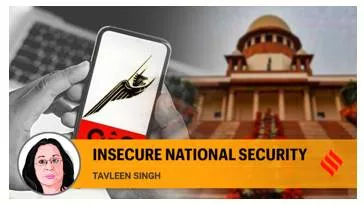
Insecure national security
As someone who believes that Aryan Khan was wrongfully jailed, it made me happy that he got bail last week in time to spend Diwali with his family. He should not have spent a single day in jail, and may not have, had he been chatting to his friends on Signal and not WhatsApp. The Government of India’s mighty investigative agencies have started weaponising the private phones of private citizens and created a scary new standard in violating our right to privacy.This is why the Supreme Court’s decision to set up a committee to investigate the Pegasus case is the most important decision it has taken in a long while. If without the technology that Pegasus provides our cellphones can already be used to spy on us, imagine what will happen if the government is not severely reprimanded for buying this anti-terrorism software from Israel and using it against political opponents and journalists. We must hope that the Supreme Court’s committee is allowed to do its job without interference.
The Supreme Court said something crucial when it announced that it would be investigating the Pegasus matter through its own committee. It said that national security could not be used as an excuse for spying on journalists and politicians. It made the point that the ‘spectre of national security’ cannot always be invoked to prevent judicial scrutiny of such things as the illegal surveillance of ordinary citizens.
No government in living memory has invoked this ‘spectre’ more than the government of Narendra Modi. Last week it was invoked to charge Kashmiri students with sedition for having celebrated Pakistan’s victory over India on the cricket field last Sunday. The Indian cricket team was gracious in defeat and showed none of the belligerence that the BJP’s national spokesmen showed when asked if it was not wrong to charge students with sedition simply because they cheered for Pakistan. In a tone of menace, the national spokesman who has become the TV face of the Modi government said, “They should be in jail and they should stay in jail. We did not win 303 seats in Parliament to allow people who speak against India to remain free. The times have changed, and as long as Modi is Prime Minister, this kind of thing will not be tolerated.”
Those who speak for Modi appear not to have noticed that if students and dissidents constitute a real threat to India, then we should be ashamed. There is no point in banging on about how national security is safe in the hands of Modi if it becomes vulnerable when a handful of students behave stupidly after a cricket match. They were students, not jihadi killers, and yet the laws that have been used to arrest them in Srinagar and in Uttar Pradesh are anti-terrorism laws. We need to ask if it will make India safer to alienate ordinary Muslims in the name of national security.
This supposed concern for national security is mixed up with a poisonous kind of nationalism that allows thugs wearing saffron scarves to decide who and what is anti-national. In Bhopal last week the well-known film director, Prakash Jha, had black ink smeared on his face and his crew was attacked by a mob of ‘nationalists’ who objected to ‘Aashram’ being the title of the drama series he was making. These thugs were not immediately jailed, as they should have been, they had time to give interviews on national television in which they said that ashrams had existed in India for centuries and so it was ‘anti-Hindu’ to make films about them. Bollywood has been under attack since Modi became Prime Minister for the same reason. Anti-Hindu is a synonym these days for anti-national, and it is now the prerogative of the Sangh Parivar’s more violent spawn to decide who should be targeted in the name of national security.
As a result, there is palpable fear in the air these days. Journalists hesitate to speak to each other on the phone and hesitate even more to speak to one of their political sources, so conversations usually begin with, “I hope we are speaking on Facetime Audio or Signal.” The Supreme Court while ruling on Pegasus said that the right of journalists to protect their sources was fundamental to freedom of the press. But, there are new realities. Journalists who have not accepted current realities and learned to kowtow, hesitate to report boldly on the things that are going wrong because they know that doing this immediately comes to the notice of the BJP’s media managers and that this can lose them their jobs.
The irony is that the real threat to national security now comes from those who believe they are protecting it. By labeling dissidents as ‘anti-nationals’, you end up weakening democracy. By working on the assumption that if Muslim students cheer for Pakistan at the end of a cricket match, it is alright to conclude that they are traitors who must be jailed for sedition, the message that goes out to ordinary Muslims is that they are all suspect. How these things serve to protect national security is hard to understand, because by diminishing fundamental rights guaranteed by the Constitution, you end up weakening democracy. How will it help the cause of national security if ordinary people start to live in fear of their shadows and their cellphones?












Stay updated with The Hindu Editorial Vocab24 app, your definitive source for breaking news and comprehensive coverage from India and around the globe. Whether it's political developments, business updates, sports highlights, the latest technology trends, or current events, The Hindu brings live, accurate, and reliable news directly to your device.
Don’t fall for sensationalized or fake news shared online. Read and share accurate updates with friends and family through The Hindu Editorial Vocab24 app. Download it today!
News Coverage in The Hindu Editorial Vocab24 App
Breaking News: Receive instant notifications on breaking news stories as they unfold. Stay informed about major events and developments in India and around the world with live blogs, news in shorts videos, and concise articles.
Politics: Get the latest updates on Indian politics, including elections, policy changes, government decisions, and political events that shape the nation.
Business and Economy: Stay ahead in the economic landscape with detailed business news and market analysis. Learn about stock market trends, financial reports, corporate news, and economic developments to make informed investment decisions.
Current Events: Follow stories on social issues, policy changes, global events, and daily current affairs, tailored for UPSC and other competitive exam preparations.
Technology: Keep up with the latest gadgets, innovations, and tech trends. Read expert reviews and analyses in short, concise updates on cutting-edge technology from India and beyond.
Sports: Never miss a moment of your favorite sports. Get live scores, match reports, and expert analysis on cricket, football, tennis, and more.
International News: Stay informed about global events and geopolitical developments, including the Russia-Ukraine war, Israel-Palestine conflict, and other key international stories.
Local News: Stay connected to your community with the latest updates on city events, issues, and local news. Coverage includes hyperlocal updates from cities like Bangalore, Chennai, Delhi, Hyderabad, Mumbai, Kolkata, and more.
Trending Topics: Discover what's trending today with the most talked-about stories and hot topics across India and the world.
Experience journalism that values integrity, accuracy, and reliability. Download The Hindu Editorial Vocab24 app today and stay connected with the world.
Subscribe to our newsletter!







