

India wants a quad to counteract china’s expanding influence
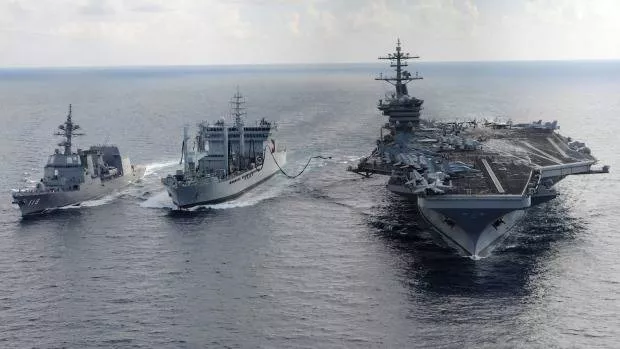
There is excitement in India's strategic community after senior naval officers from India, Australia, Japan and the United States appeared together in an international conference in New Delhi last week. Ever since Indian naval chief Admiral Sunil Lanba shared a stage with Admiral Harry Harris, the US Pacific Commander, Admiral Katsutoshi Kawano, the Chief of Joint Staff of the Japanese Self Defense Force and Vice Admiral Tim Barrett, the Chief of the Royal Australian Navy at the Indian government sponsored Raisina Dialogue, speculation has grown in the Indian media that New Delhi might be preparing to join a maritime quadrilateral aimed at the containment of growing Chinese power in the Indo-Pacific region.Analysts say India's strengthening resolve in the maritime domain is clear from the Indian Navy's recent multilateral naval engagements, including the Malabar series of exercises with the US Navy and the Japanese Navy, as well as the recent induction of platforms that can project power and presence across the Indian Ocean.
The United States' strengthened defense posture, the acknowledgement of "great power competition" in Asia, has further raised hopes for a maritime-quad. As he unveiled the National Defence Strategy last week, US Secretary of Defense, James Mattis called for the restoration of America's competitive military advantage to deter China and Russia from challenging the postwar international order. At the Raisina dialogue, Admiral Harris' portrayal of China as a "disruptive power", led to more talk of a possible alignment between India, Japan, Australia and the US in the Asian commons.
Not everyone equally convinced of the Quadrilateral's utility as an instrument of strategic dissuasion; not least since member states appear reluctant to endorse a China-centric security agenda. Notwithstanding the repeated references to a "free and open Indo-Pacific" during his tour of Asia late last year, US President Donald Trump is yet to announce a clear China-focused security policy in Asia. Tokyo too seems unsure about using the Quad as a weapon to neutralise Chinese influence in Asia. Last week, Japanese Prime Minister Shinzo Abe in an interview with the AFR Weekend, played down the possibility of the Quad being used as a China-containment strategy. While outlining an ambitious agenda of aid, infrastructure and maritime security in Asia, Abe seemed open to the idea of including China in the Quad, provided Beijing agreed with the concept's core tenets.
Australia appears to be the only one with an uncomplicated message for China. Not only has Canberra, in its recent Foreign Policy White Paper, recognised the challenge posed by China's military rise in Asia, the Royal Australian Navy (RAN) has significantly enhanced its engagement with maritime powers across Asia. One such interaction last year, the Indo-Pacific Endeavour-2017, involved 1300 RAN personnel; the largest co-ordinated task-group from Australia since the 1980s. But Canberra's naval activism has irked Beijing, which has also not taken kindly to Australia's criticism of the Belt and Road Initiative (BRI) and, more recently, the claim that China's Pacific aid programme was a "white elephant."
Australia, like the US and Japan, has been critical of China's aggressive posturing in the South China Sea. While India shares these concerns, it believes that an excessive focus on China's activities in the South China Sea has taken the attention away from the PLA Navy's growing assertiveness in South Asia. This includes China's expanding naval footprint in Sri Lanka, Bangladesh and Myanmar, and the strengthening China-Pakistan nexus in the Arabian Sea. With the US unwilling to part with vital anti-submarine warfare technology, the defense establishment in New Delhi is wary of entering into an arrangement that does not help secure India's vital interests in the near-seas. The Quad's real problem is the absence of a plan to counter China's smart-strategy in South Asia that combines economic activity with benign naval presence. In expanding its activities in South Asia, the PLAN (People's Liberation Army Navy) has been careful not to challenge Indian interests in the regional littorals. By avoiding any entanglement with Indian naval ships in the sub-continental littorals, and limiting its ventures to friendly countries in the region, China has ensured it keeps things below the threshold of conflict.
But Beijing has been successful in normalising its naval activism in the Indian Ocean littorals. Indian maritime observers suspect China's maritime outreach is aimed at a "slow choke" of New Delhi's geopolitical influence in the neighbourhood. Whatever the implications for India's security, the Chinese navy has gone about its business in low-key fashion, ensuring that Beijing isn't held legally or politically accountable for a territorial violation.
The challenge for quad-partners, then, is to imaginatively counteract China's expanding influence without resorting to overtly aggressive tactics. While co-ordinated maritime operations in the regional littorals will be critical, these need to be supplemented by grand-economic endeavours aimed at providing an alternative to China's BRI-led proposals in Asia.
To protect their strategic equities in Asia, Quad-members will need to play the long-game with China, using the tools of diplomacy, geo-economics and hard military power. The maritime-quad can only be effective if India, Japan, Australia and the US make common cause in the regional littorals, acting in unison to ensure a favourable balance of strategic and economic power in Asia.
Courtesy : The Financial Reviews Editorial






Stay updated with The Hindu Editorial Vocab24 app, your definitive source for breaking news and comprehensive coverage from India and around the globe. Whether it's political developments, business updates, sports highlights, the latest technology trends, or current events, The Hindu brings live, accurate, and reliable news directly to your device.
Don’t fall for sensationalized or fake news shared online. Read and share accurate updates with friends and family through The Hindu Editorial Vocab24 app. Download it today!
News Coverage in The Hindu Editorial Vocab24 App
Breaking News: Receive instant notifications on breaking news stories as they unfold. Stay informed about major events and developments in India and around the world with live blogs, news in shorts videos, and concise articles.
Politics: Get the latest updates on Indian politics, including elections, policy changes, government decisions, and political events that shape the nation.
Business and Economy: Stay ahead in the economic landscape with detailed business news and market analysis. Learn about stock market trends, financial reports, corporate news, and economic developments to make informed investment decisions.
Current Events: Follow stories on social issues, policy changes, global events, and daily current affairs, tailored for UPSC and other competitive exam preparations.
Technology: Keep up with the latest gadgets, innovations, and tech trends. Read expert reviews and analyses in short, concise updates on cutting-edge technology from India and beyond.
Sports: Never miss a moment of your favorite sports. Get live scores, match reports, and expert analysis on cricket, football, tennis, and more.
International News: Stay informed about global events and geopolitical developments, including the Russia-Ukraine war, Israel-Palestine conflict, and other key international stories.
Local News: Stay connected to your community with the latest updates on city events, issues, and local news. Coverage includes hyperlocal updates from cities like Bangalore, Chennai, Delhi, Hyderabad, Mumbai, Kolkata, and more.
Trending Topics: Discover what's trending today with the most talked-about stories and hot topics across India and the world.
Experience journalism that values integrity, accuracy, and reliability. Download The Hindu Editorial Vocab24 app today and stay connected with the world.
Subscribe to our newsletter!







