

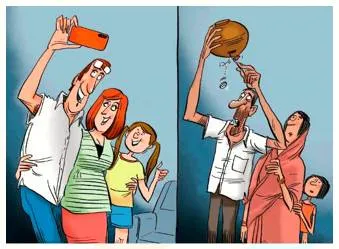
India versus bharat
They must come together in enlightened partnership, else coronavirus will defeat both.The Great Indian Middle Class is a peculiar animal. At one level, it has remarkable qualities of entrepreneurship, resourcefulness, resilience, inventiveness and ingenuity. At another level, it can be unforgivably insular, indifferent to the trauma of those economically and socially below it, and even irrationally hostile to those of its own who it imagines could threaten its well-being.
How else can one explain the reaction of some members of this class to health workers who are in the front trenches fighting against the coronavirus menace, and to airline staff who have risked their lives to evacuate hundreds of Indians stranded abroad? Such is the self-centred paranoia of these residents that some landlords have given eviction notices to health workers, while many have publicly harassed and attacked those in the airline industry. For those displaying such panic bigotry, the only concern is their own safety, even when the threat is non-existent.
There are two behavioural inferences from this condemnable conduct. First, it appears that some in the middle class want the virus to be handled effectively, but are happy to outsource the battle against it to others who stay out of their lives. Those on the frontline need to be lauded but not seen. They should do their ‘dangerous work’, because someone has to do it, but they should remain on TV screens rather than threaten People Like Us. Admiration for them should be verbal; social boycott should be the practice.
Second, some worthies of the middle class really think they can secede to form their own Republic of Corona Impregnability. Such a Republic would give no visas to anyone remotely capable of polluting the purity of this personalised territory. True, some ‘outsiders’ are essential. After all, someone has to remove the garbage, clean the premises, guard the gates, provide part-time household assistance and – for the more affluent – drive the car. But, these are ‘intruders’ on sufferance. They are part of the unwashed masses, who are best not seen, but whose services cannot be done without.
And, where do these ‘intruders’ come from? In most cases, they live in the nearby urban slum, where such luxuries like social distancing are just physically not possible. Dwelling units are built in chaotic proximity; people live cheek by jowl; several people share the same room; sanitation facilities are rudimentary, if at all; sewage disposal is poor at best. Large parts of urban India consist of such slums. Their existence cannot just be wished away.
Besides, the lockdown has reinforced the India versus Bharat divide. For those living in India, self-isolation is occasionally irksome, but endurable. For the affluent it is almost an exotic opportunity. Social media is full of celebs in trendy sports casuals doing yoga, drinking watermelon juice, watching Netflix, video conferencing, reading hitherto unread books, spending quality time with family, playing with their pets, and issuing homilies to everybody else on the importance of staying at home.
But, Bharat consists of millions of those in the unorganised sector, migrant workers, street vendors, contract workers, lower level employees in worksites which have closed down, and daily wage labourers who must go out and work in order to be able to eat at night. Is India self-obsessed about self-isolation, aware of the compulsions of the denizens of Bharat, who have almost no social security safety net? Is the Great Indian Middle Class aware that there is a larger less privileged India right outside the citadel behind which it wants to withdraw, and thousands are stranded on roads without a job unable to return to their native place?
The coronavirus pandemic must teach Indians that this menace can only be defeated by our tradition of collective paropkar, not a selfishly segmented society. Either Bharat and India must come together in an enlightened partnership to face it, or both will be defeated. There are some excellent examples of the privileged working to provide food to the hungry during the lockdown. The Sikh community has opened langars, free food centres, and other religions must also immediately organise to help the needy. A few public spirited individuals are collecting money to contribute masks and gloves for hospital workers.
Some in the corporate sector have become valuable partners in the production of ventilators and testing kits. Public-private partnership to aggressively increase testing, ensuring complete quarantine, and upgrading hospital infrastructure is the need of the hour. Many states, Kerala and Delhi notably, are proactively helping the marginalised. The PM has asked each person to feed at least nine poor people on each of the nine days of Navratra. The PM Garib Kalyan Yojana is a step in the right direction, but efficient delivery is essential. MSMEs and the business sector also need relief and support.
Self-isolation cannot become self-centredness. Social distancing does not mean distance from social realities. Better hygiene does not mean that we wash our hands of the tribulations of the vulnerable. Selfpreservation does not mean selfishness. Social responsibility is not social panic. Concern is not prejudice. The coronavirus requires personal discipline, but it can only be definitively defeated by the compassion of all citizens. The Great Indian Middle Class is not an island unto itself. It needs to understand this in its own interest.











Stay updated with The Hindu Editorial Vocab24 app, your definitive source for breaking news and comprehensive coverage from India and around the globe. Whether it's political developments, business updates, sports highlights, the latest technology trends, or current events, The Hindu brings live, accurate, and reliable news directly to your device.
Don’t fall for sensationalized or fake news shared online. Read and share accurate updates with friends and family through The Hindu Editorial Vocab24 app. Download it today!
News Coverage in The Hindu Editorial Vocab24 App
Breaking News: Receive instant notifications on breaking news stories as they unfold. Stay informed about major events and developments in India and around the world with live blogs, news in shorts videos, and concise articles.
Politics: Get the latest updates on Indian politics, including elections, policy changes, government decisions, and political events that shape the nation.
Business and Economy: Stay ahead in the economic landscape with detailed business news and market analysis. Learn about stock market trends, financial reports, corporate news, and economic developments to make informed investment decisions.
Current Events: Follow stories on social issues, policy changes, global events, and daily current affairs, tailored for UPSC and other competitive exam preparations.
Technology: Keep up with the latest gadgets, innovations, and tech trends. Read expert reviews and analyses in short, concise updates on cutting-edge technology from India and beyond.
Sports: Never miss a moment of your favorite sports. Get live scores, match reports, and expert analysis on cricket, football, tennis, and more.
International News: Stay informed about global events and geopolitical developments, including the Russia-Ukraine war, Israel-Palestine conflict, and other key international stories.
Local News: Stay connected to your community with the latest updates on city events, issues, and local news. Coverage includes hyperlocal updates from cities like Bangalore, Chennai, Delhi, Hyderabad, Mumbai, Kolkata, and more.
Trending Topics: Discover what's trending today with the most talked-about stories and hot topics across India and the world.
Experience journalism that values integrity, accuracy, and reliability. Download The Hindu Editorial Vocab24 app today and stay connected with the world.
Subscribe to our newsletter!







