

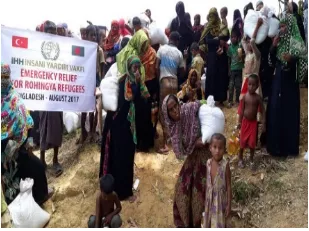
India needs proper refugee legislation
India with its history, culture, traditions, is today an example of generosity in the way it has opened its borders to all people who have come looking for safety and sanctuary.”Antonio Guterres, the Secretary General of United Nations and the-then United Nations High Commissioner for Refugees, had thus commended India’s open-door policy for refugees who had fled from persecution (hostility and ill-treatment, especially because of race or political or religious beliefs) in their homeland and sought asylum (shelter or protection from danger.) in India.
Indeed, India has given shelter to more than 400,000 refugees from myriad countries including Tibet, Myanmar, Sri Lanka, Afghanistan, Somalia and Ethiopia. But the Indian Government’s recent plan to identify and deport all Rohingya refugees from the country threatens to imperil that tradition of hospitality and the generous framework that Guterres so effusively spoke of.
Indeed, the Ministry of Home Affairs’ quest to deport all Rohingyas from the country, not only runs against the country’s history and tradition but also falls foul of (come into conflict with.) international law and India’s constitutional norms. Since Rohingyas have been at the receiving end of systematic and sustained ethnic violence in their homeland in the Rakhine state in Myanmar, their deportation would arguably violate the principle of non-refoulment (the forcible return of refugees or asylum seekers to a country where they are liable to be subjected to persecution.), the cornerstone of international refugee law.
The essence of this duty is that no state shall expel an asylumseeker or refugee to any country where he or she is likely to face threat to life or freedom on account of race, religion, nationality, membership of a particular social group or political opinion.
Human rights groups and the international media have shown that the violence against Rohingyas has not only been widespread but has also been spearheaded by the security forces in Myanmar. In fact, the Army Chief of Myanmar has reportedly justified the anti-Rohingyas violence as “unfinished business.”
Deportation of Rohingya refugees to Myanmar in face of such a climate of hatred, violence and impunity (exemption from punishment or freedom from the injurious consequences of an action.), shall surely pose a severe risk of persecution for them and would undeniably impinge (infringe) the principle of non-refoulement.
Admittedly, India is a not a signatory to the UN Refugee Convention 1951, the primary international treaty on refugee rights.
Yet, non-refoulement is grounded not only in the Refugee Convention but also in broader international human rights law. Article 14 of the Universal Declaration of Human Rights 1948 (UDHR) declares that everyone has a right to seek and enjoy in other countries, asylum from persecution. India is also a party to other international human rights treaties like the International Covenant (an agreement.) and Civil Political Rights (ICCPR) and the International Covenant on Elimination of Racial Discrimination (ICERD), which indirectly recognise the principle.
Not surprisingly, non-refoulement is widely regarded as part of customary international law and as binding even on countries that are not party to the refugee Convention. Indeed, non-refoulement has been recognised as a part of Indian constitutional law too.
The Delhi High Court observed in 2013 that this principle “is required to be taken as part of the guarantee under Article 21 of the Constitution of India as “non-refoulement” affects/protects the life and liberty of a human being, irrespective of his nationality.” [Dong Lian Kham v Union of India]. More than fifteen years before this case, the Supreme Court of India had ruled in National Human Rights Commission vs. State of Arunachal Pradesh [(1996) 1 SCC 742] that the right to life under Article 21 of the Constitution of India is not restricted to citizens but also extends to asylum-seekers and that no person, including a foreigner, could be deprived of his life or personal liberty except according to a reasonable procedure established by law.
Therefore, even if one were to keep international legal obligations aside, the proposed deportation would contravene (offend against the prohibition or order of (a law, treaty, or code of conduct).) Indian constitutional law, and thereby constitute a grave miscarriage of justice. Indeed, the Delhi High Court had remarked in the Dong Lian Kham case that “since the petitioners apprehend danger to their lives on return to their country”, it would be proper and “in keeping with the golden traditions of this country in respecting international comity and according good treatment to refugees” for the government to hear the refugees and consult UNHCR regarding the option of deportation to a third country, before taking a final decision.
These sagacious (having or showing keen mental discernment and good judgement) words of the High Court should act as a very pertinent reminder for the Government of India in its treatment of Rohingyas refugees. Denied citizenship by Myanmar State since 1982 and having been persecuted for many years, Rohingyas refugees have a well-founded fear of persecution on account of their ethnicity.
As such, they must be treated as worthy of the same protection that the High Court extended to asylum-seekers in its verdict.
The Supreme Court’s decision to issue notice to the Centre on the proposed deportation provides a valuable opportunity that the government must use to review its stance in light with its constitutional duties.
Most critically, this tragic episode highlights the need for a refugee legislation in India. India’s traditionally hospitable treatment of refugees has paradoxically been accompanied by an absence of a formal legal regime.
Legal rights of refugees have thus been governed by ad-hoc (created or done for a particular purpose as necessary.) administrative mechanisms that are ambiguous and distinguish between refugee groups on account of political considerations. As a result, refugees have been left dependent on the benevolence of the state rather than on a rights regime to reconstruct their lives with dignity.
Legal protection has thus remained a chimera (a thing which is hoped for but is illusory or impossible to achieve.) for several of the refugee communities whose presence have been inconvenient for dominant political interests of the day. As a leading liberal democracy of the world and an aspiring global power, India can ill-afford such inchoate (just begun and so not fully formed or developed) state of affairs.
India’s international and constitutional obligations and its tradition of ‘atithi devo bhava’ demand a statutory legal framework that distinguishes between illegal migrants and refugees like Rohingyas who have fled persecution and provide them asylum.

No war for now
Sep 08, 2017





Stay updated with The Hindu Editorial Vocab24 app, your definitive source for breaking news and comprehensive coverage from India and around the globe. Whether it's political developments, business updates, sports highlights, the latest technology trends, or current events, The Hindu brings live, accurate, and reliable news directly to your device.
Don’t fall for sensationalized or fake news shared online. Read and share accurate updates with friends and family through The Hindu Editorial Vocab24 app. Download it today!
News Coverage in The Hindu Editorial Vocab24 App
Breaking News: Receive instant notifications on breaking news stories as they unfold. Stay informed about major events and developments in India and around the world with live blogs, news in shorts videos, and concise articles.
Politics: Get the latest updates on Indian politics, including elections, policy changes, government decisions, and political events that shape the nation.
Business and Economy: Stay ahead in the economic landscape with detailed business news and market analysis. Learn about stock market trends, financial reports, corporate news, and economic developments to make informed investment decisions.
Current Events: Follow stories on social issues, policy changes, global events, and daily current affairs, tailored for UPSC and other competitive exam preparations.
Technology: Keep up with the latest gadgets, innovations, and tech trends. Read expert reviews and analyses in short, concise updates on cutting-edge technology from India and beyond.
Sports: Never miss a moment of your favorite sports. Get live scores, match reports, and expert analysis on cricket, football, tennis, and more.
International News: Stay informed about global events and geopolitical developments, including the Russia-Ukraine war, Israel-Palestine conflict, and other key international stories.
Local News: Stay connected to your community with the latest updates on city events, issues, and local news. Coverage includes hyperlocal updates from cities like Bangalore, Chennai, Delhi, Hyderabad, Mumbai, Kolkata, and more.
Trending Topics: Discover what's trending today with the most talked-about stories and hot topics across India and the world.
Experience journalism that values integrity, accuracy, and reliability. Download The Hindu Editorial Vocab24 app today and stay connected with the world.
Subscribe to our newsletter!







