

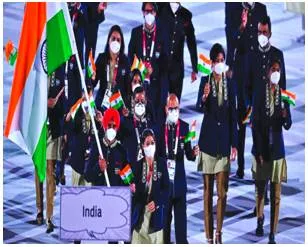
India at the olympics over the decades
Unlike in the ancient times, sport has not been regarded as integral to Indian society, except for a few privileged families.Even as we celebrate our best ever Olympic performance this year in Tokyo, a retrospective view is in order. Much effort and money was invested by India in the 1982 Asian Games. However, at one event, the guest-in-chief was one of our cine superstars. When he approached the podium to award the medals, the audience erupted in wild applause, as if the players did not matter; the gold, silver and bronze winners were not Indian. The coach of one of the winning teams asked who this chief guest was, to which the rather chirpy reply was: “Don’t you know him? He is our most famous cine star.” To this, the coach’s response was: “I now understand why a vast country like India is nowhere in sport.”
Except for a few privileged families, sport has not been regarded as integral to Indian society. This wasn’t so in ancient India; in the times of Mahabharata, proficiency in archery and other weaponry were a part of the education of the Pandava and Kaurava boys with Dronacharya as their guru. In the war that followed between the boys when they turned men, Dronacharya was a general.
But in later times, sports did not travel or touch villages until recently. Governments seldom took any interest and most sports bodies were treated by their members as little political arenas for self-promotion. As a result, regional representation was more important than players’ potential.
It is said, “The battle of Waterloo was won on the playing fields of Eton”. This implies how sports help make capable military officers of young men. Sports build the physique, introduce strategy and tactics in the lives of youth and teach how to outwit the opponent. While the East India Company and later the British Indian Government employed Indian soldiers, they confined their choice to what they labelled ‘martial’ communities, which meant a limited pool of selection in a vast country. In any case, most of those recruited were employed as sepoys, with no officerial exposure, a level they remained confined to.
Over the centuries, most Indians stayed aloof from war and perhaps from sport. Cricket has been an exception, in which modern facilities are available in the cities. But even these are not affordable by the poor although the Board of Control for Cricket in India (BCCI) is lately rolling in wealth.
I do not know whether we would pay sufficient attention in setting up an academy for the poor to provide for the vital need of diet and nourishment, currently unaffordable for many a family in our country. In this context, the Odisha Government deserves hearty congratulations for patronising hockey. On the contrary, West Bengal, which was once noted in football, allowed its clubs to recruit players from other States and even overseas. In the process, local players declined in numbers as well as quality. If other States could choose other games a la Odisha, it would be a great national service.
It is also important to note that we were monopolists of the Olympic gold medal in hockey until 1960. Today, we are celebrating our men’s hockey team winning the bronze at Tokyo. Apart from the decline, hockey was an illustration of how not to be smug about one’s success. As an instance, Indian players were adept at dribbling the ball while the rest of the world had adopted the technique of passing the ball from player to player as a replacement. For several players, Indian hockey could not adjust to Astroturf or mandatory wearing of shoes. Earlier, there were years when our hockey wizards won because they played barefoot.
In the 1936 Berlin Olympics, India faced Germany in the hockey final. At half-time, India led the hosts by only 1-0. Maharaja Sayajirao Gaekwad of Baroda, who was present in the stadium, was concerned and visited the dressing room. He advised Dhyan Chand to play barefoot for the remainder of the match. The eventual score was India-5, Germany-1; Dhyan Chand scored three of the four goals. The result was not pleasing to Führer Adolf Hitler, who was also watching the contest. Nevertheless, he called Dhyan Chand later and offered him the rank of a colonel if the latter came over to Germany as its citizen.
The Olympic Games originated some 3,500 years ago in Greece as a mark of homage to God Zeus. To begin with, there were many Greek city States participating in the city of Olympia. In the early games, the events were very few but later increased. Chariot and horse racing came in. There were no medals but wreaths and garlands. When the Romans conquered Greece, the Games carried on until Emperor Theodosius I in 393 AD who disapproved of young men (there were no women participants) stripping. The Olympics were revived at the initiative of Baron Coubertin of France in 1896 at Athens.
The numbers of countries and players have been increasing, except at Moscow in 1980 because of the boycott by 60 nations led by the West to oppose the Soviet Union’s invasion of Afghanistan in 1979. The Olympics have also endured tragedy in the form of the massacre by terrorists of a dozen Israeli athletes in the 1972 Munich Games.
Can quad restrain wayward china
May 29, 2022
Concerns over finland sweden joining nato
May 22, 2022
Sustainability road to a better future
May 16, 2022
Aap lays out its goal
May 11, 2022
Shanghai covid crisis a test for xi’s leadership
May 09, 2022
The idea of universal equality
May 06, 2022





Stay updated with The Hindu Editorial Vocab24 app, your definitive source for breaking news and comprehensive coverage from India and around the globe. Whether it's political developments, business updates, sports highlights, the latest technology trends, or current events, The Hindu brings live, accurate, and reliable news directly to your device.
Don’t fall for sensationalized or fake news shared online. Read and share accurate updates with friends and family through The Hindu Editorial Vocab24 app. Download it today!
News Coverage in The Hindu Editorial Vocab24 App
Breaking News: Receive instant notifications on breaking news stories as they unfold. Stay informed about major events and developments in India and around the world with live blogs, news in shorts videos, and concise articles.
Politics: Get the latest updates on Indian politics, including elections, policy changes, government decisions, and political events that shape the nation.
Business and Economy: Stay ahead in the economic landscape with detailed business news and market analysis. Learn about stock market trends, financial reports, corporate news, and economic developments to make informed investment decisions.
Current Events: Follow stories on social issues, policy changes, global events, and daily current affairs, tailored for UPSC and other competitive exam preparations.
Technology: Keep up with the latest gadgets, innovations, and tech trends. Read expert reviews and analyses in short, concise updates on cutting-edge technology from India and beyond.
Sports: Never miss a moment of your favorite sports. Get live scores, match reports, and expert analysis on cricket, football, tennis, and more.
International News: Stay informed about global events and geopolitical developments, including the Russia-Ukraine war, Israel-Palestine conflict, and other key international stories.
Local News: Stay connected to your community with the latest updates on city events, issues, and local news. Coverage includes hyperlocal updates from cities like Bangalore, Chennai, Delhi, Hyderabad, Mumbai, Kolkata, and more.
Trending Topics: Discover what's trending today with the most talked-about stories and hot topics across India and the world.
Experience journalism that values integrity, accuracy, and reliability. Download The Hindu Editorial Vocab24 app today and stay connected with the world.
Subscribe to our newsletter!







