

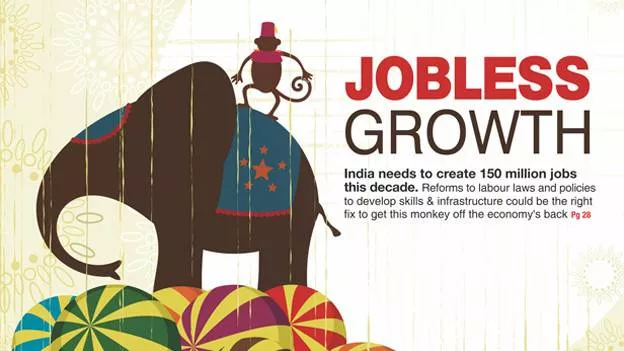
India’s jobless growth is a myth
In India, the overall employment situation is assessed on the basis of periodic comprehensive surveys undertaken by the National Sample Survey Office (NSSO), usually after every five years. The NSSO surveys reveal that overall employment growth from 1993-94 to 2011-12 (the latest year for which the data is available) averaged 1.1% per annum, perceived to be lower than the growth in the number of people who might have been entering the labour force and what one would expect from accelerating output growth. The employment elasticity during this period was only 0.18. A secular decline in the labour force participation rate (LFPR), which reflects willingness to work, from 430 per 1,000 people in 2004-05 to 395 per 1,000 in 2011-12, kept the unemployment rate at low levels.Since NSSO surveys have been infrequent, the director general of the Labour Bureau has started providing more frequent information on labour markets since 2009-10. It has released five survey reports during this period, the latest being for 2015-16. The methodology is almost similar, but results are based on large surveys. These could be considered a reasonable proxy for assessing the labour market situation, more so in the intervening periods between the publication of NSSO surveys.
We look at the information from these two surveys—NSSO and Labour Bureau—to seek answers to these three questions:
First, whether this period was one of jobless growth? Second, assuming that each state followed a different development strategy, how different was their relative record in providing employment to job seekers? Third, what is the status when it comes to providing regular, productive and well-paid jobs?
Labour Bureau data indicates that between 2009-10 and 2015-16, incremental jobs created exceeded the number of people who entered the labour force by a wide margin. At an aggregate level, 75 million jobs were created, against 61 million who were added to the list of job seekers. During this period, the overall percentage of people in the age group of 15 and above who were willing to work, both male and female, increased marginally. With employment opportunities outnumbering job seekers by 23%, the rate of unemployment also declined. Contrary to general perception, the period 2009-10 to 2015-16 does not seem to be a period of jobless growth.
Notwithstanding interstate differences, the average annual rate of growth of job creation at the all-India level, at 3.2% in 2009-2016, exceeded the rate of growth of job seekers, which averaged 2.4% . Six states—Assam, Himachal Pradesh, Jammu and Kashmir, Kerala, Sikkim and Uttarakhand—had lower job creation growth relative to the growth of job seekers. A significantly high growth of incremental job creation in Bihar, Jharkhand and Uttar Pradesh needs to be further analysed to ascertain the contributing factors.
A state-wide analysis suggests that in Gujarat, Maharashtra, Madhya Pradesh and Rajasthan, there was a sharp decline in female job seekers—and this might have helped match job opportunities to job seekers. On the other hand, in Sikkim, there were fewer job opportunities for both males and females. Despite adequate availability of job opportunities at the all-India level, state-wide differences remained significant, and, in some cases, surplus jobs arose only because of a decline in the labour and workforce participation rate for females.
The third question relates to how well paid these jobs were. The Labour Bureau survey (2015-16) has categorized workers according to their monthly income levels. Most of the workers, 84% of all, whether self-employed, regular wage earners, contract workers or casual workers, were getting an income of less than Rs10,000 per month . Regular wage earners or salaried-class workers were better off, with 57% having a monthly income of Rs10,000 or less. Finally, 96.3% of casual workers, including those who were employed for public works, and 85% of self-employed persons had a monthly income of Rs10,000 or less. Enough work was also not available for nearly 40% of the workers; they were being employed for only a part of the year. In terms of decent, productive and well-paid jobs, considerable gaps continued to persist.
It is necessary, then, to evolve strategies to create supplementary opportunities for the self-employed, improve the female labour force participation rate, increase the ratio of female to male job seekers, and reduce interstate differences.
Author : R. Gopalan and M.C. Singhi are, respectively, former secretary and senior adviser, department of economic affairs


The non trivial costs of a slow judiciary
Jan 31, 2018
Very important the economic survey an overview
Jan 30, 2018
The conflict between equity and efficiency
Jan 29, 2018
Judicial primacy is not the same as exclusivity
Jan 25, 2018
Global monetary policy enters a decisive phase
Jan 25, 2018





Stay updated with The Hindu Editorial Vocab24 app, your definitive source for breaking news and comprehensive coverage from India and around the globe. Whether it's political developments, business updates, sports highlights, the latest technology trends, or current events, The Hindu brings live, accurate, and reliable news directly to your device.
Don’t fall for sensationalized or fake news shared online. Read and share accurate updates with friends and family through The Hindu Editorial Vocab24 app. Download it today!
News Coverage in The Hindu Editorial Vocab24 App
Breaking News: Receive instant notifications on breaking news stories as they unfold. Stay informed about major events and developments in India and around the world with live blogs, news in shorts videos, and concise articles.
Politics: Get the latest updates on Indian politics, including elections, policy changes, government decisions, and political events that shape the nation.
Business and Economy: Stay ahead in the economic landscape with detailed business news and market analysis. Learn about stock market trends, financial reports, corporate news, and economic developments to make informed investment decisions.
Current Events: Follow stories on social issues, policy changes, global events, and daily current affairs, tailored for UPSC and other competitive exam preparations.
Technology: Keep up with the latest gadgets, innovations, and tech trends. Read expert reviews and analyses in short, concise updates on cutting-edge technology from India and beyond.
Sports: Never miss a moment of your favorite sports. Get live scores, match reports, and expert analysis on cricket, football, tennis, and more.
International News: Stay informed about global events and geopolitical developments, including the Russia-Ukraine war, Israel-Palestine conflict, and other key international stories.
Local News: Stay connected to your community with the latest updates on city events, issues, and local news. Coverage includes hyperlocal updates from cities like Bangalore, Chennai, Delhi, Hyderabad, Mumbai, Kolkata, and more.
Trending Topics: Discover what's trending today with the most talked-about stories and hot topics across India and the world.
Experience journalism that values integrity, accuracy, and reliability. Download The Hindu Editorial Vocab24 app today and stay connected with the world.
Subscribe to our newsletter!







