

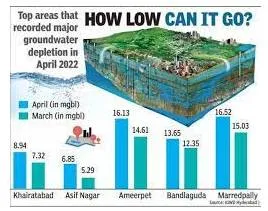
India’s growing water crisis the seen and the unseen
Rural-urban water disputes are very likely to occur as scarcity grows, exacerbated by climate change The UNESCO United Nations World Water Development Report of 2022 has encapsulated global concern over the sharp rise in freshwater withdrawal from streams, lakes, aquifers and human-made reservoirs, impending water stress and also water scarcity being experienced in different parts of the world. In 2007, ‘Coping with water scarcity’ was the theme of World Water Day (observed on March 22). The new Water Report of the Food and Agriculture Organization of the United Nations (FAO) sounded a note of caution about this silent crisis of a global dimension, with millions of people being deprived of water to live and to sustain their livelihood.Growing water stress
Further, the Water Scarcity Clock, an interactive webtool, shows that over two billion people live in countries now experiencing high water stress; the numbers will continue to increase. The Global Drought Risk and Water Stress map (2019) shows that major parts of India, particularly west, central and parts of peninsular India are highly water stressed and experience water scarcity. A NITI Aayog report, ‘Composite Water Management Index’ (2018) has sounded a note of caution about the worst water crisis in the country, with more than 600 million people facing acute water shortages. The typical response of the areas where water shortage or scarcity is high includes transfer of water from the hinterlands/upper catchments or drawing it from stored surface water bodies or aquifers. This triggers sectoral and regional competition; rural-urban transfer of water is one such issue of global concern.
Increasing trans-boundary transfer of water between rural and urban areas has been noted in many countries since the early 20th century. A review paper published in 2019 reported that, globally, urban water infrastructure imports an estimated 500 billion litres of water per day across a combined distance of 27,000km. At least 12% of large cities in the world rely on inter-basin transfers. A UN report on ‘Transboundary Waters Systems – Status and Trend’ (2016) linked this issue of water transfer with various Sustainable Development Goals proposed to be achieved during 2015 to 2030. The report identified risks associated with water transfer in three categories of biophysical, socio-economic and governance. South Asia, including India, falls in the category of high biophysical and the highest socio-economic risks.
Urban water use
According to Census 2011, the urban population in India accounted for 34% of total population distributed in 7,935 towns of all classes. It is estimated that the urban population component in India will cross the 40% mark by 2030 and the 50% mark by 2050 (World Urbanization Prospects, 2018). The urban population accounted for 50% of the total world population by the end of the last century. Although the pace of India’s urbanisation is relatively slow, it is now urbanising at a rapid pace — the size of the urban population is substantial. Water use in the urban sector has increased as more and more people shift to urban areas, and per capita use of water in these centres rises, which will continue to grow with improved standards of living.
Examining the urban water management trajectory, it is evident that in the initial stages when a city is small, it is concerned only with water supply; in a majority of cases, water is sourced locally, with groundwater meeting the bulk of the supply. As the city grows and water management infrastructures develop, dependence shifts to surface water.
With a further growth of cities, water sources shift further up in the hinterlands, or the allocation of urban water is enhanced at the expense of irrigation water. Almost all cities in India that depend on surface water experience this trend. City water supply is now a subject of inter-basin and inter-State transfers of water.
The case of Ahmedabad
Ahmedabad is an interesting case in this context. More than 80% of water supply in this city used to be met from groundwater sources till the mid-1980s. The depth to groundwater level reached 67 metres in confined aquifers. The city now depends on the Narmada canal for the bulk of its water supply. The shift is from local groundwater to canal water receiving supply from an inter-State and inter-basin transfer of surface water.
Dependence on groundwater continues particularly in the peri-urban areas in almost all large cities that have switched to surface water sources. While surface water transfer from rural to urban areas is visible and can be computed, the recharge areas of groundwater aquifers are spread over well beyond the city boundary or its periphery.
Whatever be the source, surface or groundwater, cities largely depend on rural areas for raw water supply, which has the potential to ignite the rural-urban dispute. Available studies covering Nagpur and Chennai indicate the imminent problem of rural-urban water disputes that the country is going to face in the not-so-distant future as water scarcity grows, which will be further exacerbated by climate change.
At present, the rural-urban transfer of water is a lose-lose situation in India as water is transported at the expense of rural areas and the agricultural sector; in cities, most of this water is in the form of grey water with little recovery or reuse, eventually contributing to water pollution. Rural and urban areas use water from the same stock, i.e., the water resources of the country. Therefore, it is important to strive for a win-win situation.
Such a situation is possible through a host of activities in the rural and urban areas, which is primarily a governance challenge. A system perspective and catchment scale-based approach are necessary to link reallocation of water with wider discussions on development, infrastructure investment, fostering an rural-urban partnership and adopting an integrated approach in water management.
Institutional strengthening can offer entry points and provide opportunities to build flexibility into water resource allocation at a regional level, enabling adjustments in rapidly urbanising regions. In India’s 75th anniversary of Independence, it is time to examine the state of its water resources and ensure that the development process is not in jeopardy.
Srikumar Chattopadhyay is former Scientist, Centre for Earth Science Studies, Thiruvananthapuram, and Indian Council of Social Science Research (ICSSR) National Fellow, Gulati Institute of Finance and Taxation, Thiruvananthapuram

Atiqa records two top-four finishes in WSK Final Cup
Sep 05, 2026










Stay updated with The Hindu Editorial Vocab24 app, your definitive source for breaking news and comprehensive coverage from India and around the globe. Whether it's political developments, business updates, sports highlights, the latest technology trends, or current events, The Hindu brings live, accurate, and reliable news directly to your device.
Don’t fall for sensationalized or fake news shared online. Read and share accurate updates with friends and family through The Hindu Editorial Vocab24 app. Download it today!
News Coverage in The Hindu Editorial Vocab24 App
Breaking News: Receive instant notifications on breaking news stories as they unfold. Stay informed about major events and developments in India and around the world with live blogs, news in shorts videos, and concise articles.
Politics: Get the latest updates on Indian politics, including elections, policy changes, government decisions, and political events that shape the nation.
Business and Economy: Stay ahead in the economic landscape with detailed business news and market analysis. Learn about stock market trends, financial reports, corporate news, and economic developments to make informed investment decisions.
Current Events: Follow stories on social issues, policy changes, global events, and daily current affairs, tailored for UPSC and other competitive exam preparations.
Technology: Keep up with the latest gadgets, innovations, and tech trends. Read expert reviews and analyses in short, concise updates on cutting-edge technology from India and beyond.
Sports: Never miss a moment of your favorite sports. Get live scores, match reports, and expert analysis on cricket, football, tennis, and more.
International News: Stay informed about global events and geopolitical developments, including the Russia-Ukraine war, Israel-Palestine conflict, and other key international stories.
Local News: Stay connected to your community with the latest updates on city events, issues, and local news. Coverage includes hyperlocal updates from cities like Bangalore, Chennai, Delhi, Hyderabad, Mumbai, Kolkata, and more.
Trending Topics: Discover what's trending today with the most talked-about stories and hot topics across India and the world.
Experience journalism that values integrity, accuracy, and reliability. Download The Hindu Editorial Vocab24 app today and stay connected with the world.
Subscribe to our newsletter!







