

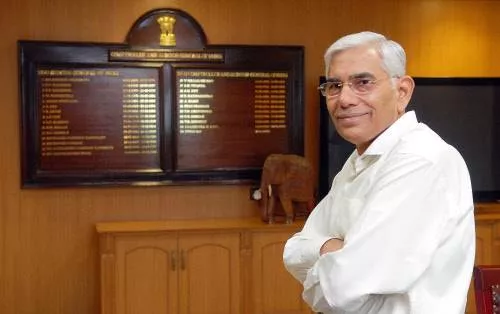
In the 2g debris questions for the cag
The allegedly largest scam in the country’s history has loomed large in the public imagination for well over half a decade. It will not fade away quietly. The Central Bureau of Investigation (CBI) means to appeal the special court’s verdict, for one. For another, given the 2G affair’s role in laying the Manmohan Singh government low, the verdict will continue to resonate politically, with a cycle of state polls next year and the general elections in 2019. And Videocon—which was among those hit by the Supreme Court’s cancellation of 122 licences in 2012 and is now preparing to file a Rs10,000 crore compensation claim against the government—may well be the first in a procession of claimants. Among the most important takeaways, however, is the overreach of the Comptroller and Auditor General of India (CAG).In 2012, representatives of the supreme audit institutions of the US, Australia, Canada, Denmark and the Netherlands conducted a peer review of the CAG’s recent audits, International Peer Review Report on the Performance Audit function of Comptroller and Auditor General of India. This was the first such initiative and long overdue. The review examined CAG audit reports presented to central and state legislatures over the period of roughly a year, starting from April 2010. It had mixed findings. There are positives aplenty, but also shortcomings. Among the latter was a lack of sufficient evidence in about half of the 35 audits considered.
The CAG’s role in the 2G mess should be seen in this context. The catalyst and subsequent leitmotif of the entire affair was Rs1.76 trillion—the CAG’s estimate of the notional loss to the exchequer in the allocation of 2G licences. As Swaminathan S. Anklesaria Aiyar has pointed out in his The Times of Indiablog on 24 December, this is a dubious figure based on dubious assumptions such as the use of 3G spectrum bids as a benchmark. More importantly, the CAG began with a faulty premise: that the government’s guiding principle should have been revenue maximization. Governance does not always move along such straight lines; there are occasions when other imperatives such as public welfare take precedence.
This overreach was born of institutional shortcomings. The question of where exactly the CAG fits into the accountability framework of the Indian state has never really been answered adequately in practice. In the US and UK, for instance, legislation establishes corresponding audit bodies firmly as agents of the legislative branch of government.
The Indian scenario is more fuzzy. The CAG is the successor to the pre-independence auditor general. Come independence, the Constitution made interim provisions rather than providing a final solution—understandable given the ambiguities of governance in a fledgeling republic. As per the Constitution, the legislature would decide the CAG’s remit. Until the time it was able to do so, the CAG would continue functioning along the lines of the auditor general. Parliament finally established the CAG’s duties only in 1971 with the Comptroller and Auditor-General’s (Duties, Powers and Conditions of Service) Act.
The legacy of the decades of ambiguity is an uneasy working relationship between the CAG and Parliament, the body it is answerable to. A fair share of the blame here goes to the latter. It has been apathetic both in its oversight and in its usage of CAG reports. The CAG has responded by often appropriating an outsize role for itself. For instance, in a 2013 speech, then-CAG Vinod Rai argued that accountability institutions such as his should operate independent of the control of any other authority.
This has resulted in an occasionally adversarial approach. The peer review has noted that in a number of the audit reports it examined, the CAG could have been “more balanced in content and tone. In large measure, this could be achieved by placing the audit findings in the appropriate perspective and reporting more fully against the audit objectives.” Such an approach could perhaps have produced a more reasonable report on the 2G licences.
This is not to say that the allocation process followed by the department of telecommunications under A. Raja was the correct choice. Auctions will always be preferable to discretionary allocation for national resources for reasons of transparency and accountability. Nor is it to rule out the possibility of criminality. The 2012 Supreme Court judgement had to do with the civil aspect of the case—the constitutional propriety and rightness of the allocation process. But it also pointed to alleged corruption on the part of Raja. The discrepancy between this and the special court verdict is sure to play out with the CBI appeal.
But the CAG is a vital component of the system of checks and balances in the Indian state«and for all the good it has done, the 2G case shows that it has some distance to go yet.
Courtesy : Livemint Editorial


The non trivial costs of a slow judiciary
Jan 31, 2018
Very important the economic survey an overview
Jan 30, 2018
The conflict between equity and efficiency
Jan 29, 2018
Judicial primacy is not the same as exclusivity
Jan 25, 2018
Global monetary policy enters a decisive phase
Jan 25, 2018





Stay updated with The Hindu Editorial Vocab24 app, your definitive source for breaking news and comprehensive coverage from India and around the globe. Whether it's political developments, business updates, sports highlights, the latest technology trends, or current events, The Hindu brings live, accurate, and reliable news directly to your device.
Don’t fall for sensationalized or fake news shared online. Read and share accurate updates with friends and family through The Hindu Editorial Vocab24 app. Download it today!
News Coverage in The Hindu Editorial Vocab24 App
Breaking News: Receive instant notifications on breaking news stories as they unfold. Stay informed about major events and developments in India and around the world with live blogs, news in shorts videos, and concise articles.
Politics: Get the latest updates on Indian politics, including elections, policy changes, government decisions, and political events that shape the nation.
Business and Economy: Stay ahead in the economic landscape with detailed business news and market analysis. Learn about stock market trends, financial reports, corporate news, and economic developments to make informed investment decisions.
Current Events: Follow stories on social issues, policy changes, global events, and daily current affairs, tailored for UPSC and other competitive exam preparations.
Technology: Keep up with the latest gadgets, innovations, and tech trends. Read expert reviews and analyses in short, concise updates on cutting-edge technology from India and beyond.
Sports: Never miss a moment of your favorite sports. Get live scores, match reports, and expert analysis on cricket, football, tennis, and more.
International News: Stay informed about global events and geopolitical developments, including the Russia-Ukraine war, Israel-Palestine conflict, and other key international stories.
Local News: Stay connected to your community with the latest updates on city events, issues, and local news. Coverage includes hyperlocal updates from cities like Bangalore, Chennai, Delhi, Hyderabad, Mumbai, Kolkata, and more.
Trending Topics: Discover what's trending today with the most talked-about stories and hot topics across India and the world.
Experience journalism that values integrity, accuracy, and reliability. Download The Hindu Editorial Vocab24 app today and stay connected with the world.
Subscribe to our newsletter!







