

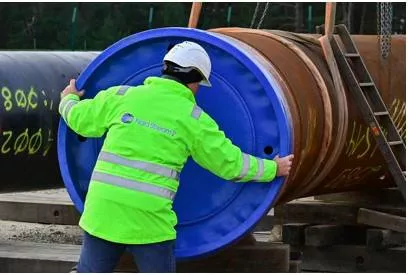
In sanctions bite nord stream 2 in the cross hairs
A well chosen target, the massive gas pipeline is one of the key issues central to the Ukraine conflict.Russia’s attack on Ukraine has triggered “unprecedented’ economic sanctions by the United States, though how deeply they damage the Russia-Europe energy relationship remains to be seen. The speed with which the U.S. declared the Nord Stream 2 pipeline to be “dead at the bottom of the sea” indicates that this massive gas pipeline is one of the key issues at the bottom of the conflict.
Still a critical fuel
Despite global efforts to decarbonise energy, natural gas is set to remain one of the principal sources of primary energy till at least 2040. Europe is the world’s second largest market for natural gas, and hence the battleground between the superpowers of hydrocarbon energy, the U.S. and Russia. Germany, despite a decade of “energiewende” (an ‘energy turnaround’ or the ‘ongoing transition to a low carbon, environmentally sound, reliable, and affordable energy supply’), is still one of the world’s largest importers of oil and gas. It is again at the epicentre, as it has been in earlier energy pipeline disputes.
The post-war European security order under the North Atlantic Treaty Organization (NATO) and the Warsaw Pact was underpinned by an energy order in which oil was sold to West Europe from West Asian/Middle Eastern fields controlled by U.S. companies; and to East Europe from the giant oilfields of the Soviet Union. West Germany (the Federal Republic of Germany or the FRG) and other European countries had “economic miracles” and were drawn into the dollar denominated oil trade cycle, which supports U.S. global dominance to this day. Problems arose in the 1960s when Soviet production expanded rapidly and their planned “Druzhba” pipeline network went beyond integrating East Europe, to offering West Europe both lower prices for oil and large orders for specialised pipes and transmission equipment. The FRG found the offer compelling and the U.S. fought to preserve market dominance by pressurising NATO partners into an embargo on pipe sales — applied retroactively. The FRG’s then 87-year-old Chancellor, Konrad Adenauer, finally acquiesced after a bitter internal debate. The Soviets built the pipeline with a two year lag; however, they only won a large share of the West European oil market after the West Asia/Middle East oil supply crises of the 1970s and fall in U.S. domestic production made it an importer.
An energy transition
The 1970s European energy transition to natural gas led to the geoeconomic linkage of giant Soviet gas fields to West European markets via pipelines through East Europe, again generating lucrative sales of large diameter pipes for German companies. The synergy of Germany’s Ostpolitik with the Siberian pipeline worked during the U.S.-Soviet détente; but during the 1981-83 crisis over Soviet backed martial law in Poland, there was another showdown when the U.S. tried to stop the completion of the huge Siberian pipeline. The U.S. had no alternative to offer except coal; and the formidable German Chancellor, Helmut Schmidt, faced down U.S. sanctions, saying bluntly “the pipeline will be built”. Built it was, and the U.S. gave up the sanctions within six months, switching to other tools to win the Cold War. The 1986 oil price crash caused by friendly Saudi Arabia which dented the Soviet economy may have been one.
The victorious U.S. then used NATO expansion into Eastern Europe and the Baltic States to create a new European security order in the face of a diminished Russia, and a risk-averse European Union. Breaking up Russia’s good friend Serbia in 1999 after 79 days of NATO bombing, was an early success. Plans to probe further into Georgia and Ukraine have however divided NATO. For the U.S., maintaining leadership in the face of Russia’s determined pushback now requires curtailing the growing EU-Russia gas synergy as a strategic objective, combined with a 1960s style fight over market share.
Impact of Putin’s push
Russian President Vladimir Putin revived Russia by leveraging oil and gas production which provide 60% of exports, 25% of government revenue, and have boosted national reserves to $600 billion. It can, and has used gas as an instrument of influence in its “near abroad”. However, for the EU (60% of Russia’s gas exports), and its main customer Germany, Russia has been a most reliable supplier right through the Cold War, the break-up of the Soviet Union, the division of the assets of the pipeline network with Ukraine and other successor states, and economic chaos under Russia’s Boris Yeltsin. A new pipeline was built to Germany via Belarus and Poland; and Russia now supplies 35%-40% of the EU’s gas needs. In the early 2000s, the EU noted the stability of Russia’s gas deliveries. However in 2004, political instability in Ukraine began causing problems for gas flow, and thereafter, work on the direct Russia-Germany link via the undersea giant Nord Stream project was planned.
The two Nord Stream pipelines are gamechangers as they can meet nearly all of Germany’s import requirements, and are symbols of synergy with Russia. Crucially, however, they deprive Ukraine and East European transit countries of revenues and leave them dependent on Russia for continued supplies. Some have had to get Russian gas via eastward flows from Germany! Hence, their strident opposition to the Nord Stream project from the outset, and with U.S. support they have launched the Three Seas Initiative to develop north-south gas connectivity using liquefied natural gas (LNG) imported via maritime terminals on the Baltic, Adriatic and Black Seas.
The U.S. strategy
As in the 1950s, the U.S. can now deliver energy — LNG — to buttress its security umbrella. The shale gas revolution has made the U.S. the world’s largest producer of gas; and as production surpassed the peak set in 1973, it has become a major exporter of LNG. The strategy of reducing Russia’s grip on the lucrative EU gas market is thus being pursued ruthlessly for both strategic and commercial reasons. U.S. LNG exports to the EU have grown rapidly to 22 billion cubic meters (BCM) worth $12 billion in 2021; and will go up sharply, if Nord Stream 2 remains non-functional and Germany has to set up LNG terminals instead. In case “green” activism curbs U.S. shale gas expansion, the geopolitically risk-laden effort to create a long-term Europe-Mideast gas nexus using the enormous gas reserves of Iran (and Qatar) could be revived.
German Chancellor Olaf Scholz’s support for Nord Stream 2 has been threatened since his assumption of office last December, which coincided with U.S. intelligence leaks about the imminent invasion of Ukraine. The beleaguered leader was ambivalent even in early February when U.S. President Joe Biden audaciously announced in Mr. Scholz’s presence, that in case of an invasion of Ukraine “there will no longer be a Nord Stream 2... We will bring an end to it”. His hand has now been forced and regulatory certification of the pipeline is suspended; and Mr. Scholz announced a U-turn away from Ostpolitik to closer coordination with NATO.
Key reasons, looking ahead
Nord Stream 2 is a well chosen target as the recently completed €10 billion asset is wholly owned by Russia’s Gazprom unlike Nord Stream 1 (functional for a decade) which is jointly owned with European companies. Mr. Scholz’s Green coalition partners are also sceptical about it. The Nord Stream project has larger capacity than all of Russia’s current and planned gas pipelines to China; so it remains of great importance for Moscow. Nord Stream 1 survives, as Europe will suffer without it, but preserving market share in the EU requires Russia to keep gas also flowing through Ukraine.
The implications for the U.S.’s Indo-Pacific strategy, of the current focus on Europe are presently unclear. Much will depend on how Mr. Putin’s gamble plays out: i.e. of a pre-emptive strike against Ukraine itself, rather than a “minor incursion”, perhaps in Donbass, which Mr. Biden said would divide NATO over how to respond. Whether the EU, now sans the fervently NATO-inclined U.K., is actually jolted enough to take on a military dimension is a question for the future. For the present, the U.S. aims to maintain preponderance at the western end of Eurasia with energy included in its arsenal.




Top court quashes FIRs against Gen Z protesters
Sep 04, 2026






Stay updated with The Hindu Editorial Vocab24 app, your definitive source for breaking news and comprehensive coverage from India and around the globe. Whether it's political developments, business updates, sports highlights, the latest technology trends, or current events, The Hindu brings live, accurate, and reliable news directly to your device.
Don’t fall for sensationalized or fake news shared online. Read and share accurate updates with friends and family through The Hindu Editorial Vocab24 app. Download it today!
News Coverage in The Hindu Editorial Vocab24 App
Breaking News: Receive instant notifications on breaking news stories as they unfold. Stay informed about major events and developments in India and around the world with live blogs, news in shorts videos, and concise articles.
Politics: Get the latest updates on Indian politics, including elections, policy changes, government decisions, and political events that shape the nation.
Business and Economy: Stay ahead in the economic landscape with detailed business news and market analysis. Learn about stock market trends, financial reports, corporate news, and economic developments to make informed investment decisions.
Current Events: Follow stories on social issues, policy changes, global events, and daily current affairs, tailored for UPSC and other competitive exam preparations.
Technology: Keep up with the latest gadgets, innovations, and tech trends. Read expert reviews and analyses in short, concise updates on cutting-edge technology from India and beyond.
Sports: Never miss a moment of your favorite sports. Get live scores, match reports, and expert analysis on cricket, football, tennis, and more.
International News: Stay informed about global events and geopolitical developments, including the Russia-Ukraine war, Israel-Palestine conflict, and other key international stories.
Local News: Stay connected to your community with the latest updates on city events, issues, and local news. Coverage includes hyperlocal updates from cities like Bangalore, Chennai, Delhi, Hyderabad, Mumbai, Kolkata, and more.
Trending Topics: Discover what's trending today with the most talked-about stories and hot topics across India and the world.
Experience journalism that values integrity, accuracy, and reliability. Download The Hindu Editorial Vocab24 app today and stay connected with the world.
Subscribe to our newsletter!







