

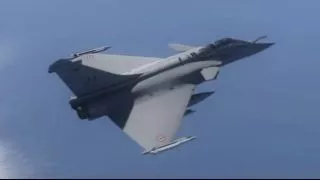
Iaf’s 36 rafales what’s the noise about
The IAF was hoping for a minimum of 80 Dassault Rafale fighters, but the Narendra Modi government has kept the initial order down to 36 fighters in a flyaway condition for 7.8 billion euros. Or $9.13 billion (@1 euro=$1.17). This gave rise to the calculation we were buying the fighters for Rs 1,600 crores each. In the run-up to the deal, then defence minister Manohar Parrikar muddied the waters a bit by making off-the-cuff comments about the high cost of Rafale compared to the IAF’s mainstay SU-30 MKI. I don’t think there is any issue about the quality of the Rafale, unless Ram Jethmalani has a view on it, like he had on the Bofors FH-77 howitzer. The public, quite rightly too, believes all weapons purchases by the government involve murky transactions and huge payoffs. This has been our well-beaten track record. The Modi government too is a government of politicians. The main offset contractor is Anil Ambani’s Reliance Defence Ltd. According to the ministry of company affairs, Reliance Defence Ltd was registered on March 28, 2015. On April 11, 2015 it became the main partner to ensure the 50 per cent offset clause under which Dassault and other French parties will invest half the contract value back in the country. Government officials insist 74 per cent of offsets will be exported, earning India 3 billion euros in the next seven years. Incidentally, Anil Ambani’s flagship company, Reliance Communications Ltd (RCom), just defaulted on a major foreign loan and its future ability to fulfil its Rafale offsets commitment should now be in doubt.The defaulted 2020 notes issued by RCom, once the country’s second-largest wireless operator, were trading at a record low of about 35.6 cents on the dollar in Hong Kong. The company’s shares slid 3.3 per cent to an all-time low of Rs 11.55. Yet Reliance Defence is gung-ho about fulfilling its Rafale-related obligations. There is much noise about the huge costs at which the 36 Rafales have been contracted for. The comparable costs of the 126 and 36 deals can only be read when all costs are factored in. The cost of the new deal for 36 Rafales is 3.42 billion euros as the cost of bare planes; 1.8 billion euros for associated supplies for infrastructure and support; 1.7 billion euros for India-specific changes; and 353 million euros for “performance-based logistics support”; with the weapons package of 700 million euros being the extra. What is new here are the performance-based logistics support and weapons package. So take out 1,053 million euros out and you have the comparable cost, which means it is 7.1 billion euros. It appears that the “fiddle” is in India-specific costs, additional infrastructure and support, and performance logistics support. The first MMRCA deal would also have included India-specific specifications, as in the case of IAF’s SU-30 MKIs. For comparison’s sake, the argument can be that 36 Rafales now cost 7.1 billion euros, while 126 Rafales in 2012 cost 7.75 billion euros.
IAF “spokesmen” have been justifying the Rafale purchase as the package includes the Meteor air-to-air missile. The Meteor is the new game-changer in the air. It increases the “no-escape” zone for a hostile aircraft by about three times. The Meteor is an active radar guided beyond-visual-range air-to-air missile (BVRAAM) developed by MBDA. It will offer a multi-shot capability against long-range manoeuvring targets in a heavy electronic counter-measures (ECM) environment with range in excess of 100 km (62 mi). According to the manufacturer, in a head-on engagement the Meteor provides a no-escape zone three times greater than that of a conventionally-powered missile. With the Meteor launched in pursuit of a target — a tail-chase engagement — the Meteor is five times as lethal as a conventional equivalent, such as the American AMRAAM. According to MBDA, Meteor has three to six times the kinematic performance of current air-to-air missiles of its type. The key to Meteor’s performance is believed to be its throttleable ducted rocket (ramjet) manufactured by Bayern-Chemie of Germany.
Since the IAF cannot speak for itself, it deploys former IAF officials to speak for it. These “experts” have been deceptively disseminating the Meteor missile as the real reason for buying the Rafales. It was said on a RSTV discussion in which I took part by an air vice-marshal who has found second wind as a strategic expert. The fact is that the Swedish Gripfen has now been integrated with the Meteor and open sources indicate that the IAF too is contemplating integrating the SU-30 MKI and Meteor. Even the Tejas can be fitted out with Meteors. So we aren’t buying the Rafale for the Meteor. The cost of procuring Meteors is hard to come by. Limited figures came to light in Germany in 2013. The Luftwaffe will acquire 150 missiles at a cost of around $323 million, plus a further $175 million for integration. That compares favourably with a price tag of $423 million for 180 AIM-120Ds, which the Pentagon paid in 2012. Today each Meteor will cost about 2.5 million euros each. I don’t think the IAF will need more Meteor missiles than the US Air Force or the Luftwaffe. But then there are other missiles to pay for too. Missile purchases can never be part of the capital cost of a fighter. Since they are expendable, and presumably mean to be expendable, they should be part of revenue expenditure. Make no mistake. The Rafale is a top class 4+ generation fighter. Perhaps even the best. But we are concerned with prices and payoffs. If this is a given, we must be happy that we made a good purchase.
Courtesy : MOHAN GURUSWAMY , The writer, a policy analyst studying economic and security issues, held senior positions in government and industry. He also specialises in the Chinese economy











Stay updated with The Hindu Editorial Vocab24 app, your definitive source for breaking news and comprehensive coverage from India and around the globe. Whether it's political developments, business updates, sports highlights, the latest technology trends, or current events, The Hindu brings live, accurate, and reliable news directly to your device.
Don’t fall for sensationalized or fake news shared online. Read and share accurate updates with friends and family through The Hindu Editorial Vocab24 app. Download it today!
News Coverage in The Hindu Editorial Vocab24 App
Breaking News: Receive instant notifications on breaking news stories as they unfold. Stay informed about major events and developments in India and around the world with live blogs, news in shorts videos, and concise articles.
Politics: Get the latest updates on Indian politics, including elections, policy changes, government decisions, and political events that shape the nation.
Business and Economy: Stay ahead in the economic landscape with detailed business news and market analysis. Learn about stock market trends, financial reports, corporate news, and economic developments to make informed investment decisions.
Current Events: Follow stories on social issues, policy changes, global events, and daily current affairs, tailored for UPSC and other competitive exam preparations.
Technology: Keep up with the latest gadgets, innovations, and tech trends. Read expert reviews and analyses in short, concise updates on cutting-edge technology from India and beyond.
Sports: Never miss a moment of your favorite sports. Get live scores, match reports, and expert analysis on cricket, football, tennis, and more.
International News: Stay informed about global events and geopolitical developments, including the Russia-Ukraine war, Israel-Palestine conflict, and other key international stories.
Local News: Stay connected to your community with the latest updates on city events, issues, and local news. Coverage includes hyperlocal updates from cities like Bangalore, Chennai, Delhi, Hyderabad, Mumbai, Kolkata, and more.
Trending Topics: Discover what's trending today with the most talked-about stories and hot topics across India and the world.
Experience journalism that values integrity, accuracy, and reliability. Download The Hindu Editorial Vocab24 app today and stay connected with the world.
Subscribe to our newsletter!







