

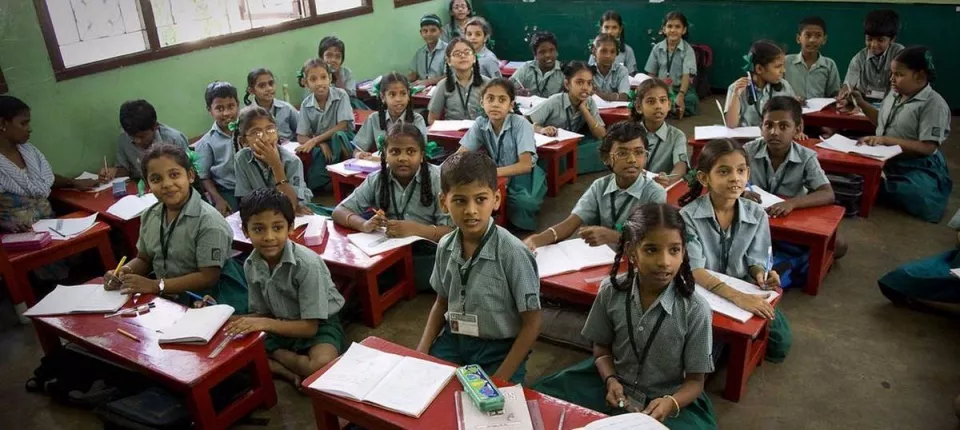
How to fix accountability in school education
For some time now, accountability has become the buzzword in school education. Everyone seems to have suggestions about “fixing” education by holding teachers accountable for student test scores. But we should ask ourselves whether test scores are the only way to assess how well education systems are performing; whether teachers are the only ones to blame for low-performing systems; and whether ‘blame’ itself is the right approach at all.UNESCO’s new Global Education Monitoring Report 2017/18 is a comprehensive and nuanced look at the role of accountability in global education systems in the effort to achieve the vision of the UN Sustainable Development Goal (SDG) 4: to ensure inclusive and quality education for all, and to promote lifelong learning.
The report points out that providing universal quality education depends not on the performance of teachers alone, but is the shared responsibility of several stakeholders: governments, schools, teachers, parents, the media and civil society, international organisations, and the private sector. It does indeed take an entire village.
Teachers, doing a complex and difficult job against many odds, are only one rung in the complex chain that makes up the education system. Hence it is both unfair and short-sighted to turn every discussion of the performance of education systems into a blame game and fix responsibility only on teachers, disproportionately, for poor test scores and absenteeism. Using poor test scores to punish teachers is a bad idea for many reasons, including the risk that it might result in teachers simply teaching ‘to the test’. Teaching to the test is never a good way forward for any education system: examination scores by themselves are an inadequate way of assessing the complex process of teaching and learning. Not only does an exclusive focus on test scores have the risk of leaving weaker students behind, it also leaves academically better-performing students with a narrow understanding of what education is all about.
Don’t blame teachers
As for teacher absence, very often the reasons for this are beyond the teachers’ own control. It is unfair to hold them responsible for factors that are not in their hands. For example, nearly half of teacher absenteeism in Indonesia in one year was due to excused time for study, during which substitutes should have been provided.
In this context one recalls an important study of teacher absenteeism in 619 schools across six States carried out by the Azim Premji Foundation. It found that while the overall percentage of teachers not in school was 18.5%, most of these were either out of school on other official duty, or on bonafide leave. Actual teacher absenteeism because of teachers’ truancy was 2.5%.
If the larger problem is of teacher shortages, perhaps it is time to talk of accountability with a constructive focus on the role of each stakeholder in the education system. How can we better fund and resource schools and colleges? How can we better train and support our teachers? How can we help communities to ensure that every child is in school? How can we support parents, so many of whom never went to school themselves, in helping their children learn?
Accountability mechanisms should be developed for education systems that are supportive, constructive and focus as much on the fundamental issues of access, equity and inclusion as on quality.




Top court quashes FIRs against Gen Z protesters
Sep 04, 2026







Stay updated with The Hindu Editorial Vocab24 app, your definitive source for breaking news and comprehensive coverage from India and around the globe. Whether it's political developments, business updates, sports highlights, the latest technology trends, or current events, The Hindu brings live, accurate, and reliable news directly to your device.
Don’t fall for sensationalized or fake news shared online. Read and share accurate updates with friends and family through The Hindu Editorial Vocab24 app. Download it today!
News Coverage in The Hindu Editorial Vocab24 App
Breaking News: Receive instant notifications on breaking news stories as they unfold. Stay informed about major events and developments in India and around the world with live blogs, news in shorts videos, and concise articles.
Politics: Get the latest updates on Indian politics, including elections, policy changes, government decisions, and political events that shape the nation.
Business and Economy: Stay ahead in the economic landscape with detailed business news and market analysis. Learn about stock market trends, financial reports, corporate news, and economic developments to make informed investment decisions.
Current Events: Follow stories on social issues, policy changes, global events, and daily current affairs, tailored for UPSC and other competitive exam preparations.
Technology: Keep up with the latest gadgets, innovations, and tech trends. Read expert reviews and analyses in short, concise updates on cutting-edge technology from India and beyond.
Sports: Never miss a moment of your favorite sports. Get live scores, match reports, and expert analysis on cricket, football, tennis, and more.
International News: Stay informed about global events and geopolitical developments, including the Russia-Ukraine war, Israel-Palestine conflict, and other key international stories.
Local News: Stay connected to your community with the latest updates on city events, issues, and local news. Coverage includes hyperlocal updates from cities like Bangalore, Chennai, Delhi, Hyderabad, Mumbai, Kolkata, and more.
Trending Topics: Discover what's trending today with the most talked-about stories and hot topics across India and the world.
Experience journalism that values integrity, accuracy, and reliability. Download The Hindu Editorial Vocab24 app today and stay connected with the world.
Subscribe to our newsletter!







