

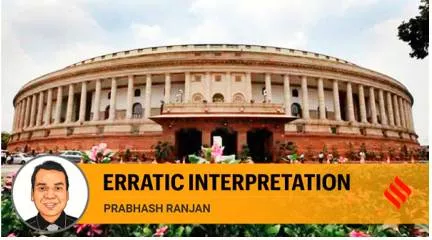
How india has approached customary international law
An important report on “India and international law” by the parliamentary committee on external affairs was recently presented to the Lok Sabha. Among other things, the report discusses how Indian courts have dealt with international law. The committee observed that India follows the principle of “dualism”, that is, international law does not automatically get incorporated into the domestic legal regime. An act of Parliament is necessary to transform international law into municipal law as recognised by Article 253 of the Indian Constitution. However, the committee believes that the Supreme Court has digressed from the principle of dualism and moved towards monism by holding that customary international law (CIL), unless contradictory to domestic law, is part of the Indian legal regime even without an enabling legislation enacted by the Parliament. CIL refers to international law norms derived from a custom that is a formal source of international law.India has indeed moved away from the principle of dualism towards monism by judicially incorporating not just CIL but also international treaties including those treaties that India has not signed. As regards customary norms, the Supreme Court in Vellore Citizens Welfare Forum v. Union of India held that CIL which is not contrary to the municipal law shall be deemed to have been incorporated in India’s domestic law. This principle has been affirmed in subsequent decisions. The apex court in Research Foundation for Science v. Union of India, relying on the Vellore Citizen case, declared that the precautionary principle, an environmental law concept, is part of CIL and thus part of Indian law.
Several facets of this judiciary-led transition from dualism to monism require elucidation. First, the apex court incorporating CIL as part of the domestic legal regime is consistent with the practice of other common law countries. However, the sticky part is the ease with which CIL is accepted as part of Indian law. For instance, the Supreme Court’s willingness to readily accept the precautionary principle as part of CIL flies in the face of international law debates where the acceptance of this principle as a customary norm remains contested. Determination of whether a particular provision indeed constitutes a binding customary norm under international law requires the double requirement of state practice (the actual practice of the states) and opinio juris (belief that the custom is part of the law). The apex court rarely conducts such an analysis.
Second, the apex court hasn’t been consistent in incorporating CIL. In a 2021 case, Mohamad Salimullah v. Union of India, the court appallingly refused to rule against the deportation of Rohingya refugees to Myanmar despite the principle of non-refoulment being part of CIL. The principle of non-refoulment prohibits a country from returning refugees to countries where they face a clear threat of persecution. But curiously the court did not incorporate this principle into Indian law.
Third, international law-making is often critiqued for democratic deficit. Arguably, judicially incorporating international law without parliamentary scrutiny legitimises such a democratic deficit. Accordingly, judicial incorporation of international law is questioned because it amounts to the judiciary riding roughshod over the Parliament. The committee too feels that this could become a bone of contention between the judiciary and the other organs of the state.
Fourth, the bright side of judicial incorporation is the progressive development of law when the executive and the parliament for ideological or political persuasions fail to enact laws transforming a liberal international legal norm into domestic law. India’s spectacular failure to enact a refugee law incorporating the principle of non-refoulment is a classic example of this. The apex court squandered the terrific opportunity in the Mohamad Salimullah case to incorporate non-refoulment as part of the Indian legal regime.
The committee’s recommendation that the executive should take note of the vacuum in domestic legislation on customary norms in international law and develop adequate domestic laws is an important one. However, this should not mean expanding domestic law that rejects binding customary norms in international law. On the contrary, India should enact domestic laws that are harmonious with CIL. The judiciary, on its part, should demonstrate greater analytical rigour in interpreting and applying CIL as part of the Indian legal regime.












Stay updated with The Hindu Editorial Vocab24 app, your definitive source for breaking news and comprehensive coverage from India and around the globe. Whether it's political developments, business updates, sports highlights, the latest technology trends, or current events, The Hindu brings live, accurate, and reliable news directly to your device.
Don’t fall for sensationalized or fake news shared online. Read and share accurate updates with friends and family through The Hindu Editorial Vocab24 app. Download it today!
News Coverage in The Hindu Editorial Vocab24 App
Breaking News: Receive instant notifications on breaking news stories as they unfold. Stay informed about major events and developments in India and around the world with live blogs, news in shorts videos, and concise articles.
Politics: Get the latest updates on Indian politics, including elections, policy changes, government decisions, and political events that shape the nation.
Business and Economy: Stay ahead in the economic landscape with detailed business news and market analysis. Learn about stock market trends, financial reports, corporate news, and economic developments to make informed investment decisions.
Current Events: Follow stories on social issues, policy changes, global events, and daily current affairs, tailored for UPSC and other competitive exam preparations.
Technology: Keep up with the latest gadgets, innovations, and tech trends. Read expert reviews and analyses in short, concise updates on cutting-edge technology from India and beyond.
Sports: Never miss a moment of your favorite sports. Get live scores, match reports, and expert analysis on cricket, football, tennis, and more.
International News: Stay informed about global events and geopolitical developments, including the Russia-Ukraine war, Israel-Palestine conflict, and other key international stories.
Local News: Stay connected to your community with the latest updates on city events, issues, and local news. Coverage includes hyperlocal updates from cities like Bangalore, Chennai, Delhi, Hyderabad, Mumbai, Kolkata, and more.
Trending Topics: Discover what's trending today with the most talked-about stories and hot topics across India and the world.
Experience journalism that values integrity, accuracy, and reliability. Download The Hindu Editorial Vocab24 app today and stay connected with the world.
Subscribe to our newsletter!







