

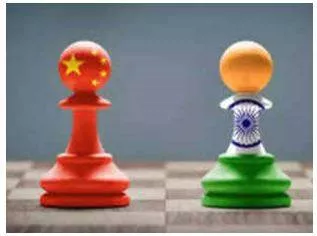
How china is playing a twin track game with india
Amid ongoing diplomatic exchanges between India and China, including an ongoing visit by Defence Minister Rajnath Singh and recent visit of National Security Advisor Ajit Doval for the SCO Summit, China is also taking provocative steps. It has halted or severely delayed critical exports to India, including rare earth magnets, specialty fertilisers and even tunnel boring machines (TBMs) destined for the Mumbai–Ahmedabad high-speed rail corridor. These moves raise urgent questions about China's strategy: why is it choosing to weaponise trade just as both sides are seeking to ‘normalise’ ties?China's twin-track strategy on India unfolds as overt diplomatic engagement while exerting covert trade pressures. China’s recent actions reflect how it views its trade relationship with India as a tool of strategic leverage.
China's strategic leverage through export denials
China’s control over key supply chains is well established. As the world’s leading producer of rare earth elements, fertiliser inputs and industrial machinery, it occupies a dominant position in many high-value sectors. By deliberately delaying or halting exports of these items to India, Beijing is asserting this dominance in subtle but unmistakably coercive ways.
The case of rare earth magnets is particularly revealing. These components are essential in advanced electronics, electric vehicles, wind turbines, etc. By denying their export to Indian firms, China is slowing down India’s ambitions in high-tech manufacturing, a key pillar of the ‘Make in India’ and Production-Linked Incentive (PLI) initiatives. Similarly, specialty fertilisers held up at Chinese ports affect India’s agricultural sector at a time when global food security concerns remain high. The blockade of tunnel boring machines, critical for a flagship infrastructure project co-funded by Japan, introduces both economic delays and diplomatic awkwardness.
All of these actions share a common thread. They enable China to remind India of its central role in global industrial ecosystems, and the consequences of falling out of its favour.
Domestic priorities or geopolitical game?
China has offered technical reasons for some of these export delays, particularly around fertilisers. Chinese customs authorities have cited inspections under the guise of entry–exit Inspection & Quarantine (CIQ) protocols, ostensibly to protect domestic agricultural needs and control inflation.
Yet these justifications do not fully explain export curbs. The deliberate and consistent nature of these export denials, especially when targeted at sensitive sectors and projects, points to a more calculated geopolitical strategy. The Chinese state is using bureaucratic tools to exert pressure without officially declaring a trade embargo. People with knowledge of the matter have told ET that China has not been inspecting shipments meant for India, using various procedures to block exports without imposing an express ban. The pattern suggests this is less about domestic need and more about strategic messaging.
‘China has been restricting suppliers of specialty fertilisers to India for the last four to five years. However, this time it is a complete halt,’ Rajib Chakraborty, president, Soluble Fertilizer Industry Association (SFIA), has told ET recently.
Another key driver behind China’s trade obstructions may be retaliation for India’s post-Galwan restrictions on Chinese economic engagement. Since the deadly 2020 border clash in Ladakh, India has taken several steps to limit Chinese influence in its economy. India mandates government approval for investment by countries that have a border with it, specifically aimed at its northern neighbour.
Investment from China now requires government approval under the updated FDI norms (Press Note 3). Over 200 Chinese mobile apps, including TikTok, have been banned on national security grounds. Direct flights between India and China have remained restricted. From China's perspective, these restrictions have curbed its access to India’s vast consumer market and investment space. The export denials, therefore, serve as a tit-for-tat response, an attempt to signal displeasure at India's protective economic posture. By denying key supplies, China is reminding India of the cost of economic decoupling.
What are India’s options?
China’s export denial strategy is a textbook example of economic statecraft. It reflects not just China's confidence in its industrial leverage but also its increasing willingness to use trade as a tool of coercion. China’s export blockades may be an attempt to test India’s resilience under pressure. By selectively disrupting supplies of items that are not easily substitutable such as precision magnets or specific fertiliser grades, China could be observing how quickly India can pivot to alternatives.
India has already begun to diversify. Russia has emerged as the largest supplier of fertilisers to India, overtaking China. For rare earths, India is deepening ties with Australia, the US and Japan. Domestically, Production-Linked Incentive schemes are being ramped up to encourage local manufacturing of critical components. China may be calculating that while India can eventually diversify, the short-term costs and disruptions will serve as a deterrent. If Chinese exports remain unreliable, and alternatives are more expensive or slower to arrive, India might be forced to recalibrate its trade posture vis-a-vis China by sourcing critical imports from more reliable suppliers as well as ramping up domestic capacity.
Diplomacy on the surface, pressure beneath
Ironically, these coercive trade tactics are unfolding even as both countries are engaged in diplomatic overtures. NSA Ajit Doval’s visit to Beijing and Defence Minister Rajnath Singh’s current presence in China underscore a shared interest in stabilising ties, particularly along the Line of Actual Control.
But the export denials reveal a different layer of strategy. Beijing appears to be testing the sincerity and strength of India’s outreach, using trade friction as a way to probe India’s limits. Probably, China wants steep concessions from India to normalise ties just as India seeks a permanent solution to border issues. Beneath overt diplomacy, China is exerting covert pressures through trade to extract benefits from India. But India is playing hardball. While acknowledging constructive and forward-looking exchange of views on issues pertaining to bilateral relations, Rajnath Singh said he told Admiral Don Jun, the Defence Minister of China, ‘It is incumbent on both the sides to maintain this positive momentum and avoid adding new complexities in the bilateral relationship.’
The recent export-denial pressures by China could be a ploy as India and China try to reach a new understanding leaving behind years of tension in ties due to border clashes. The first group of Indian pilgrims undertaking the sacred Kailash-Manasarovar Yatra, has reached Manasarovar Lake, marking the resumption of the journey after a five-year break and a sign that both the countries are willing to try to mend relations.



Prices of onions pulses cotton hit 3 year low
Sep 29, 2025
Domestic coke makers flag import misuse
Sep 22, 2025





Stay updated with The Hindu Editorial Vocab24 app, your definitive source for breaking news and comprehensive coverage from India and around the globe. Whether it's political developments, business updates, sports highlights, the latest technology trends, or current events, The Hindu brings live, accurate, and reliable news directly to your device.
Don’t fall for sensationalized or fake news shared online. Read and share accurate updates with friends and family through The Hindu Editorial Vocab24 app. Download it today!
News Coverage in The Hindu Editorial Vocab24 App
Breaking News: Receive instant notifications on breaking news stories as they unfold. Stay informed about major events and developments in India and around the world with live blogs, news in shorts videos, and concise articles.
Politics: Get the latest updates on Indian politics, including elections, policy changes, government decisions, and political events that shape the nation.
Business and Economy: Stay ahead in the economic landscape with detailed business news and market analysis. Learn about stock market trends, financial reports, corporate news, and economic developments to make informed investment decisions.
Current Events: Follow stories on social issues, policy changes, global events, and daily current affairs, tailored for UPSC and other competitive exam preparations.
Technology: Keep up with the latest gadgets, innovations, and tech trends. Read expert reviews and analyses in short, concise updates on cutting-edge technology from India and beyond.
Sports: Never miss a moment of your favorite sports. Get live scores, match reports, and expert analysis on cricket, football, tennis, and more.
International News: Stay informed about global events and geopolitical developments, including the Russia-Ukraine war, Israel-Palestine conflict, and other key international stories.
Local News: Stay connected to your community with the latest updates on city events, issues, and local news. Coverage includes hyperlocal updates from cities like Bangalore, Chennai, Delhi, Hyderabad, Mumbai, Kolkata, and more.
Trending Topics: Discover what's trending today with the most talked-about stories and hot topics across India and the world.
Experience journalism that values integrity, accuracy, and reliability. Download The Hindu Editorial Vocab24 app today and stay connected with the world.
Subscribe to our newsletter!







