

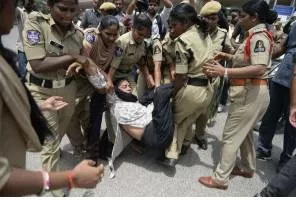
Hounding of rights activists an attack on democracy
The raids in different parts of the country and arrests of human, Dalit and tribal rights activists such as Sudha Bharadwaj, Gautam Navlakha and Varavara Rao constitute an attack on democracy. Not so much because these are blameless individuals as because bringing the weight of the state down on them amounts to using the power of the state to suppress the subaltern voices these activists articulate.The police action today has been prompted, reportedly, by the evidence gathered from those arrested earlier in connection with the Bhima-Koregaon violence, for which the police have now discovered a Maoist inspiration.
Dalit celebration of the victory of a mostly-Mahar (a Dalit caste of Maharashtra) unit of the British East India Company army over the army of Peshwa Baji Rao II in 1818 is an annual affair. Dalits prefer to focus on the Dalit triumph over upper-caste forces represented in that victory, rather than take the view that the upper caste Marathas, whom the Dalit army routed, represented Indian nationalism, while the Dalit unit of the East India Company army served colonial interests.
In this bicentennial year, some right-wing groups decided to challenge this ‘anti-national’ celebration of a colonial victory over local heroes. Violence broke out. Police investigations into and action against leaders of the right-wing groups involved have been perfunctory ((of an action) carried out without real interest, feeling, or effort.) . Investigations into and action against Dalit groups have been extensive, sustained and prolific, yielding welcome links to Left Wing Extremism, in the name of combating which decidedly anti-national force, the public can be called upon to excuse almost any amount of police highhandedness.
For the Dalits of Maharashtra, Bhima-Koregaon represents a rare moment of triumph in the age-old yearning of the community for dignity and respect amidst routine oppression and subjugation. For the upper caste groups that bridle at Dalit triumphalism, invoking of nationalism to denigrate the Dalit victory serves two purposes: it devalues Dalit assertion and gives Indian nationalism a Hindu, upper-caste flavour.
Now, Maoists do the tribal villagers whom they claim to champion a disservice by positing violence as the solution to their problems. But Maoists have takers for the mistrust of democracy and its institutions they preach precisely because democracy and its institutions have, by and large, failed India’s original settlers, the Adivasis. The Forest Rights Act of 2005 decriminalised their existence for the first time since colonial law declared forests to be state property and those who lived on forest land or lived off forest produce as trespassers (A person entering someone's land or property without permission) and thieves. The Forest Rights law is intensely resented by the Forest Department and its officers have not only not implemented the law’s many pro-Adivasi provisions, but also actively undermined them.
Mainstream political parties have been less than forthcoming in the defence of tribal rights, preferring to parrot a development narrative whose cost-benefit calculus is easily manipulated to justify displacing tribals to open mines, build roads, replace forests with plantations and new company towns. The tribal people loose not just hearth and home but their way of life and culture as well, and end up in destitute hamlets, victims of trafficking, dope and hooch.
It would be an incremental addition to the cost of any large project to rehabilitate displaced Adivasis decently and integrate them into the processes of creating new income and wealth that come up on their erstwhile land. Public enterprises such as SAIL have, indeed, done this relatively successfully, for which they are given little credit. But Indian private capital has, by and large, chosen to avoid this additional cost and pursue ruthless profit maximisation in the narrowest possible sense. Global investors have begun to put pressure on mining companies around the world to show more respect to indigenous peoples, and Indian companies, too, have responded.
But any attempt by the Adivasis to resist the takeover of their land or otherwise protest has met with state repression. The Maoists use the resultant tension to impose their hegemony on tribal areas and attack state forces. Tribal people get caught in the crossfire (To be involved in a situation where people around you are arguing:) . Who speaks for these people and their rights? Ideally, mainstream parties and their functionaries should. More often than not, this does not happen. It falls to civil liberties groups and rights activists to take on the mantle of defenders of Adivasi rights.
Rights activists necessarily interact with the entire range of the dramatis personae in the conflict in tribal areas, from tribal victims and activists, assorted champions of tribal rights, including Maoists, other civil rights campaigners and, unwillingly, with the state machinery that seeks to hinder or stop their activity.
Such contacts would necessarily show up in their correspondence and contacts. This does not make them Maoists, any more than their contacts with policemen make them police agents. Human rights and civil liberties activists necessarily believe in democracy and its institutions, and seek to mobilise them to defend the vulnerable. To brand them as enemies of the state is perversion (Distortion or corruption of the original course, meaning, or state of something) of democracy itself.
Democracy is hard on itself. It has to defend the rights of even its enemies. That is the inherent character of democracy. It has to care about the democratic rights of Maoists, too. Defenders of Maoists’ democratic rights are defenders of democracy, not of Maoism. Admittedly, it is a fine distinction. But it is such fine distinctions that form the mortar and cement that hold the edifice of democracy together, not just the building blocks of elections, political parties, unions, Parliament, the Courts, the executive, a free press, the regulatory bodies and so on.
Take away the cement and the edifice will come tumbling down – regardless of whether a state of Emergency has officially been declared or not.









Stay updated with The Hindu Editorial Vocab24 app, your definitive source for breaking news and comprehensive coverage from India and around the globe. Whether it's political developments, business updates, sports highlights, the latest technology trends, or current events, The Hindu brings live, accurate, and reliable news directly to your device.
Don’t fall for sensationalized or fake news shared online. Read and share accurate updates with friends and family through The Hindu Editorial Vocab24 app. Download it today!
News Coverage in The Hindu Editorial Vocab24 App
Breaking News: Receive instant notifications on breaking news stories as they unfold. Stay informed about major events and developments in India and around the world with live blogs, news in shorts videos, and concise articles.
Politics: Get the latest updates on Indian politics, including elections, policy changes, government decisions, and political events that shape the nation.
Business and Economy: Stay ahead in the economic landscape with detailed business news and market analysis. Learn about stock market trends, financial reports, corporate news, and economic developments to make informed investment decisions.
Current Events: Follow stories on social issues, policy changes, global events, and daily current affairs, tailored for UPSC and other competitive exam preparations.
Technology: Keep up with the latest gadgets, innovations, and tech trends. Read expert reviews and analyses in short, concise updates on cutting-edge technology from India and beyond.
Sports: Never miss a moment of your favorite sports. Get live scores, match reports, and expert analysis on cricket, football, tennis, and more.
International News: Stay informed about global events and geopolitical developments, including the Russia-Ukraine war, Israel-Palestine conflict, and other key international stories.
Local News: Stay connected to your community with the latest updates on city events, issues, and local news. Coverage includes hyperlocal updates from cities like Bangalore, Chennai, Delhi, Hyderabad, Mumbai, Kolkata, and more.
Trending Topics: Discover what's trending today with the most talked-about stories and hot topics across India and the world.
Experience journalism that values integrity, accuracy, and reliability. Download The Hindu Editorial Vocab24 app today and stay connected with the world.
Subscribe to our newsletter!







