

Hear the general speak
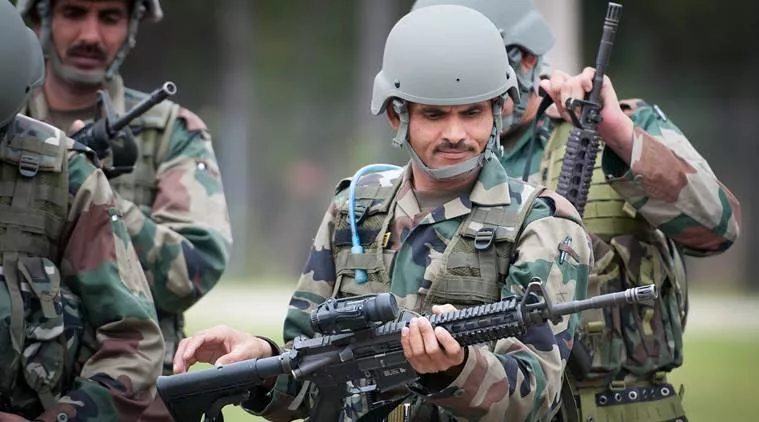
Those maligning the army repeat the mistakes of the Nehruvian eraIn recent months, we have witnessed an unfortunate assault on some of our hallowed institutions. The Indian Army and its chiefs have been targeted. This process has degenerated to heaping invective and abuse. Not long ago, Sandeep Dikshit of the Congress party called the army chief a sadak ka goonda (road-side ruffian). Now, historian Ramachandra Guha has given an imperious shut-up call to the current army chief (‘General speaks too much’, IE, November 9). What is worse is that he has also lampooned Field Marshal KM Cariappa, an iconic figure of the Indian Armed Forces. Cariappa was its first Indian chief and established firmly its apolitical and secular traditions and its ethos of duty, honour, country.
Guha seems to suggest that Cariappa was somewhat of a peacetime soldier with no worthwhile combat achievements. This is a preposterous suggestion. “Kipper” Cariappa was an infantry officer who fought in the Burma campaign during World War II. By the end of the war, he was the highest ranking Indian officer. As Army Commander, Western Command, he directed the critical 1947-48 operations in Jammu and Kashmir (J&K) and liberated two-thirds of the state. Post release of troops from Hyderabad, he was poised to clear the entire state when Jawaharlal Nehru committed the criminal folly of taking the case to the UN. The J&K operations were one of the longest wars the Indian Armed Forces have fought till date. What is remarkable is that despite the glaring paucity of resources, so much was achieved.
Operations in J&K were characterised by a high degree of creativity and innovation: Air power was used to tremendous effect to build an air bridge to Srinagar, sustain the garrisons at Leh and Poonch and finally, lift the siege — in one case by using tanks at the record altitudes at Zojila. If J&K is with India today, the credit must surely go to Field Marshal Cariappa. General KS Thimayya was then the divisional commander and Cariappa’s junior by far.
Guha tries to demolish this iconic figure by painting him as a garrulous man who had to be given a shut-up call by Nehru. He wants the Nehruvian legacy to be re-emphasised by another shut-up call now to the present Army Chief. Nehru’s antipathy to the armed forces is well-known. He had shocked the British Chief of the Indian Army by telling him that India did not need an army. The police would suffice. India was a country devoted to peace and non-violence and no country would attack such an angelic entity. Mercifully, Sardar Patel, a realist, prevented Nehru from disbanding the army. He used it to force the princely states to merge with India, liberate Hyderabad and save Kashmir. Unfortunately, Patel died early. After the 1956 military coup in Pakistan, Nehru’s antipathy to the army turned to paranoia.
With no Patel to restrain him, he starved the armed forces of resources, marginalised them and unleashed the bureaucracy to harry and humiliate them. In such an atmosphere, sycophants and blood relations prospered in the military ranks. The tragic result of this concerted assault was the disaster of 1962. Fortunately, India learnt its lessons and realism prevailed — till recently, that is.
What is worrying is the return of the marginalisation mindset and a concerted assault on the armed forces — there is a campaign of calumny to demolish its icons and reduce its sense of self-worth. This is dangerous. The armed forces are a critical instrument of the state and its last line of defence. No sane state wages this kind of a war upon its own armed forces. Let us not repeat the criminal folly of the pre-1962 era.
Guha wants to make the service chiefs faceless bureaucrats. The service chief is not a bureaucrat. He has to inspire his men and lead them into combat. Hence, he needs to reach out to them through the media. The army chiefs during the 1965 and 1971 wars (General J.N. Chaudhuri and Field Marshal Sam Manekshaw) had highly visible media profiles. We did not hear anybody lamenting that during the wars. Our tails were on fire then and we needed our service chiefs desperately — to lead.
The current chief is a highly combat-experienced soldier. His proactive approach has quietened things down in the Kashmir valley. He had been invited to Coorg to unveil a statue of Cariappa. He made no suo motu statements. He was asked a specific question and he opined that the Field Marshal deserves the Bharat Ratna. Hold an opinion poll and rest assured, the vast majority of the people of India will support the Bharat Ratna for Field Marshals Cariappa and Sam Manekshaw, as also the Marshal of our Air Force, Arjan Singh. This is where the rub lies.
The NDA regime has democratised the process of nomination for national awards. Any Indian citizen can now visit the Padma website and nominate any citizen (including herself) for the Padma awards. Guha is living in the era of the ancien regime when sycophants, courtiers and court historians felt that such awards were their prerogative. If any citizen of India can nominate people for national honours, why can’t the service chief? Why this apartheid vis a vis our armed forces?











Stay updated with The Hindu Editorial Vocab24 app, your definitive source for breaking news and comprehensive coverage from India and around the globe. Whether it's political developments, business updates, sports highlights, the latest technology trends, or current events, The Hindu brings live, accurate, and reliable news directly to your device.
Don’t fall for sensationalized or fake news shared online. Read and share accurate updates with friends and family through The Hindu Editorial Vocab24 app. Download it today!
News Coverage in The Hindu Editorial Vocab24 App
Breaking News: Receive instant notifications on breaking news stories as they unfold. Stay informed about major events and developments in India and around the world with live blogs, news in shorts videos, and concise articles.
Politics: Get the latest updates on Indian politics, including elections, policy changes, government decisions, and political events that shape the nation.
Business and Economy: Stay ahead in the economic landscape with detailed business news and market analysis. Learn about stock market trends, financial reports, corporate news, and economic developments to make informed investment decisions.
Current Events: Follow stories on social issues, policy changes, global events, and daily current affairs, tailored for UPSC and other competitive exam preparations.
Technology: Keep up with the latest gadgets, innovations, and tech trends. Read expert reviews and analyses in short, concise updates on cutting-edge technology from India and beyond.
Sports: Never miss a moment of your favorite sports. Get live scores, match reports, and expert analysis on cricket, football, tennis, and more.
International News: Stay informed about global events and geopolitical developments, including the Russia-Ukraine war, Israel-Palestine conflict, and other key international stories.
Local News: Stay connected to your community with the latest updates on city events, issues, and local news. Coverage includes hyperlocal updates from cities like Bangalore, Chennai, Delhi, Hyderabad, Mumbai, Kolkata, and more.
Trending Topics: Discover what's trending today with the most talked-about stories and hot topics across India and the world.
Experience journalism that values integrity, accuracy, and reliability. Download The Hindu Editorial Vocab24 app today and stay connected with the world.
Subscribe to our newsletter!







